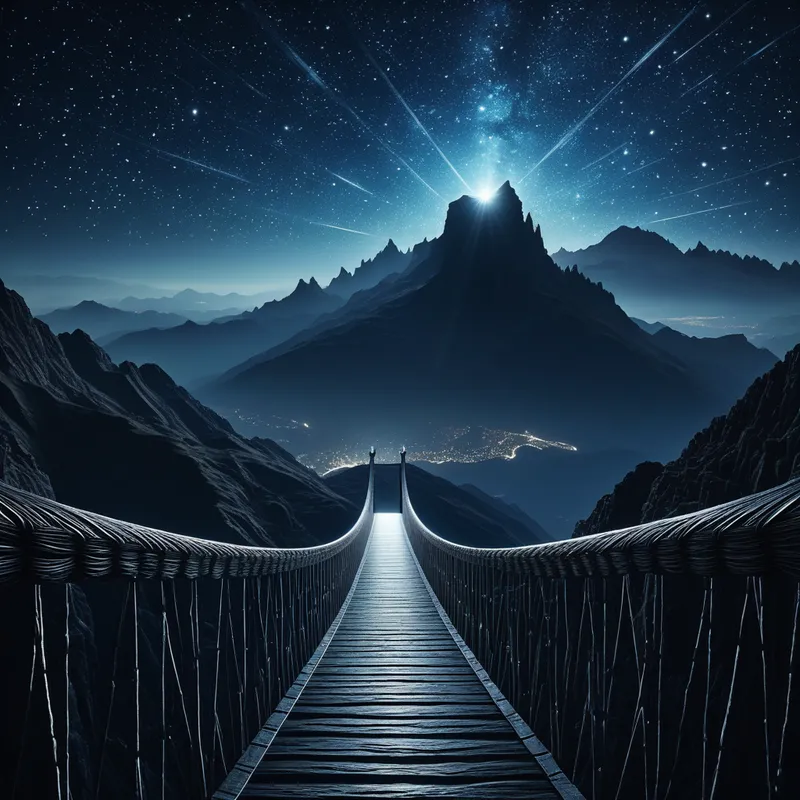
Rope/Bridge Symbolism Myth Meaning & Symbolism
A universal tale of a fragile, sacred connection spanning chaos, linking worlds, gods, and the human soul on its most perilous and necessary journey.
The Tale of the Rope Across the Abyss
In the time before time, when the world was raw and unspoken, there existed only the Tohu wa-Bohu—the formless void, and the deep, churning waters. Above was the realm of radiant order, the Upper World, a place of pure song and light. Below was the realm of fertile, dreaming darkness, the Lower World, whispering with forgotten memories. And between them? The Abyss. A gulf of absolute silence, where not even echo dared to dwell. The worlds were islands, and the souls of things were lonely.
Then, from the heart of the silence, a thought was spun. Some say it was the Spider Grandmother, who, feeling the loneliness in her own eight-chambered heart, drew the silk of intention from her own being. Others whisper it was the first shaman, who, driven by a longing he could not name, took the sinew of his courage and the hair of his ancestors and began to braid. And others still say it was the sky itself, weeping stars, whose tears fell in a single, glistening strand.
However it began, the making was an agony of hope. The builder stood at the crumbling edge of the known, the winds of chaos tearing at their spirit. Each knot tied was a prayer. Each length secured was a story remembered. It was not built of stone or iron, but of things far less certain and far more potent: a promise made at a birth, the last breath of a dying hero, the shared glance between lovers, the unspoken understanding between friends. These were the fibres.
When the last knot was tied, there it hung: a slender, trembling line across the infinite dark. A rope. A bridge. It seemed a foolish thing, a thread against the galaxy. To step onto it was to trust the intangible with your entire being. The journey was the trial. The bridge sang a low, haunting note in the cosmic wind. It swayed, and in its swaying, it asked the only question that mattered: Do you wish to cross?
Many turned back, their yearning overcome by the vertigo of the deep. But the seeker, the messenger, the soul in transition—they grasped the slender guide. They did not walk; they inched, hand over hand, foot feeling for a purchase that seemed to dissolve. Below, the abyss yawned, not with menace, but with the profound indifference of all that is not yet formed. Above, the destination glimmered, a teasing star. The crossing was an eternity contained in a single breath. It was the ultimate act of faith—not in the bridge, but in the necessity of the connection it made possible. And when the far shore was finally, tremblingly reached, the traveler was no longer who they had been. They had been unmade and rewoven in the crossing, a living stitch between the worlds.
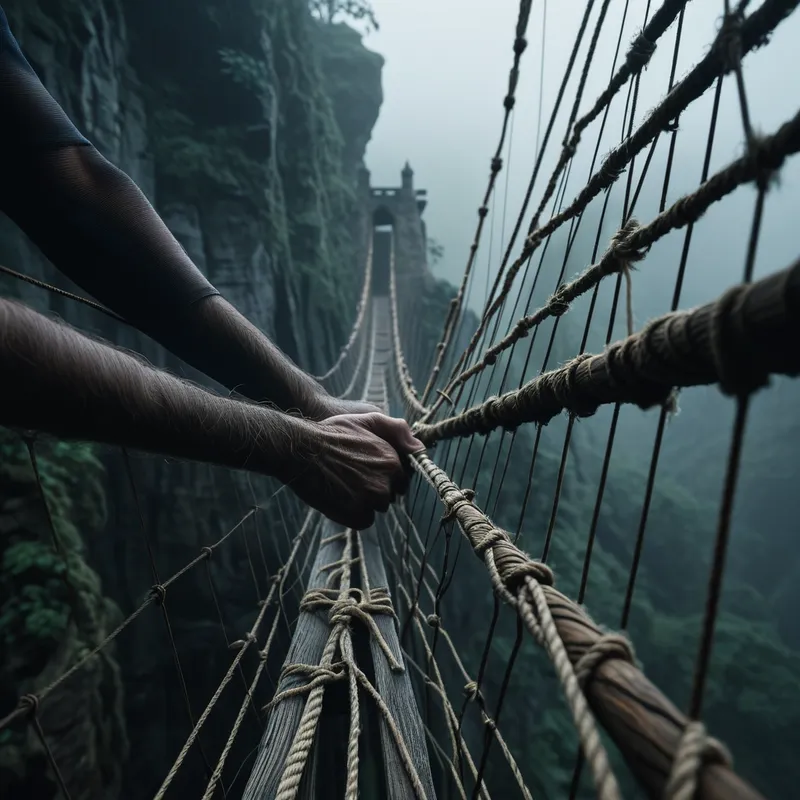
Cultural Origins & Context
This is not a myth belonging to any one tablet, scroll, or oral tradition. It is a psychic artifact, emerging independently in the dream-life of humanity. We see it in the Bifröst of the Norse, a trembling, fiery rainbow bridge guarded by a watchful god, forever under threat from the giants of chaos. It is present in the Chinvat Bridge of Zoroastrian and Persian belief, which narrows to a razor's edge for the wicked. It is the Sirat al-Mustaqim, the straight path in Islamic eschatology.
It was told by shamans drumming in yurts, describing their soul's journey to the spirit world via a rope or tree. It was etched by philosophers pondering the ascent from the cave. It is the universal story told at liminal moments: at funerals, to describe the soul's passage; at initiations, to describe the ordeal of becoming; and by explorers and migrants, to give meaning to the terrifying journey into the unknown. Its societal function was and is orientation. It maps the terrifying, empty spaces between life's certainties and gives them a form—a fragile, walkable form. It says: The gap can be crossed. You are not the first to feel this terror.
Symbolic Architecture
The rope or bridge is the ultimate symbol of the liminal, the in-between. It is not a place to reside, but a process to undergo. Its symbolism is triune.
First, it is Connection. It represents the psychic tissue that links opposites: conscious and unconscious, life and death, known and unknown, self and other, earth and heaven. It is the ego's necessary tether to the depths of the Self.
The bridge does not deny the abyss; it is the abyss made traversable. It is the courage to relate where separation seems absolute.
Second, it is Transition. The bridge is always a crisis. To be upon it is to be in a state of maximum vulnerability and minimum control. It is the psychological experience of therapy, of creative block, of grief, of any life-altering decision—the old shore has been left, the new one is not yet secure. The swaying is the agitation of the psyche reorganizing itself.
Third, it is Precarious Mediation. The bridge is never permanent. In myth, it is often burned, broken, or guarded because the connection between worlds must be earned, not assumed. It symbolizes the fragile, moment-to-moment effort required to maintain relationship, understanding, or consciousness itself. It can fray.
The Dreamer's Resonance
When this myth stirs in the modern dreamer, it announces a psyche at a threshold. To dream of a rope bridge, a narrow beam over water, a broken pass, or of desperately clinging to a line is to experience the somatic truth of transition.
The body in the dream tells the story: the white-knuckled grip (anxiety, control), the vertigo-looking-down (fear of regression, falling into chaos), the forward focus on the distant end (longing, goal-orientation), the feeling of the structure swaying or breaking (loss of foundational security). This is not a dream of pathology, but of process. The dream-ego is actively engaged in the perilous, essential work of integrating a new piece of reality. Perhaps a career change, the end of a relationship, or the confrontation of a buried trauma has dissolved the solid ground. The bridge-dream is the psyche's way of simulating the crossing, of building the neural and emotional "muscle memory" needed to navigate the uncertainty awake. The abyss below is the pull of the unresolved past, depression, or dissociation. The far shore is the nascent, not-yet-embodied potential of the future self.
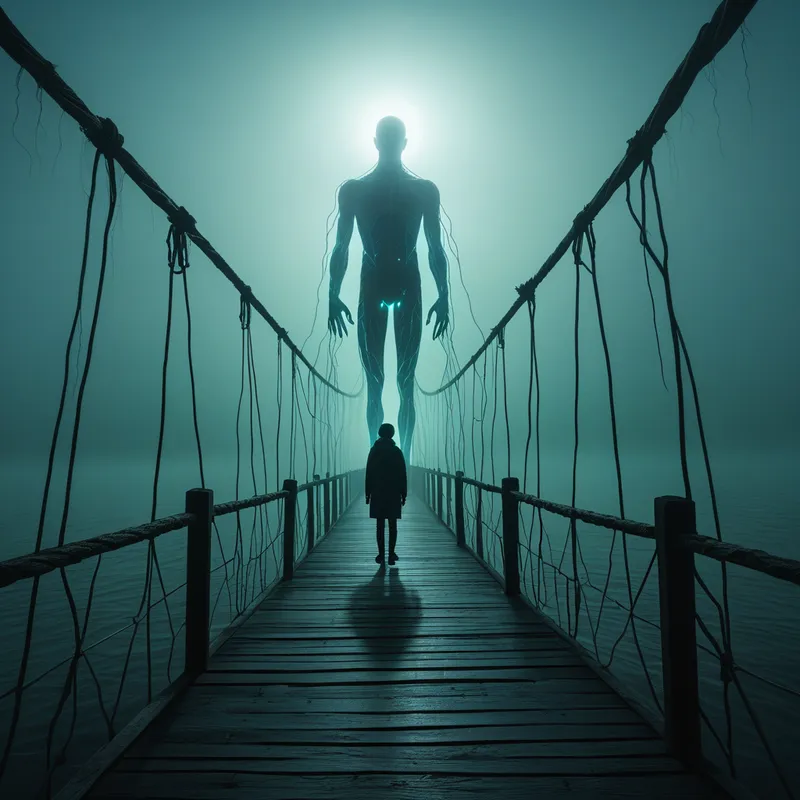
Alchemical Translation
In the alchemy of individuation—the process of becoming whole—the rope bridge myth models the stage of separatio and coniunctio simultaneously. The old, leaden state of consciousness (the familiar shore) must be left behind. This is a kind of psychic death. The soul then enters the solutio—the dissolving waters of the abyss, where all forms are fluid. But here, the myth provides the critical, active ingredient: the vinculum, the bond.
The individuating ego does not swim the abyss; it constructs a bridge from the very materials of its own dissolution—its insights, its wounds, its hard-won awareness.
The act of crossing is the transmutation. Each step of terror and balance integrates a piece of the shadow (the abyss) into the structure of the personality (the bridge). By the time the far shore is reached, the traveler realizes a profound truth: they are not separate from the bridge. They have become it. The connection they sought to make between their own inner opposites—rationality and emotion, strength and vulnerability, persona and shadow—has been embodied. They have become the living mediator of their own cosmos. The rope, once an external lifeline, is now the spine of their own completed spirit, a permanent, internalized connection between heaven and earth. The journey ends where it began: within. But the inner world is now vast, spanned by bridges of meaning where once there was only silent, lonely space.
Associated Symbols
Explore related symbols from the CaleaDream lexicon: