Rolmo Myth Meaning & Symbolism
A myth of a cosmic demoness subdued and transformed into a protector, embodying the sacred act of turning raw chaos into enlightened order.
The Tale of Rolmo
Listen. Before the chants echoed in the first monastery, before the sutras were written on mountain wind, the land itself was a wild and sentient dream. It was a time when earth was not yet a foundation, but a being—a vast, sleeping demoness.
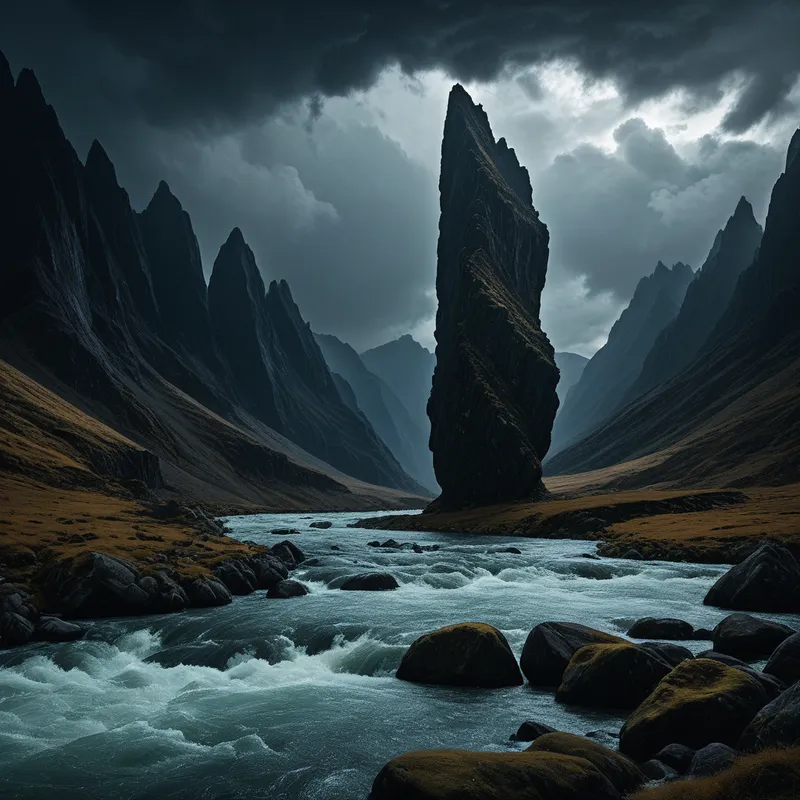
She was Rolmo, and her body was the landscape of Tibet. Her head rested where the Himalayas pierced [the sky](/myths/the-sky “Myth from Persian culture.”/), her limbs sprawled as sprawling mountain ranges, her blood flowed as untamed rivers. But she was not a gentle giantess of fertility; she was a being of raw, chaotic potential, her restless turning causing earthquakes, her turbulent breath spawning storms. She lay upon her back, and her very posture was an obstacle to the establishment of sacred order. She was the land, wild and unyielding.
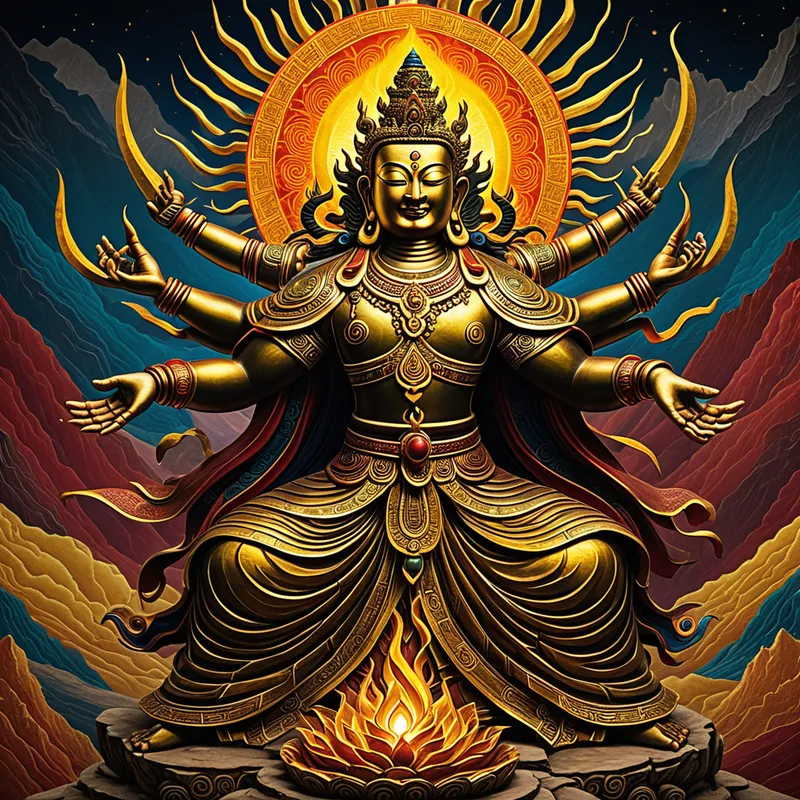
Into this primordial scene came the great Bodhisattva of compassion, Chenrezig (Avalokiteshvara). He perceived not just a geological problem, but a spiritual one. The demoness was not evil, but untamed—a colossal embodiment of unrefined energy that prevented the Dharma, the sacred law, from taking root. To build temples was futile if the ground itself churned with unconscious force.
Chenrezig, in his boundless ingenuity, did not seek to destroy Rolmo. Destruction would be to deny a part of creation itself. Instead, he enacted a sacred architecture of transformation. From his mind arose a plan, a divine blueprint. He summoned the wrathful emanation Chakrasamvara, a deity of fierce, enlightened power. Chakrasamvara descended not as an annihilator, but as a subduer and consort.
In a cosmic act that married force with sacred union, Chakrasamvara engaged Rolmo. The battle was not of weapons, but of energies. It was the dynamic, overwhelming power of enlightened awareness meeting the static, massive resistance of primal matter. He subdued her, pinning her down not to crush her, but to still her chaotic thrashing. In the moment of her subduing, her wild energy was not extinguished, but oriented. Chakrasamvara, in a profound tantric mystery, took her as his consort, symbolizing the integration of her raw power into [the mandala](/myths/the-mandala “Myth from Architectural culture.”/) of enlightenment.
To ensure this transformation was permanent, to anchor the new order into the very flesh of the land, Chenrezig and the Tibetan king, Songtsen Gampo, built a network of temples. These were not mere buildings; they were spiritual nails, driven into specific points on Rolmo’s colossal body—at her shoulders, hips, knees, and elbows. The main temple, the Jokhang, was constructed directly over her heart. With each temple raised, a part of her wild spirit was consecrated. The demoness of the land became the protector of the land. The chaos was transmuted into a stable foundation, and upon it, the edifice of Tibetan Buddhist civilization could be built.
Cultural Origins & Context
The myth of Rolmo is inextricably linked to the historic conversion of Tibet to Buddhism in the 7th and 8th centuries CE. It is a terma, or “treasure” narrative, that serves as a foundational etiological myth. It answers a profound question: How does a spiritual tradition root itself in a new, vast, and seemingly hostile physical and psychic landscape?
The story is intimately associated with the reign of King Songtsen Gampo, who is credited with building the first Buddhist temples in Tibet, including the Jokhang. The myth provided the sacred justification and cosmological blueprint for this massive cultural project. It was told by lamas and storytellers not as a fairy tale, but as a literal sacred history. Its function was societal and psychogeographic: it transformed the entire Tibetan plateau from a collection of animistic, local spirits into a single, integrated body sanctified by [the Buddha](/myths/the-buddha “Myth from Buddhist culture.”/)-dharma. It turned the land itself into a testament to the power of Buddhism to subdue and integrate all phenomena, no matter how seemingly obstructive.
Symbolic Architecture
At its core, the Rolmo myth is a masterful [allegory](/symbols/allegory “Symbol: A narrative device where characters, events, or settings represent abstract ideas or moral qualities, conveying deeper meanings through symbolic storytelling.”/) for the process of psychic [integration](/symbols/integration “Symbol: The process of unifying disparate parts of the self or experience into a cohesive whole, often representing psychological wholeness or resolution of internal conflict.”/). Rolmo is not an external [monster](/symbols/monster “Symbol: Monsters in dreams often symbolize fears, anxieties, or challenges that feel overwhelming.”/) to be slain; she is the primordial, unconscious substrate of the [psyche](/myths/psyche “Myth from Greek culture.”/) itself—the raw, undifferentiated, and often disruptive [energy](/symbols/energy “Symbol: Energy symbolizes vitality, motivation, and the drive that fuels actions and ambitions.”/) of the instincts, emotions, and [shadow](/symbols/shadow “Symbol: The ‘shadow’ embodies the unconscious, repressed aspects of the self and often represents fears or hidden emotions.”/) [material](/symbols/material “Symbol: Material signifies the tangible aspects of life, often representing physical resources, desires, and the physical world’s influence on our existence.”/).
The true work is not to conquer the wilderness within, but to map it, to build temples of awareness upon its most turbulent points.
Chenrezig represents the compassionate, discerning [awareness](/symbols/awareness “Symbol: Conscious perception of self, surroundings, or internal states. Often signifies awakening, insight, or heightened sensitivity.”/) that recognizes this inner [chaos](/symbols/chaos “Symbol: In Arts & Music, chaos represents raw creative potential, uncontrolled expression, and the breakdown of order to forge new artistic forms.”/) not as an [enemy](/symbols/enemy “Symbol: An enemy in dreams often symbolizes an internal conflict, self-doubt, or an aspect of oneself that one struggles to accept.”/), but as untapped potential. Chakrasamvara symbolizes the active principle of transformation—the fierce, focused [application](/symbols/application “Symbol: An application symbolizes engagement, integration of knowledge, or the pursuit of goals, often representing self-improvement and personal development.”/) of [consciousness](/symbols/consciousness “Symbol: Consciousness represents the state of awareness and perception, encompassing thoughts, feelings, and experiences.”/) ([meditation](/symbols/meditation “Symbol: Meditation represents introspection, mental clarity, and the pursuit of inner peace, often providing a pathway for deeper self-awareness and spiritual growth.”/), discipline, [insight](/symbols/insight “Symbol: A sudden, deep understanding of a complex situation or truth, often arriving unexpectedly and illuminating hidden connections.”/)) required to engage and “pin down” our chaotic impulses. The act of subduing is the act of paying profound [attention](/symbols/attention “Symbol: Attention in dreams signifies focus, awareness, and the priorities in one’s life, often indicating where the dreamer’s energy is invested.”/), of not being swept away.
The temples are the constructed aspects of a mature psyche: values, habits, rituals, and cognitive frameworks. They are built upon the subdued energy, not in spite of it. The [temple](/symbols/temple “Symbol: A temple often symbolizes spirituality, sanctuary, and a deep connection to the sacred aspects of life.”/) on the [heart](/symbols/heart “Symbol: The heart symbolizes love, emotion, and the core of one’s existence, representing deep connections with others and self.”/) center, the Jokhang, signifies that the ultimate transformation happens when our core [identity](/symbols/identity “Symbol: Identity represents the sense of self, encompassing personal beliefs, cultural background, and social roles.”/) (the [heart](/symbols/heart “Symbol: The heart symbolizes love, emotion, and the core of one’s existence, representing deep connections with others and self.”/)) becomes a sanctuary for enlightened awareness, built directly upon our raw, emotional [nature](/symbols/nature “Symbol: Nature symbolizes growth, connectivity, and the primal forces of existence.”/).
The Dreamer’s Resonance
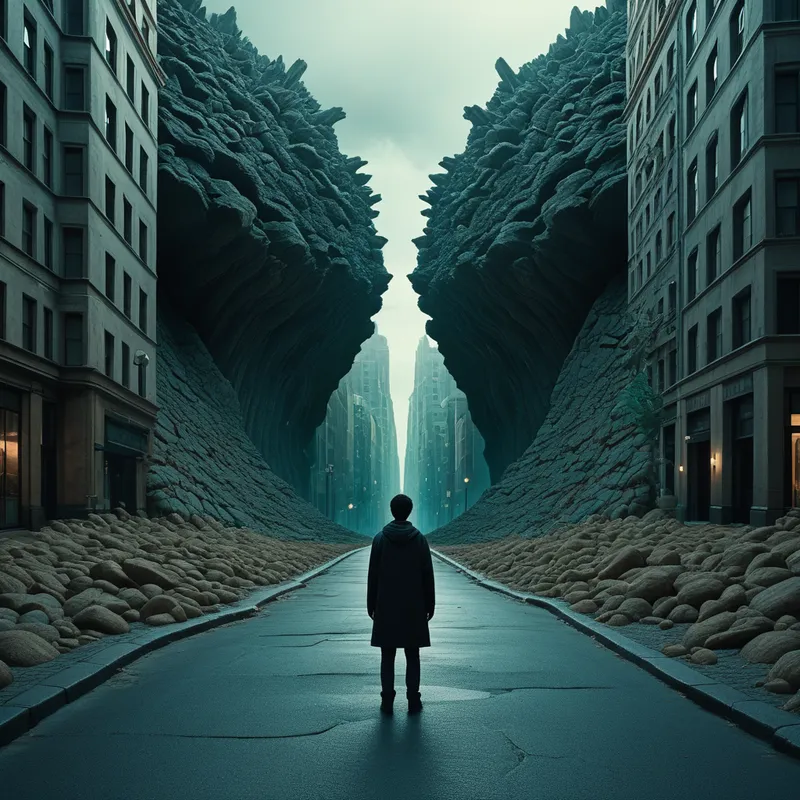
When this mythic pattern stirs in the modern dreamer, it often manifests as dreams of chaotic, overwhelming landscapes or architecture. One might dream of their home being built on unstable, shifting ground, or of a wild, sentient force (a giant animal, a geological event) threatening their stability. The somatic sensation is one of deep unease, a rumbling in the very foundation of one’s sense of self.
Psychologically, this signals a critical phase where long-ignored or repressed aspects of the unconscious (the Rolmo within) are demanding recognition. The chaotic force is the accumulated energy of unlived life, unprocessed trauma, or innate potential that has been denied expression. The dream is the psyche’s announcement that the old, superficial order is insufficient; the ground must be addressed. The process underway is the initial, often frightening, confrontation with the sheer scale and power of one’s own inner wilderness.
Alchemical Translation
The alchemy of the Rolmo myth models the entire individuation process. It begins with the honest recognition of our inner “demoness”—the chaotic, messy, powerful, and authentic parts of ourselves that defy easy categorization and social convenience.
The subduing by Chakrasamvara translates to the courageous act of containment. This is the practice of mindfulness in the face of rage, of holding space for grief without being dissolved by it, of observing addictive impulses without acting on them. It is a fierce, loving discipline.
Individuation is the sacred architecture of the self. We do not erase our history; we build our consciousness upon it, turning each site of past pain into a pillar of present wisdom.
Finally, the building of the temples is the ongoing work of creating a coherent, resilient personality structure. Each insight, each healed wound, each integrated complex becomes a “temple”—a stable, sacred point of [reference](/myths/reference “Myth from Global/Universal culture.”/) in the inner landscape. The ultimate goal is not a flat, placid plain, but a rich, varied, and stable terrain where the wild energy of Rolmo—our creativity, passion, and vitality—now flows in service of the whole, as a protected and protecting force. The demoness-turned-protector symbolizes the crowning achievement of inner work: when our deepest wounds and wildest energies become the very sources of our strength and compassion.
Associated Symbols
Explore related symbols from the CaleaDream lexicon: