Rod Myth Meaning & Symbolism
The myth of Rod, the primordial Slavic creator who shaped the cosmos from chaos and established the sacred laws of fate, ancestry, and the world tree.
The Tale of Rod
Before the sun knew its path and the moon its phases, before the mountains rose and the rivers found their beds, there was only the Void. It was not an empty nothing, but a seething, dreaming potential—a dark, warm ocean beneath a starless sky. In this womb of all-that-could-be, a thought stirred. It was not a voice, but a presence; not a shape, but a will. This was Rod.
He awoke from the dream of non-being, and his first breath was a wind that parted the waters from the heavens. From his own substance, he drew forth the first light, a golden egg that held the seed of the sun. He placed it in the Sky, and its warmth began to gentle the face of the deep. But the world was formless, a chaos of elements without law. So Rod reached into the waters and drew up the first land—a great, rocky Stone that became the navel of the world.
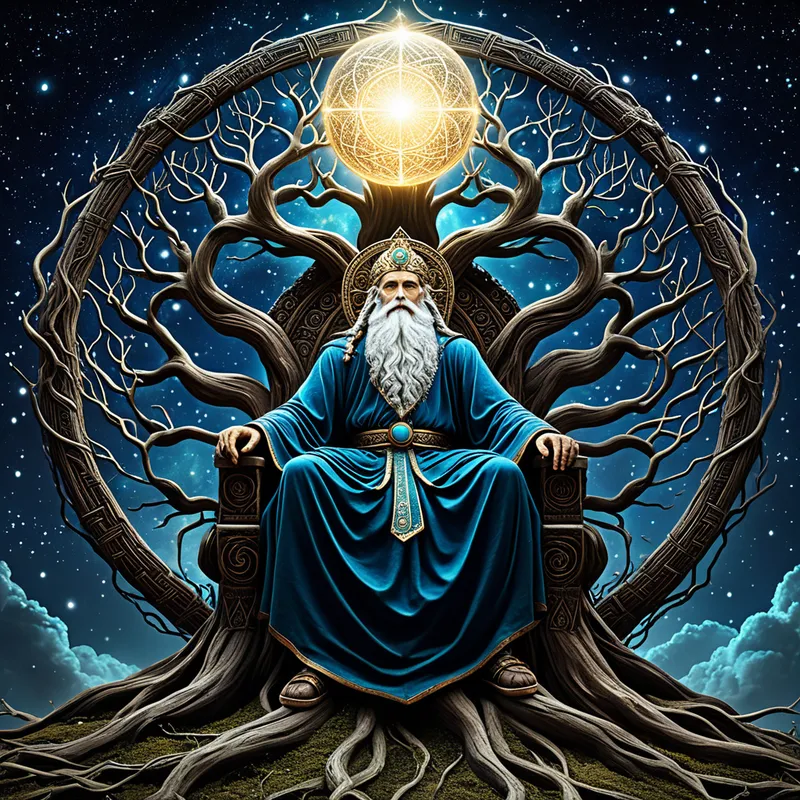
Upon this stone, Rod planted a sapling born from his own breath. It grew with impossible speed, its roots drinking from the primal waters, its trunk piercing the layers of reality, its branches spreading to hold up the vault of the sky. This was the World Tree, the spine of creation. In its highest branches, the realm of Prav took shape, a land of pure law and light. Among its mighty roots, the realm of Yav solidified, the world of the living, of form and action. And deep in the earth, cradled by the deepest roots, lay Nav, the world of the dead and the unseen.
His work was not done. From the bark of the World Tree, Rod carved the first man and woman, breathing into them the spark of life and a fragment of his own divine breath—the Rod. He set them in Yav, in a garden at the foot of the great tree. But to govern the cosmos, to weave the threads of cause and effect, Rod needed stewards. From his brow came Perun, the warrior of order. From his heart came Dazhbog, the giver of life. From his breath came Stribog. And many others, each a facet of his primordial will.
Finally, Rod took his place at the very crown of the World Tree, yet also within its deepest root. He became the silent watcher, the first ancestor from whom all life and law descended. He spun the threads of Sudba on a celestial spindle, his hands no longer shaping clay but weaving the destinies of gods, men, and all creatures. His work complete, Rod receded, becoming not an absent god, but the very fabric of reality—the law in the seed, the memory in the blood, the pattern in the stars. The cosmos now breathed with his ordered rhythm, a sacred hymn begun in the silence before time.
Cultural Origins & Context
The myth of Rod is the foundational stratum of pre-Christian Slavic cosmology, pieced together from folk songs, ritual remnants, and comparative linguistics. Unlike the more narrative myths of Perun or Veles, the story of Rod exists more as a theological framework than a single tale. It was likely the sacred knowledge of tribal elders and wise men, the volkhvs, recited during pivotal communal rites—solstices, harvests, and rituals honoring the ancestors.
His name, Rod, is linguistically profound, sharing its root with words for birth, genus, kin, nature, and destiny (rod, rodytsia, narod, poroda, uroda). This reveals his societal function: he was the personification of the generative and ordering principle itself. To invoke Rod was to affirm the cosmic and social order—the rightness of the seasons, the authority of the clan (rod), and the inescapable weave of fate (sudba). He was the ultimate answer to the questions of origin and purpose, providing a sacred anchor that connected the individual’s life to the family line, the community, and the structure of the universe.
Symbolic Architecture
Rod is not a god who acts in history, but the precondition for history itself. He symbolizes the primordial act of consciousness bringing order to the inner chaos of the unconscious. The Void is the unus mundus, the undifferentiated psychic totality. Rod’s awakening is the emergence of the differentiating ego, the "I" that can perceive and name.
The first act of creation is not making a thing, but making a distinction.
The World Tree is the central symbol of this ordered psyche. Its three realms—Prav (superconscious ideals, laws), Yav (conscious ego, reality), and Nav (personal and collective unconscious)—map a complete model of the self. Rod’s position both above and below signifies that the Self, in the Jungian sense, transcends and contains all these layers. He is the totality that orchestrates the interplay between our highest aspirations, our daily lives, and our deepest, often hidden, drives and memories.
The act of creating gods from his own body parts represents the process of psychic differentiation—the splitting of the unified Self into archetypal complexes (the Warrior, the Sovereign, the Sage) that govern different aspects of our experience.
The Dreamer's Resonance
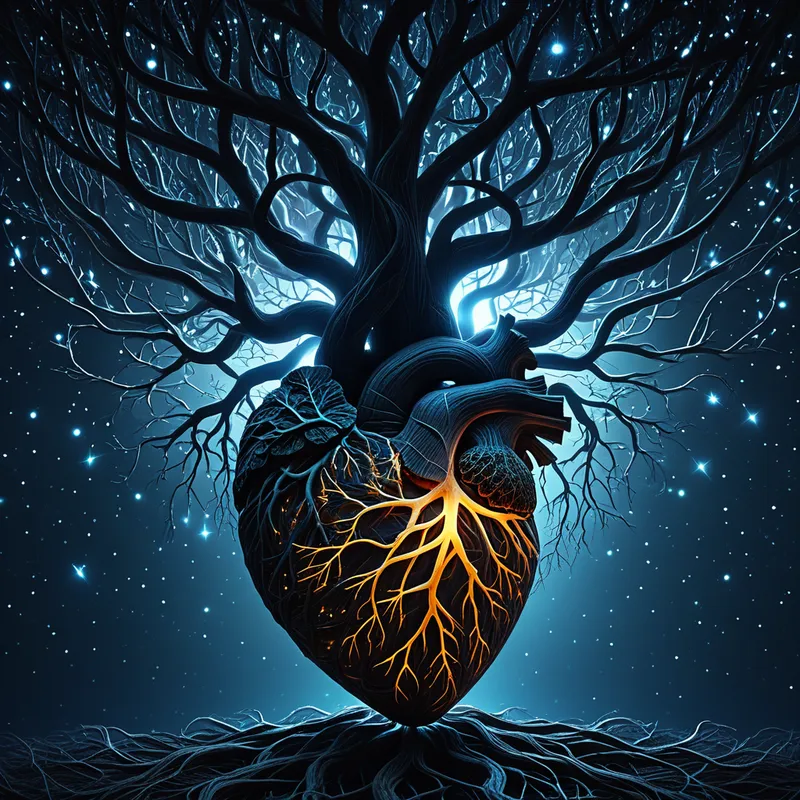
When the archetype of Rod stirs in the modern Dream, it often manifests not as a bearded figure, but as a profound experience of structure, origin, or inescapable pattern. One might dream of discovering immense, ancient roots beneath their house; of seeing their family tree visualized as a glowing, neural network; or of being given a heavy, intricate key that fits a lock in the trunk of a colossal tree.
Somatically, this can feel like a deep, grounding pressure—a sense of being "rooted" or, conversely, the anxiety of being bound by an unseen web. Psychologically, it signals a confrontation with one’s own foundational programming: the genetic inheritance, the family Destiny, the cultural conditioning, and the core laws of one’s personal psyche. It is the unconscious presenting the blueprint of the dreamer’s own World Tree. The process involves acknowledging these often-invisible roots, assessing which support growth and which are constricting, and ultimately, taking conscious responsibility for the life that grows from this ancestral soil.
Alchemical Translation
The myth of Rod models the alchemical opus of Individuation—the creation of a coherent, authentic Self from the raw material of the psyche. The prima materia is the chaotic Void of our unlived life, our repressed memories, and unintegrated potentials.
The first stage, nigredo, is mirrored in the dark, watery chaos. The seeker must endure this state of confusion and potential. The act of Rod separating the waters is the separatio—the conscious mind beginning to distinguish itself from the swirling emotions and impulses of the unconscious. Planting the World Tree is the establishment of the ego-Self axis, a stable center from which to navigate the inner and outer worlds.
Individuation is not becoming God; it is becoming responsibly human, acknowledging the god-like act of creation that is shaping one’s own soul.
Creating the gods represents the multiplicatio and subsequent unio mentalis—differentiating the various archetypal forces within (the inner critic, the nurturer, the adventurer) and then consciously relating to them, rather than being possessed by them. Finally, Rod’s withdrawal to spin fate symbolizes the ultimate goal: the attainment of the Lapis Philosophorum. The individual no longer feels like a passive victim of circumstance or biology but recognizes themselves as the weaver at the loom of their own destiny. They become the conscious steward of their own Soul, understanding that their life is both a unique creation and an expression of a vast, ancestral pattern.
Associated Symbols
Explore related symbols from the CaleaDream lexicon:
- Tree — The World Tree is the central axis of Rod's creation, representing the structured cosmos, the connection between realms, and the spine of the individuating psyche.
- Root — Symbolizes the deep, often hidden foundations of existence—ancestral lineage, genetic memory, and the unconscious forces that nourish and ground conscious life.
- Stone — The first solid land drawn from the waters, representing the foundational principle, the unshakable center, and the altar upon which the self is built.
- Sky — The celestial vault separated by Rod's breath, representing the realm of law, order (Prav), consciousness, and highest potential.
- Water — The primordial, chaotic ocean of potential from which all form emerges, symbolizing the unconscious, the womb of creation, and the fluidity of pre-form.
- Destiny — The threads of Sudba spun by Rod, representing the inescapable patterns of fate, karma, and the unique life-path woven for each soul.
- Circle — Implied in the cosmic egg and the cyclical nature of creation, representing wholeness, the totality of the Self, and the eternal return.
- Spirit — The divine breath (Rod) instilled in creation, representing the animating life force, the soul, and the connection to the divine source.
- Order — The fundamental principle Rod imposes upon chaos, representing cosmic law, psychic structure, and the necessary framework for life and meaning.
- Seed — The potential within the cosmic egg and the World Tree, representing the origin point, latent possibility, and the encoded blueprint of all that will become.