Rock of Horeb Myth Meaning & Symbolism
In the desert's crushing thirst, a desperate people witness their leader strike a rock, unleashing a life-giving torrent from stone at God's command.
The Tale of the Rock of Horeb
Hear now a tale of thirst, not of the body alone, but of the soul. It is a story carved not on tablets of stone, but on the cracked earth of a wilderness memory.
The sun was a hammer, and the desert of Rephidim its anvil. A people, countless as the sands, moved as a single, parched beast across the barren land. They were the children of Abraham, led out from the house of bondage by the hand of Moses. Behind them lay the drowned chariots of Pharaoh; before them lay only the shimmering, waterless void. The memory of the Nile’s muddied waters became a torment. Lips cracked, throats burned like kilns, and hope evaporated into the merciless air. The murmuring began—a dry, desperate rustle that grew into a roar of accusation. “Why did you bring us up out of Egypt, to kill us and our children and our livestock with thirst?”
Moses stood between the fury of the people and the silent, searing sky. He cried out to YHWH, “What shall I do with this people? They are almost ready to stone me.” The silence that followed was heavier than the heat. Then came the Voice, not in thunder, but in a directive of profound simplicity. “Pass on before the people, and take with you some of the elders of Israel; and take in your hand the staff with which you struck the Nile, and go. Behold, I will stand before you there on the rock at Horeb. You shall strike the rock, and water shall come out of it, that the people may drink.”
The command was impossible. Water from stone? Yet, obedience was the only path. Moses took the elders, that they might be witnesses. He took the staff, the symbol of both plague and deliverance. They walked until they came to the foot of the great, brooding mountain, Horeb. And there it was: a specific, unremarkable rock, baked by a thousand suns. But Moses saw what the others could not—the Presence, standing upon it.
He raised the staff. The air held its breath. The people watched, a sea of sunken eyes. With a cry that was part faith, part desperation, he brought the wood down upon the unyielding stone.
Crack.
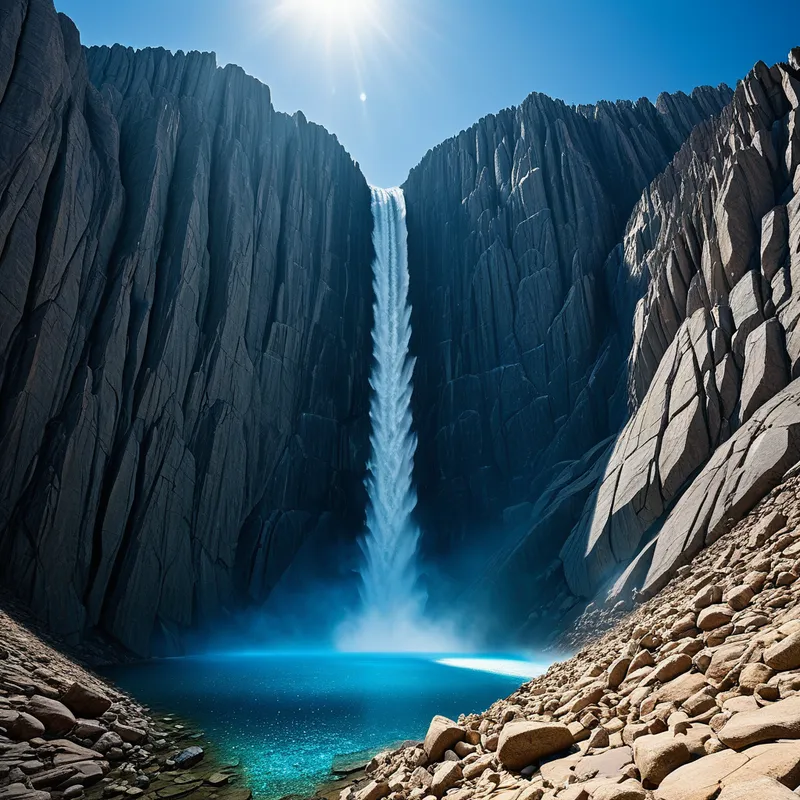
Not a loud sound, but one that echoed in the hollow of every soul. And then—a sigh. A deep, groaning sigh from the heart of the mountain itself. From the point of impact, not a trickle, but a torrent. A gushing, roaring, life-giving flood of clear, cold water burst forth, carving a channel in the instant, cascading down into the valley. The people fell upon it, drinking not just with their mouths but with their whole beings, washing the dust of despair from their faces. They named the place Massah and Meribah, for there they tested their God and quarreled, and there He answered from the rock.
Cultural Origins & Context
This narrative is anchored in the foundational epic of the Israelites: the Exodus. Recorded in the book of Exodus (Chapter 17), it is part of a cycle of wilderness stories that served as a national crucible. These were not mere travel logs for a later, settled people; they were the formative myths of identity. Told and retold around campfires, recited during Passover, and embedded in liturgy, they answered the perennial question: “Who are we?” The answer was: “We are the people whom God tested in the desert and provided for, despite our faithlessness.”
The story functioned on multiple societal levels. It was a etiological tale, explaining place names (Massah and Meribah). It was a legal precedent, establishing Moses’s role as intercessor and YHWH’s character as both just and merciful. Most profoundly, it was a paradigm for crisis. For a culture perpetually living on the edge of survival in a harsh land, the Rock of Horeb became a powerful symbol of unexpected, miraculous provision sourced directly from the divine command, even (or especially) in the most barren of circumstances.
Symbolic Architecture
The myth’s power lies in its stark, elemental symbolism. Each component is a psychic coordinate.
The Wilderness represents the liminal state—the “in-between” place where old identities (slaves in Egypt) have died, but new ones (a free nation) are not yet formed. It is the archetypal landscape of crisis, doubt, and purification.
The Thirst is more than physical need; it is the soul’s desperation for meaning, for assurance, for a sign that the journey has not been in vain. It is the anguish of the ego when its resources are utterly exhausted.
The Rock is the ultimate symbol of hardness, permanence, and impenetrability. It represents the seemingly unyielding facts of reality: the hopeless situation, the barren future, the heart that has turned to stone—whether in despair or in divine judgment.
The miracle is not that water exists, but that it flows from the very substance of our obstacle. The breakthrough comes not by avoiding the rock, but by engaging it directly.
Moses’s Staff is the instrument of transformation. Previously used to bring plagues (deconstruction), it is now used to bring life (reconstruction). It symbolizes directed will and authority, acting in alignment with a transpersonal directive.
The Water gushing forth is the archetype of life, spirit, and grace. It is the unconscious itself, the deep, nourishing psychic energy that erupts into consciousness when the ego, in a state of surrendered obedience or ultimate crisis, “strikes” the right point in its hardened complexes.

The Dreamer’s Resonance
When this myth stirs in the modern psyche, it often manifests in dreams of profound thirst in barren landscapes. The dreamer may wander an endless desert, crawl through a dry riverbed, or stare into an empty cup with a parched throat. This is the somatic signature of a psychic drought—a period of creative sterility, emotional numbness, or spiritual aridity.
The dream may also present the Rock: a huge, immovable boulder blocking a path, a wall of stone in a familiar room, or even a petrified part of the dreamer’s own body. To dream of striking such a rock, especially with a tool or staff, signals a critical inner shift. It is the psyche’s enactment of confronting the hardened, seemingly insurmountable complex—the entrenched resentment, the frozen grief, the rigid belief. The ensuing flood of water in the dream can be terrifying or ecstatic, often washing the dreamer away, cleansing them, or forcing them to swim. This is the moment of release, where the dam of repression breaks and long-held emotions or insights surge into awareness. The dream is modeling a necessary crisis, a striking point, to unlock the flow of life again.
Alchemical Translation
The alchemy of Horeb is a precise map for individuation during times of existential crisis. The process begins with the nigredo: the blackening, the desert experience. The ego’s plans fail, its comforts vanish, and it is reduced to its most desperate state. This “thirst” is not an error but an initiation—it creates the necessary vacuum, the intense need that makes transformation possible.
The divine command to “strike the rock” represents the call from the Self. It is the paradoxical, irrational intuition that the solution lies in confronting the very center of the problem, not in circumventing it. Moses, as the ego-consciousness, must act. He must wield his authority (the staff) not against the external people, but against the internal/collective symbol of barrenness.
The strike is the act of conscious engagement with the unconscious. It is the question asked in therapy, the feeling fully felt after years of numbness, the decisive action taken in a state of paralysis.
The resulting flood is the albedo—the whitening, the illumination. The unconscious, in the form of life-giving water, erupts into consciousness. This is not a gentle trickle of insight but often a disruptive, overwhelming flood of energy, emotion, or creativity that reorganizes the psychic landscape. The community (the inner plurality of the psyche) drinks and is saved. The place of testing (Massah) becomes, retroactively, the place of provision. The ego learns that its survival depends not on its own arid resources, but on its courageous willingness to engage the impossible at the command of a deeper wisdom. The rock, once a symbol of death, is forever transformed into a witness and a wellspring. The individual learns to carry Horeb within—the knowledge that within their most hardened places lies a potential torrent of life, awaiting the faithful, desperate strike.
Associated Symbols
Explore related symbols from the CaleaDream lexicon: