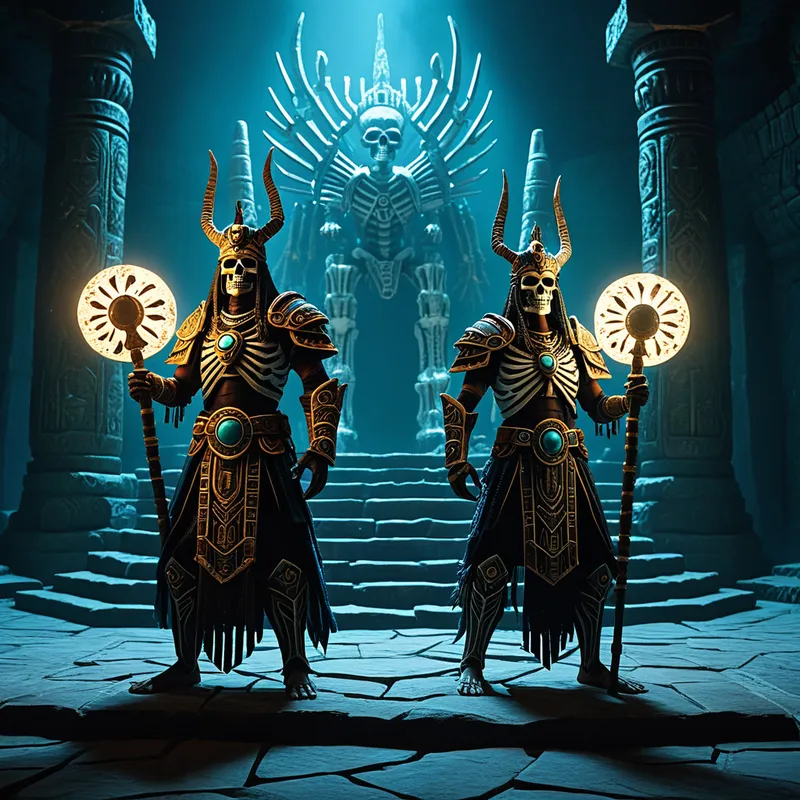
Road to Xibalba Myth Meaning & Symbolism
A mythic journey into the Maya underworld where trickster twins face impossible trials, outwit death gods, and redefine the cycle of life and sacrifice.
The Tale of Road to Xibalba
Listen. The road does not descend through earth, but through silence. It begins at the mouth of a cenote, where the laughter of the day dies and the whispers of the deep begin. This is the path to Xibalba, the Place of Fright, ruled by the One Death and Seven Death, lords whose names are maladies: Pus Master, Jaundice Master, Bone Scepter, Skull Scepter.
The story is of twins. Not once, but twice. First, the arrogant ballplayers Hun-[Hunahpu](/myths/hunahpu “Myth from Mayan culture.”/) and Vucub-[Hunahpu](/myths/hunahpu “Myth from Mayan culture.”/), whose thunderous game upon [the earth](/myths/the-earth “Myth from Hindu culture.”/) disturbed the lords below. Summoned, they took the black road down. They failed the first tests—avoiding the carved, sentient wooden figures on the path, greeting them as lords. They failed the tests of the dark houses: the Dark House, the Razor House, the Cold House, the Jaguar House, the Fire House. Blinded by pride, they were tricked, sacrificed, and buried. The head of Hun-[Hunahpu](/myths/hunahpu “Myth from Mayan culture.”/) was placed in a barren calabash tree, which then bore fruit. From this fruit, from a spittle of the maiden Xquic, new life was seeded.
Thus came the second twins: Hunahpu and Xbalanque. They were born to avenge and transcend. They cleared the milpa, outwitting the animals sent to sabotage them. They bested the arrogant bird demon Vucub-Caquix and his sons. And then, knowing their destiny, they took up their father’s ballgame. The thunder echoed again. The summons from below came again.
But these twins were wisdom clothed in youth. On the road, they sent an animal ahead—a louse, then a mosquito. They learned the names of the lords by listening to the mosquito bite each and hear their curses. They passed the wooden sentinels without a glance. In Xibalba’s court, they bowed to the real lords by name, unmasking the decoys. The lords, furious, devised the houses of doom.
In the Dark House, they lit a cigar, pledging its red ember would not die. It burned whole. In the Razor House, they spoke to the blades, which stood still. In the Cold House, they huddled together, sharing breath as warmth. In the Jaguar House, they threw bones to the beasts. In the Fire House, they did not burn. And in the final, most terrible Bat House, Hunahpu lost his head to the swooping blade-bat Camazotz. But Xbalanque, with cunning, carved a squash into a new head for his brother. They played the final, fateful ballgame not to win, but to lose—sacrificing themselves willingly in a great oven.
From the ashes, reborn as ragged dancers and magicians, they returned to perform for the lords. They danced the dance of sacrifice, killing and resurrecting each other, then offering to do the same for the death gods. When the lords, in greed and folly, asked to be sacrificed, the twins obliged—but left them dead, unmade, their power broken. The road to Xibalba was not just traveled; it was conquered from within. The twins ascended not as mere men, but as the sun and [the moon](/myths/the-moon “Myth from Tarot culture.”/), lighting the road for all who would come after.
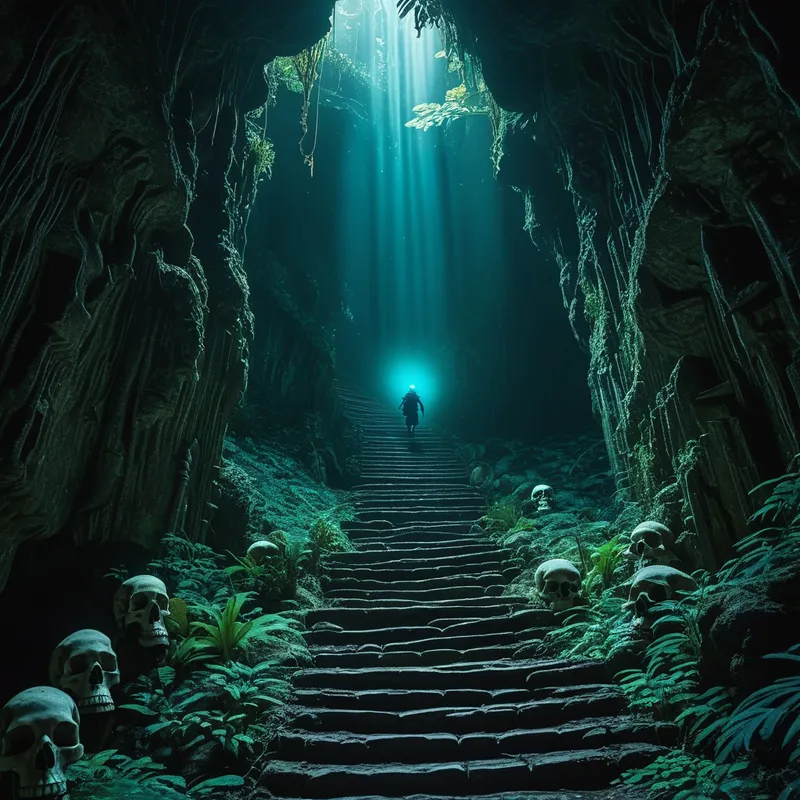
Cultural Origins & Context
This epic is the heart of the Popol Vuh, the “Book of the Community,” transcribed in the 16th century from the oral traditions of the K’iche’ Maya of the Guatemalan highlands. It is not mere entertainment but a foundational cosmogony, a narrative map of reality. The story of the Road to Xibalba was likely recited by priest-scholars during rituals, royal successions, and community gatherings, binding the people to the cycles of the maize agriculture it mirrors—planting (descent), death (trial), and rebirth (ascent).
Its societal function was multifaceted: it explained the origins of celestial bodies, justified the necessity of the sacred ballgame, and codified the proper relationship between humanity and the divine. Most profoundly, it offered a paradigm for confronting mortality itself. The road was a psychic and spiritual reality for the Maya, a template for the soul’s journey after death, where knowledge, humility, and trickster-cunning were the only true guides.
Symbolic Architecture
The myth is a masterclass in symbolic [initiation](/symbols/initiation “Symbol: A symbolic beginning or transition into a new phase, status, or awareness, often involving tests, rituals, or profound personal change.”/). Xibalba is not a literal hell of [punishment](/symbols/punishment “Symbol: A dream symbol representing consequences for actions, often tied to guilt, societal rules, or internal moral conflicts.”/), but the unconscious [realm](/symbols/realm “Symbol: The symbol of ‘Realm’ often signifies the boundaries of one’s consciousness, experiences, or emotional states, suggesting aspects of reality that are either explored or ignored.”/) of the [Shadow](/symbols/shadow “Symbol: The ‘shadow’ embodies the unconscious, repressed aspects of the self and often represents fears or hidden emotions.”/)—populated by the personified fears (the named Lords of [Death](/symbols/death “Symbol: Symbolizes transformation, endings, and new beginnings; often associated with fear of the unknown.”/)) that rule us when we are unconscious. The road is the [journey](/symbols/journey “Symbol: A journey in dreams typically signifies adventure, growth, or a significant life transition.”/) of [awareness](/symbols/awareness “Symbol: Conscious perception of self, surroundings, or internal states. Often signifies awakening, insight, or heightened sensitivity.”/) into that repressed self.
The first twins represent the ego’s initial, arrogant foray into the unconscious. They are defeated because they project their own reality onto it, mistaking decoys for truth. Their sacrifice is necessary; the old identity must die for a more conscious one to be conceived.
Hunahpu and Xbalanque represent the integrated [psyche](/myths/psyche “Myth from Greek culture.”/)—the conscious principle (Hunahpu, associated with the sun and hunting) and the instinctual, transformative principle (Xbalanque, the [jaguar](/symbols/jaguar “Symbol: The jaguar symbolizes strength, power, and stealth, often associated with transformation and the spiritual journey.”/) [moon](/symbols/moon “Symbol: The Moon symbolizes intuition, emotional depth, and the cyclical nature of life, often reflecting the inner self and subconscious desires.”/)). Their victories are not of force, but of [perception](/symbols/perception “Symbol: The process of becoming aware of something through the senses. In dreams, it often represents how one interprets reality or internal states.”/) and adaptability. They listen (the [mosquito](/symbols/mosquito “Symbol: Mosquitoes symbolize persistent irritations and the importance of self-protection against minor disturbances.”/)), they improvise (the squash head), and they ultimately use the lords’ own [nature](/symbols/nature “Symbol: Nature symbolizes growth, connectivity, and the primal forces of existence.”/)—their greed for spectacle—against them. Their final [ascension](/symbols/ascension “Symbol: A profound sense of rising upward, often representing spiritual enlightenment, personal growth, or transcendence beyond physical limitations.”/) as celestial bodies signifies the ultimate goal: the [illumination](/symbols/illumination “Symbol: A sudden clarity or revelation, often representing spiritual awakening, intellectual breakthrough, or the dispelling of ignorance.”/) of [consciousness](/symbols/consciousness “Symbol: Consciousness represents the state of awareness and perception, encompassing thoughts, feelings, and experiences.”/) (the sun) and the [acceptance](/symbols/acceptance “Symbol: The experience of being welcomed, approved, or integrated into a group or situation, often involving validation of one’s identity or actions.”/) of the cyclical, transformative [nature](/symbols/nature “Symbol: Nature symbolizes growth, connectivity, and the primal forces of existence.”/) of the [psyche](/myths/psyche “Myth from Greek culture.”/) (the [moon](/symbols/moon “Symbol: The Moon symbolizes intuition, emotional depth, and the cyclical nature of life, often reflecting the inner self and subconscious desires.”/)).
The Dreamer’s Resonance
When this myth stirs in modern dreams, it often manifests as a series of impossible tests in a labyrinthine, downward-sloping environment—a endless basement, a collapsing subway tunnel, a decaying mansion with hidden rooms. The dreamer is not fleeing a monster, but navigating a system designed to confuse and demoralize.
Somatically, this can feel like a heavy pressure on the chest (the Cold House), a sense of being cut or scrutinized (the Razor House), or suffocating darkness (the Dark House). Psychologically, it marks a crucial phase of shadow-work. The “lords” in the dream are the specific, personified anxieties the psyche is ready to face: perhaps “Pus Master” as a fear of contamination or shame, “Skull Scepter” as the tyranny of mortality or rigid thought. The dream is the psyche’s own Road to Xibalba, insisting that to bypass the tests is to remain trapped by them.
Alchemical Translation
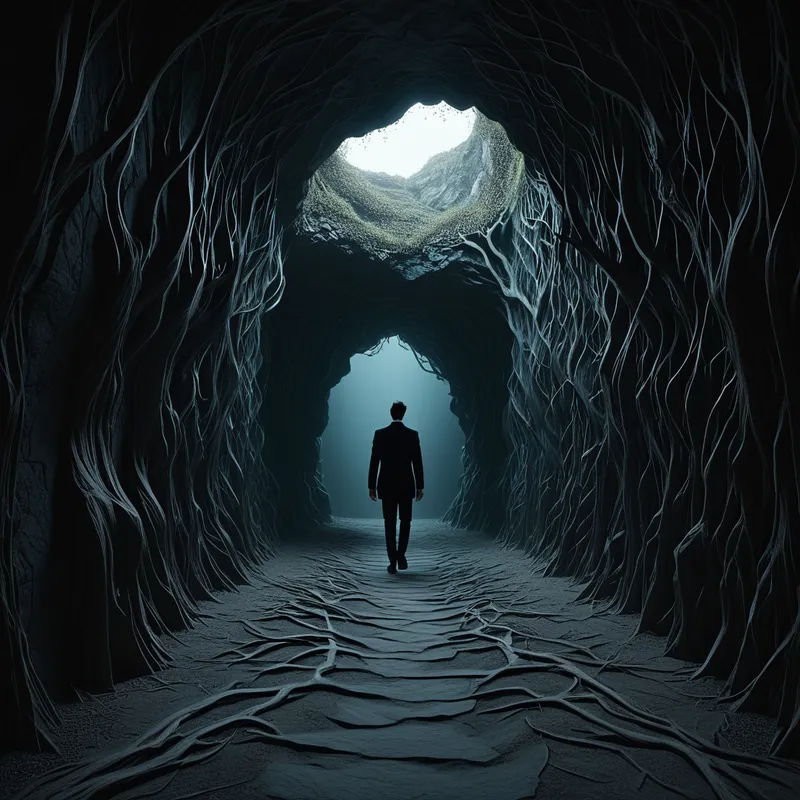
The alchemy of this myth is the transmutation of literal fear into symbolic power. The process it models is the core of Jungian individuation.
The descent is non-negotiable. One must willingly step onto the black road, into the humiliation and terror of facing one’s personal Xibalba—the repressed grief, the hidden arrogance, the childhood wounds that rule from the shadows.
The trials (the Houses) are the fires of refinement. We learn to carry our own light in the Dark House (self-trust), to negotiate with the razors of criticism in the Razor House (discernment), and to endure the cold isolation of the Cold House (self-containment). The loss of the head in the Bat House is critical; it represents the sacrifice of an old, rigid way of thinking. The replacement with a squash—a fertile, growing [thing](/myths/thing “Myth from Norse culture.”/)—signals the emergence of a new, more organic intelligence.
Finally, the ultimate alchemical act is the twins’ performance. They become the process of death and rebirth so completely that they can enact it upon the death gods themselves. For the modern individual, this translates to a profound internal shift: we stop being victims of our psychological complexes (the lords) and instead, through conscious engagement, we “perform” them. We understand their patterns, their triggers, their desires, and in that knowing, we drain them of their autonomous, frightening power. We break their scepter. We ascend from the road not by escaping [the underworld](/myths/the-underworld “Myth from Greek culture.”/), but by having its map etched into our souls, becoming, in part, the lords of our own darkness.
Associated Symbols
Explore related symbols from the CaleaDream lexicon: