R'lyeh Myth Meaning & Symbolism
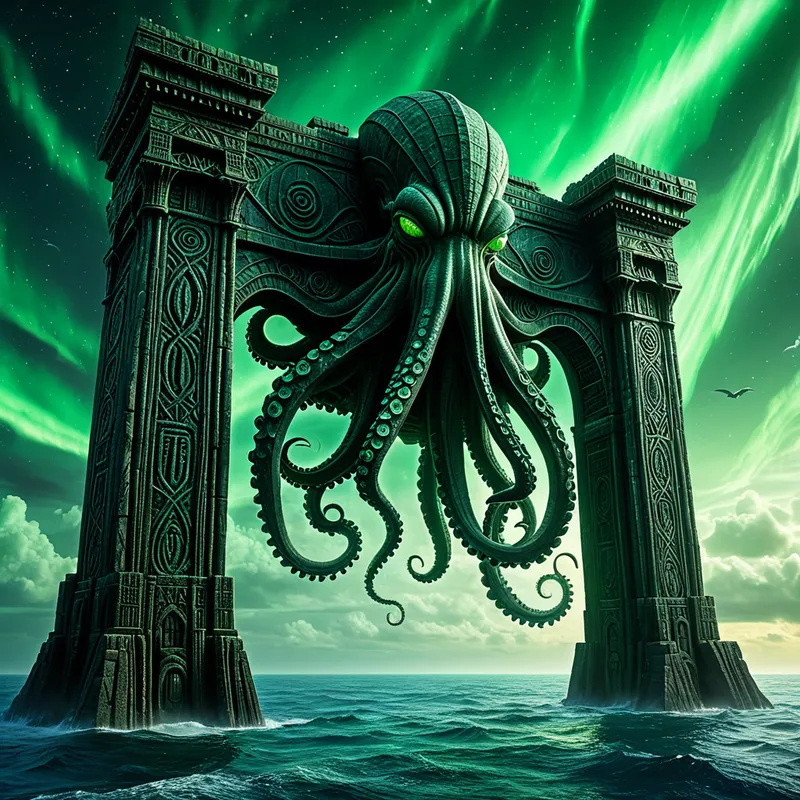
A cyclopean city sleeps beneath the Pacific, dreaming its dead architect back to life, a monument to time before time and the terror of awakening.
The Tale of R'lyeh
Listen, and know the terror that sleeps. Not in the earth, but beneath the sea, in a place the stars forgot. In the dreaming culture.") dark of the Pacific, where the water is heavy with time, lies a corpse-city. It is called R'lyeh.
It was not built for men. Its stones are a blasphemy of geometry, where walls lean inward at angles that shatter the soul, and towers spiral in defiance of sky and sea. The stone is warm, slick with a primordial ooze, and carved with hieroglyphs that tell of epochs when the Earth was young and other gods walked its crust. Here, in a vault sealed by a star-born door, the Dreamer lies. He is Cthulhu, a mountain of spongy, rubbery flesh, with vast, rudimentary wings folded like a shroud and a head of writhing feelers. He is dead, but dreaming. And in his dreams, he calls.
The call is a psychic miasma, a pressure in the deep mind of humanity. It draws the sensitive, the mad, the artists, whispering of the city’s glory and the time of waking. For the stars were not right, and so he sleeps, but the stars turn in their endless dance. When their configurations align once more, the prison of water and stone will weaken. The great door will groan on its non-Euclidean hinges.
Then shall come the rising. The sea will boil as the city, dripping with ocean weeds and the slime of aeons, heaves itself above the waves. The air will grow thick and green. And in that hour of cosmic alignment, the sleeper will stir. The dreams will cease, and the waking world will know the truth of its insignificance. This is the promise and the curse of R'lyeh: not an ending, but an unveiling. A revelation that we live on a placid island of ignorance in a black sea of infinity, and that sea is now rising.
Cultural Origins & Context
The myth of R'lyeh emerges not from ancient tablets but from the modern, anxious psyche of the early 20th century, channeled through the literature of H.P. Lovecraft. It is a foundational scripture of the "Cthulhu Mythos," a shared fictional universe that functions as a modern mythology for a secular, scientific age gripped by cosmic dread. Unlike traditional folklore passed orally, this myth was disseminated through pulp magazines, letters between writers, and later, role-playing games and digital media.
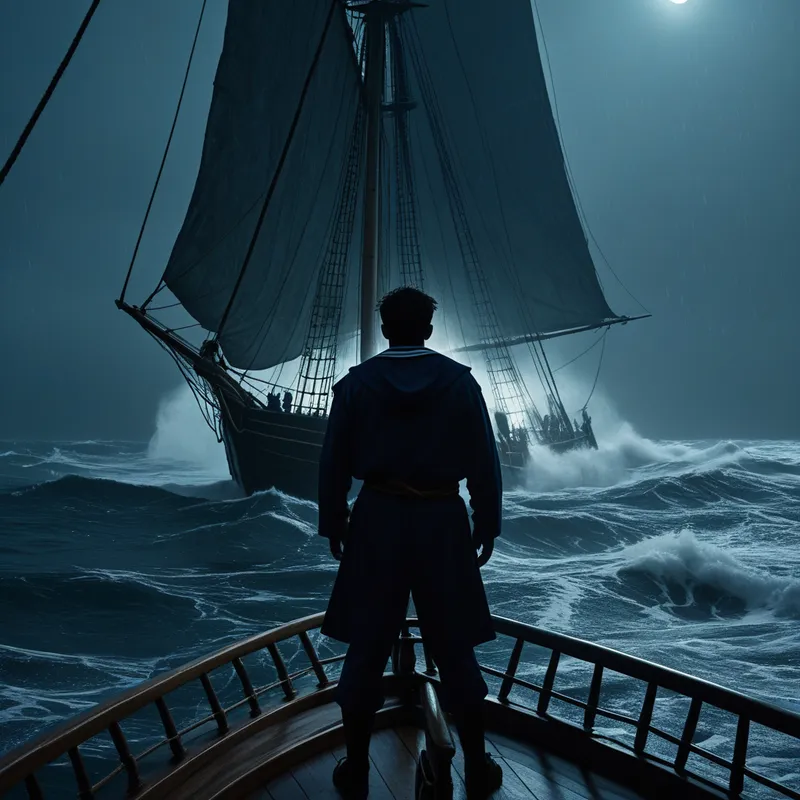
Its tellers are characters within the tales themselves: doomed sailors like Gustaf Johansen of the Alert, who glimpsed the city; unstable artists like Henry Anthony Wilcox, who sculpted its nightmares in clay; and esoteric scholars like Professor Angell, who pieced together the global cults that worship the Sleeper. Societally, the myth functions as an anti-revelation. It serves no comforting purpose, offers no salvation, and promises no order. Instead, its function is purely cautionary and epistemological—it dismantles human pretensions of centrality and warns against the pursuit of knowledge that reveals our true, terrifying place in a meaningless and hostile cosmos.
Symbolic Architecture
R'lyeh is the ultimate symbol of the repressed collective unconscious, but not as a fertile ground of archetypes. It is the unconscious as a cosmic reality, utterly indifferent and potentially annihilating to the conscious ego.
The city is not a ruin; it is a suspended sentence. Its architecture is the geometry of a mind utterly alien to human sanity.
The city itself represents forbidden knowledge—the truth of reality that the conscious mind cannot integrate without fracturing. Its non-Euclidean angles symbolize cognitive dissonance made manifest, the breakdown of logical frameworks. Cthulhu, the Sleeper, is the archetype of the Self in its most monstrous, transpersonal form. He is not the individuated Self of integration, but the primal, chaotic totality from which consciousness emerged and which it fears to re-join. His "death" is the necessary illusion of separation that allows the human psyche to exist. His "dreaming" is the constant, low-frequency pressure of that greater reality upon our fragile island of awareness.
The "stars being right" is the symbol of cosmic determinism and cyclical time—the idea that our fate is governed by vast, impersonal cycles utterly beyond our control or comprehension. The cults that await the awakening represent those parts of the psyche that, in despair or madness, choose to worship the annihilating truth rather than cling to the comforting lie.
The Dreamer's Resonance
When this myth pattern surfaces in modern dreams, it rarely appears as a literal octopus-headed giant. Instead, it manifests as a profound somatic and psychological process of confronting the abyssal.
The dreamer may experience somatic dread: a feeling of immense, crushing pressure, of being in a deep ocean trench or under a colossal weight. This is the body sensing the psychic gravity of repressed, transpersonal content. The dream imagery often involves liminal, impossible architecture: endless staircases leading nowhere, rooms that are larger inside than out, doors that open onto voids. This is the ego's perception of its own cognitive structures failing.
The psychological process is one of ego dissolution. The dreamer is not integrating a personal shadow, but brushing against the collective shadow of existence itself—the knowledge of mortality, cosmic scale, and ultimate meaninglessness. Such dreams can precipitate a spiritual crisis or a profound nihilistic depression. Yet, they can also mark the beginning of what philosopher Eugene Thacker calls a "cosmic pessimism"—a relinquishment of anthropocentric hope and a stark, clear-eyed confrontation with the world-without-us. The process is not one of healing, but of terrifying reorientation.
Alchemical Translation
In the alchemical vessel of the psyche, the myth of R'lyeh models the Nigredo—the blackening, the putrefaction, the utter dissolution of the ego's cherished illusions. This is not a stage to be rushed through, but a necessary confrontation with the prima materia of reality itself.
The individuation process requires not only integrating the personal shadow, but also kneeling before the magnitude of the cosmic shadow. This is the alchemy of humility.
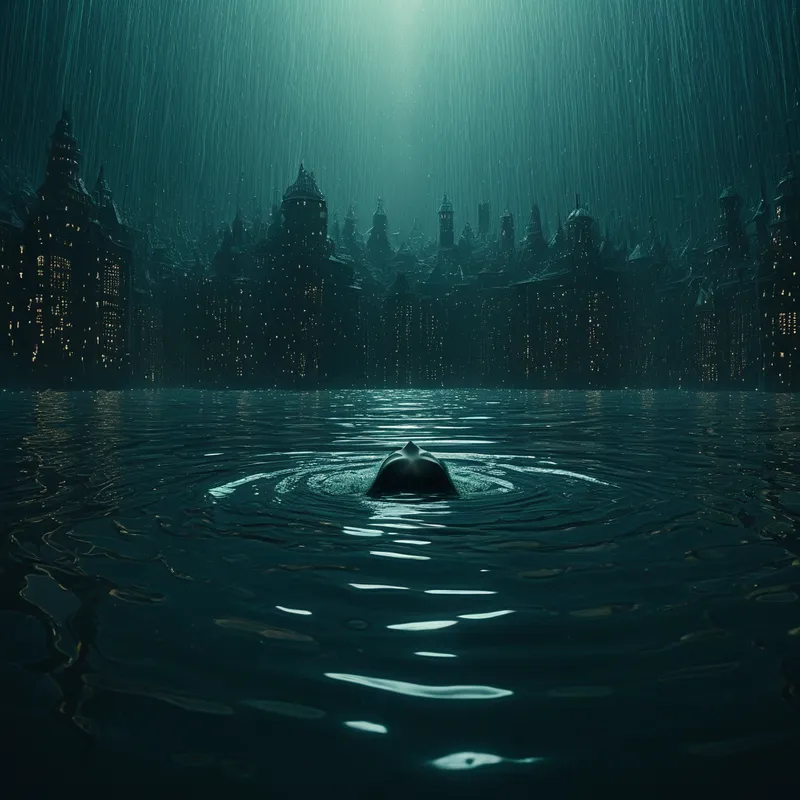
The "sunken city" is the psychic content we have actively repressed not because it is personally shameful, but because it is existentially unbearable. The "awakening" is not a goal, but the feared outcome of deep introspection. The alchemical work here is to build a vessel strong enough to behold the vision without shattering. One does not seek to raise R'lyeh, but to learn to sail the seas above it, aware of the sleeping leviathan below.
The transmutation occurs when the dread is fully metabolized. The psychic energy once used to maintain the illusion of a meaningful, human-centric cosmos is released. This energy can then be redirected not toward grandiosity, but toward a fierce, fragile love for the ephemeral beauty of the conscious moment—the "placid island." One becomes the sage who knows the abyss but chooses to tend the garden. The triumph is not over the monster, but over the need for a universe that cares. The individual emerges not as a hero who conquered the deep, but as a witness who has seen it and returned, forever changed, to the sunlit world.
Associated Symbols
Explore related symbols from the CaleaDream lexicon: