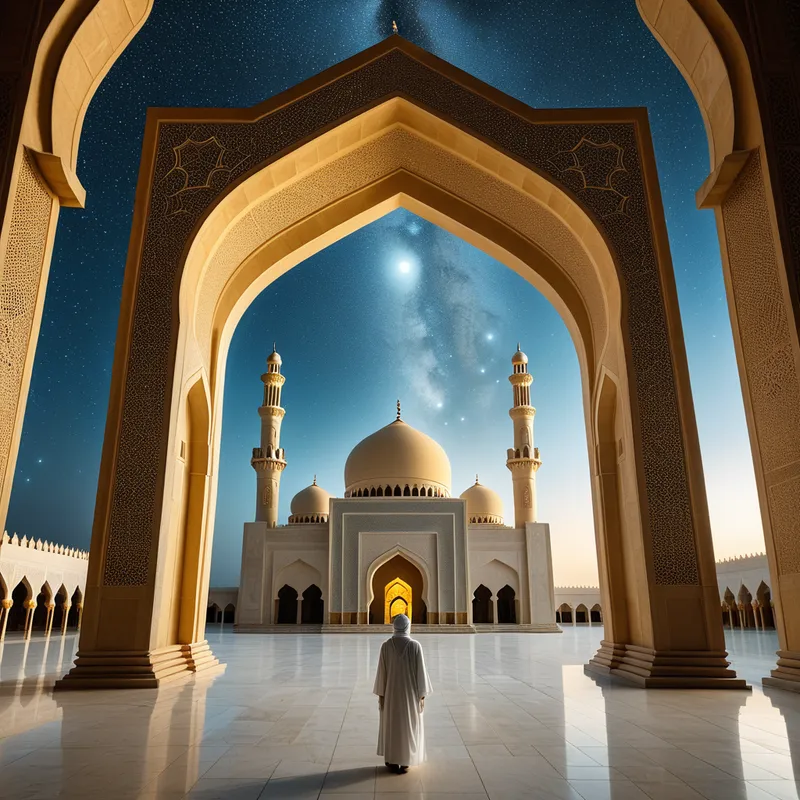
Riwaq of the Mosque Myth Meaning & Symbolism
A myth of the sacred arcade, a liminal space where the soul is weighed between the clamor of the world and the silence of divine presence.
The Tale of Riwaq of the Mosque
Listen, and let the silence between the words speak. In the time before time was measured, when the first call to prayer was still an echo in the mind of the Divine, there existed a place that was not a place. It was the Riwaq.
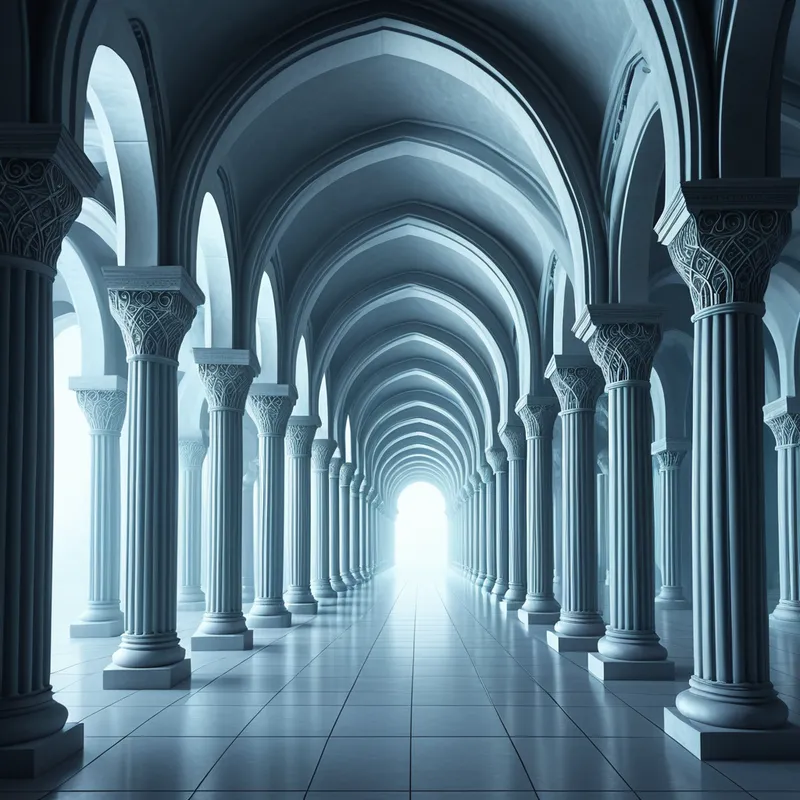
It did not begin with foundation stones, but with a breath—the space between an inhalation of worldly clamor and an exhalation of sacred silence. It was woven from twilight and dawn, from the moment a foot hesitates before taking a step. Its arches were not built; they were remembered, the curvature of a soul bowing in submission. They stretched, row upon endless row, a forest of stone and shadow holding up a ceiling of quiet stars.
Through this eternal arcade walked the Nafs. It entered not as a whole being, but as a cacophony—a marketplace of desires, a storm of regrets, a tangled knot of names and wants. [The world](/myths/the-world “Myth from Tarot culture.”/)’s dust clung to its heels. With each step onto the cool, polished marble of the Riwaq, a sound fell away. The clatter of argument dissolved into the sigh of the stone. The shrill voice of ambition was absorbed by the vast, patient space.
The Nafs al-Ammara raged here, seeing only an obstacle, a delay before the destination. It paced, a caged animal, its shadow violent against the serene pillars. But the Riwaq had no door to break down, no end to rush toward. It had only rhythm. The rhythm of footsteps slowing. The rhythm of breath deepening. The rhythm of the arches themselves, a heartbeat in stone.
Then would emerge the Nafs al-Lawwama. Here, in the impartial light filtering through lattice, every flaw was illuminated. It saw the cracks in its own character reflected in the veined marble. It heard its own hypocrisies whisper back from the vaults above. This was [the crucible](/myths/the-crucible “Myth from Alchemical culture.”/) of the arcade, where the soul was weighed not by an external hand, but by its own sudden, stark clarity. Many turned back here, fleeing this mirror of self.
But for those who remained, who allowed the judgment to become not a sentence but a shedding, a change occurred. The endless corridor began to feel not like a maze, but like a womb. The arches were no longer barriers, but arms. The silence was no longer empty, but full. The walking itself became the prayer. The destination—the prayer hall, the [Mihrab](/myths/mihrab “Myth from Islamic culture.”/)—ceased to be a place ahead and became a condition within. The soul, stripped of its noise and its lies, approached the state of the Nafs al-Mutma’inna.
It did not find a door at the end. It found that it had become [the threshold](/myths/the-threshold “Myth from Folklore culture.”/). The Riwaq had done its work. The soul passed from the arcade not by walking out, but by realizing it had arrived, carrying the sacred space within its own now-quiet center.
Cultural Origins & Context
The Riwaq, as an architectural fact, is a defining feature of mosque design, particularly in the hypostyle traditions of North Africa and the Middle East. It is the covered walkway framing the central courtyard (Sahn), a functional space providing shade and circulation. Yet, in the rich soil of Islamic spirituality, where every physical form is a sign (Ayah) of a spiritual reality, the Riwaq germinated into a powerful metaphysical and folkloric concept.
This myth was not penned in a single book but was breathed into existence by generations of worshippers, mystics (Sufis), and storytellers. It was passed down in the quiet conversations after prayer, in the allegorical teachings of a sheikh, and in the intuitive understanding of every believer who felt the palpable shift in atmosphere upon moving from the bustling street, through the courtyard, into the shaded Riwaq, and finally into the prayer hall. Its societal function was one of deep psycho-spiritual education. It taught, without a lecture, the necessity of transition. One does not leap from the marketplace to the presence of the Divine. The soul requires a buffer, a place of decompression and reorientation. The Riwaq myth ritualized this inner journey, making the architecture itself a guide for the heart.
Symbolic Architecture
The myth of the Riwaq is a masterful [blueprint](/symbols/blueprint “Symbol: A blueprint represents the foundational plan or design for something, often symbolizing potential, structure, and the mapping of one’s inner self or future.”/) of the [psyche](/myths/psyche “Myth from Greek culture.”/)’s [journey](/symbols/journey “Symbol: A journey in dreams typically signifies adventure, growth, or a significant life transition.”/) toward [integration](/symbols/integration “Symbol: The process of unifying disparate parts of the self or experience into a cohesive whole, often representing psychological wholeness or resolution of internal conflict.”/). It maps the non-[linear](/symbols/linear “Symbol: Represents order, predictability, and a direct, step-by-step progression. It symbolizes a clear path from cause to effect.”/) [path](/symbols/path “Symbol: The ‘path’ symbolizes a journey, choices, and the direction one’s life is taking, often representing individual growth and exploration.”/) from [fragmentation](/symbols/fragmentation “Symbol: The experience of breaking apart, losing cohesion, or being separated into pieces. Often represents disintegration of self, relationships, or reality.”/) to wholeness.
The arcade is the psyche’s antechamber, where the noise of the persona is filtered, and the whispers of the shadow are first acknowledged.
The Riwaq itself is the ultimate [symbol](/symbols/symbol “Symbol: A symbol can represent an idea, concept, or belief, serving as a powerful tool for communication and understanding.”/) of the liminal—[the betwixt and between](/myths/the-betwixt-and-between “Myth from Celtic culture.”/). It is not the profane world, nor is it the sanctified core. It is the process itself. Its repeating arches symbolize the cyclical [nature](/symbols/nature “Symbol: Nature symbolizes growth, connectivity, and the primal forces of existence.”/) of inner work: confrontation, surrender, [insight](/symbols/insight “Symbol: A sudden, deep understanding of a complex situation or truth, often arriving unexpectedly and illuminating hidden connections.”/), repeated until a [pattern](/symbols/pattern “Symbol: A ‘Pattern’ in dreams often signifies the underlying structure of experiences and thoughts, representing both order and the repetitiveness of life’s situations.”/) of [consciousness](/symbols/consciousness “Symbol: Consciousness represents the state of awareness and perception, encompassing thoughts, feelings, and experiences.”/) is established. The polished [floor](/symbols/floor “Symbol: The floor in dreams often symbolizes the foundation of one’s life or psyche, representing stability, grounding, and the underlying structures of our experiences.”/), reflecting the passerby, is the [symbol](/symbols/symbol “Symbol: A symbol can represent an idea, concept, or belief, serving as a powerful tool for communication and understanding.”/) of self-[reflection](/symbols/reflection “Symbol: Reflection signifies self-examination, awareness, and the search for truth within oneself.”/), where one must eventually meet one’s own [image](/symbols/image “Symbol: An image represents perception, memories, and the visual narratives we create in our minds.”/) without [distortion](/symbols/distortion “Symbol: The alteration of form, sound, or perception from its original state, often creating unsettling or creative effects.”/).
The three stages of the Nafs represent the core psychological [progression](/symbols/progression “Symbol: Symbolizes forward movement, development, or advancement through stages toward a goal or state of being.”/). The commanding [soul](/symbols/soul “Symbol: The soul represents the essence of a person, encompassing their spirit, identity, and connection to the universe.”/) (Nafs al-Ammara) is the untamed ego, driven by unconscious impulses. Its rage in the Riwaq is the [resistance](/symbols/resistance “Symbol: An object or tool representing opposition, struggle, or the act of pushing back against external forces or internal changes.”/) of [the ego](/myths/the-ego “Myth from Jungian culture.”/) to any process that diminishes its control. [The self](/myths/the-self “Myth from Jungian culture.”/)-reproaching [soul](/symbols/soul “Symbol: The soul represents the essence of a person, encompassing their spirit, identity, and connection to the universe.”/) (Nafs al-Lawwama) is the [emergence](/symbols/emergence “Symbol: A process of coming into being, rising from obscurity, or breaking through a barrier, often representing birth, transformation, or revelation.”/) of conscience, the critical self-[awareness](/symbols/awareness “Symbol: Conscious perception of self, surroundings, or internal states. Often signifies awakening, insight, or heightened sensitivity.”/) that is the first glimmer of the observing Self. Its pain is the necessary pain of growth. The [soul](/symbols/soul “Symbol: The soul represents the essence of a person, encompassing their spirit, identity, and connection to the universe.”/) at [peace](/symbols/peace “Symbol: Peace represents a state of tranquility and harmony, both internally and externally, often reflecting a desire for resolution and serenity in one’s life.”/) (Nafs al-Mutma’inna) is the goal: [the ego](/myths/the-ego “Myth from Jungian culture.”/) aligned with [the Self](/myths/the-self “Myth from Jungian culture.”/), characterized by inner unity and calm.
The Dreamer’s Resonance
When this myth stirs in the modern dreamer, it signals a profound somatic and psychological transition. To dream of wandering an endless, beautiful arcade is to dream of being in the midst of a psychic reordering.
Somatically, one may feel the dream-body slowing down, a heaviness in the legs, or a profound cooling relief, mirroring the shedding of worldly “heat” or agitation. Psychologically, the dream often occurs during life thresholds: career changes, the end of a relationship, a spiritual crisis, or any period where an old identity is dissolving, and a new one has not yet cohered. The feeling is one of being in process. The dream Riwaq may feel comforting or terrifyingly endless, reflecting the dreamer’s attitude toward their own necessary period of uncertainty and introspection. If the arches feel oppressive, the psyche is wrestling with the commanding soul’s resistance. If the space feels serene and inviting, even in its vastness, the self-reproaching soul is yielding to the work of purification.
Alchemical Translation
The alchemical operation modeled by the Riwaq myth is [solutio](/myths/solutio “Myth from Alchemical culture.”/)—the dissolving of rigid forms—followed by coagulatio—the re-forming at a higher level of integration. It is the blueprint for individuation, the journey to become who one truly is.
Individuation does not begin in the sacred chamber of the realized Self; it begins in the humble, patient arcade of the ego’s dissolution.
The first alchemical stage is the [Nigredo](/myths/nigredo “Myth from Alchemical culture.”/), the blackening. This occurs as the dreamer (or the soul in the myth) enters the arcade and the noise falls away, leaving the dark, messy truth of the Nafs al-Ammara exposed. The confrontation with the Nafs al-Lawwama is the Albedo, the whitening, where this material is purified by the light of brutal self-honesty. The endless walking is the crucial, often overlooked, stage of circulatio—the circular distillation, where insights are walked into the body and soul through repetition and patience.
The final transmutation is not an arrival at a new place, but a revelation of what was always there. The soul does not find the Mihrab; it realizes it has become the Mihrab, the oriented point of connection. The outer structure of the Riwaq is internalized as an enduring psychic function—the ability to consciously transition, to create sacred pause, to hold the tension of opposites without rushing to a false resolution. The modern individual, in their alchemical work, builds an inner Riwaq. It is the mindful space between stimulus and response, the therapeutic container, the meditative breath—the architecture of the soul that makes wholeness possible.
Associated Symbols
Explore related symbols from the CaleaDream lexicon: