River Lethe Myth Meaning & Symbolism
The river of forgetfulness in the Greek underworld, whose waters erase all memory, forcing souls to drink before reincarnation, severing past from future.
The Tale of River Lethe
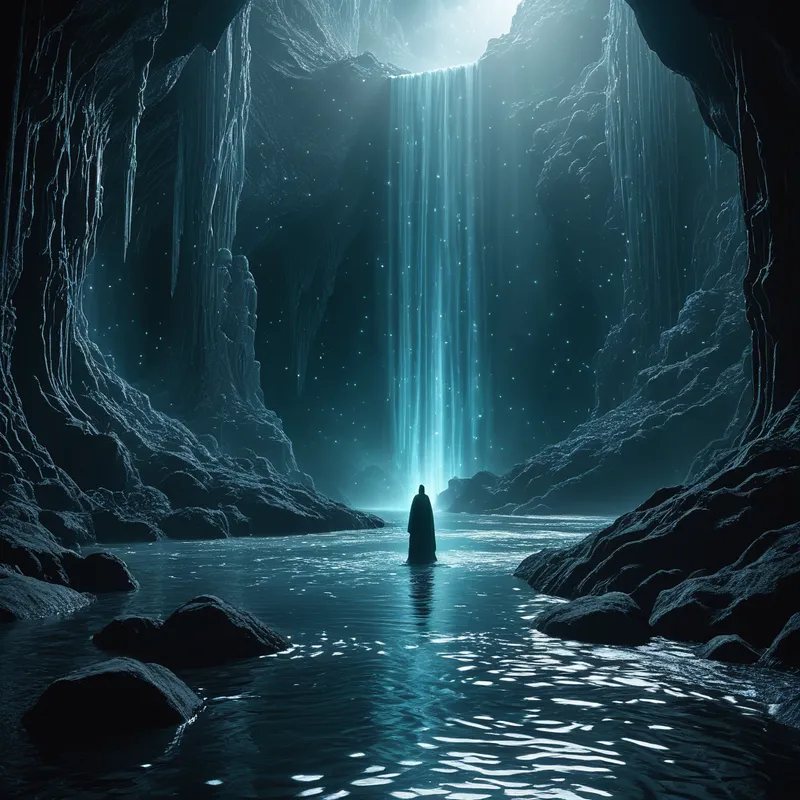
Listen, and let your mind drift to the deepest, most silent places beneath [the earth](/myths/the-earth “Myth from Hindu culture.”/). Beyond the groaning gates of [Hades](/myths/hades “Myth from Greek culture.”/), past the wailing fields of the unburied and the glittering halls of the judges, the air grows thick and still. Here, in the plain of [Lethe](/myths/lethe “Myth from Greek culture.”/), a river does not roar, but whispers. Its waters are not clear, but hold the color of twilight and polished silver, moving with a slow, hypnotic current.
This is the final station for the weary dead. Their long journey judged, their deeds weighed, they are led by the gentle but implacable psychopomps to these quiet banks. A profound thirst awakens in them—not of the body, which is ash, but of the soul, which is heavy. Heavy with the joy of a first kiss, the sting of a betrayal, the warmth of a childhood sun, the agony of a final breath. The soul is a tapestry woven too tight, and it yearns to unravel.
The guardian of this place is not a monster with three heads, but an absence. The air drinks sound. The [water](/myths/water “Myth from Chinese culture.”/) drinks light. And it drinks memory. One by one, the shades approach. They kneel. They cup the cool, weightless liquid in their hands and bring it to lips that remember tasting wine, water, and salt. They drink.
And as they drink, a great unspooling begins. The face of a mother softens into a gentle blur, then a nameless warmth, then nothing. The memory of a pain that defined a lifetime loosens its hook and floats away. Triumphs and shames, loves and hatreds, all the stories they told themselves about who they were—they dissolve like sugar in this silent water. The shade shudders, not in pain, but in a profound, empty release. The eyes, once windows to a lived world, become calm pools reflecting only the featureless gray sky of Elysium. Stripped of biography, they are now merely soul-stuff, ready to be spun again on the wheel of life, to return to [the world](/myths/the-world “Myth from Tarot culture.”/) above through the gates of rebirth, innocent and unknowing.
Cultural Origins & Context
The myth of the River Lethe flows from the deep well of Orphic and Platonic traditions, more than from the epic tales of [Homer](/myths/homer “Myth from Greek culture.”/). In Homer’s Odyssey, [the underworld](/myths/the-underworld “Myth from Greek culture.”/) is a place of shadowy remembrance, where the dead recall their lives with aching clarity. [The River Lethe](/myths/the-river-lethe “Myth from Global/Universal culture.”/) emerges later, in the philosophical and mystical schools that pondered the soul’s eternity and the mechanics of [reincarnation](/myths/reincarnation “Myth from Hindu culture.”/).
It was a myth for initiates and thinkers. Plato, in his Republic, describes souls choosing new lives before drinking from the “River of Unmindfulness” to forget their choice and their previous existence. This transformed the [underworld](/myths/underworld “Myth from Greek culture.”/) from a static endpoint into a dynamic processing station within a cyclical cosmology. The myth served a critical societal and psychological function: it provided an answer to the terror of infinite memory and the burden of eternal identity. It offered a cosmic rationale for why we do not remember past lives, framing forgetting not as a flaw, but as a sacred, necessary mercy—the ultimate cleansing ritual before a new beginning.
Symbolic Architecture
The [River](/symbols/river “Symbol: A river often symbolizes the flow of emotions, the passage of time, and life’s journey, reflecting transitions and movement in one’s life.”/) Lethe is the ultimate [symbol](/symbols/symbol “Symbol: A symbol can represent an idea, concept, or belief, serving as a powerful tool for communication and understanding.”/) of necessary oblivion. It represents the [psyche](/myths/psyche “Myth from Greek culture.”/)’s own [capacity](/symbols/capacity “Symbol: A measure of one’s potential, limits, or ability to contain, process, or achieve something, often reflecting self-assessment or external demands.”/) for [dissolution](/symbols/dissolution “Symbol: The process of breaking down, dispersing, or losing form, often representing transformation, release, or the end of a state of being.”/), a function as vital as [memory](/symbols/memory “Symbol: Memory symbolizes the past, lessons learned, and the narratives we construct about our identities.”/) itself.
To remember everything is to be paralyzed by time. The River Lethe is the psyche’s sacred delete key, without which no new sentence can be written.
Psychologically, Lethe is the embodiment of repression, not as a pathological failure, but as an organic, protective process. It is what allows [trauma](/symbols/trauma “Symbol: A deeply distressing or disturbing experience that overwhelms the psyche, often manifesting in dreams as unresolved emotional wounds or psychological injury.”/) to recede from conscious [torment](/symbols/torment “Symbol: A state of intense physical or mental suffering, often representing unresolved inner conflict, guilt, or psychological distress.”/), what lets the sharp edges of [grief](/symbols/grief “Symbol: A profound emotional response to loss, often manifesting as deep sorrow, yearning, and a sense of emptiness.”/) soften with time, and what enables the [child](/symbols/child “Symbol: The child symbolizes innocence, vulnerability, and potential growth, often representing the dreamer’s inner child or unresolved issues from childhood.”/) to forget the boundless world of imagination in order to focus on the concrete tasks of adulthood. [The river](/myths/the-river “Myth from Buddhist culture.”/) symbolizes the [water](/symbols/water “Symbol: Water symbolizes the subconscious mind, emotions, and the flow of life, representing both cleansing and creation.”/) of dissolution in the alchemical sense—the solvent that breaks down complex, solidified matter (crystallized [identity](/symbols/identity “Symbol: Identity represents the sense of self, encompassing personal beliefs, cultural background, and social roles.”/), fixed narratives) back into [prima materia](/myths/prima-materia “Myth from Alchemical culture.”/), the raw [material](/symbols/material “Symbol: Material signifies the tangible aspects of life, often representing physical resources, desires, and the physical world’s influence on our existence.”/) of [the self](/myths/the-self “Myth from Jungian culture.”/).
The act of drinking is one of active, if compelled, participation in one’s own un-becoming. It is the final surrender of [the ego](/myths/the-ego “Myth from Jungian culture.”/), which clings to its [story](/symbols/story “Symbol: The symbol of ‘Story’ represents the narrative woven through our lives, embodying experiences, lessons, and emotions that shape our identities.”/) as proof of its existence. To drink from Lethe is to consent to the [death](/symbols/death “Symbol: Symbolizes transformation, endings, and new beginnings; often associated with fear of the unknown.”/) of the personal “I” so that the impersonal [soul](/symbols/soul “Symbol: The soul represents the essence of a person, encompassing their spirit, identity, and connection to the universe.”/) may continue.

The Dreamer’s Resonance
When the River Lethe floods into modern dreams, it rarely appears as a mythological tableau. Instead, it manifests as the sensation of erasure. You dream of frantically trying to read a crucial letter, but the ink is fading as you watch. You stand in your childhood home, but the rooms are empty, white, and expanding, all familiar objects gone. You look in a mirror and your face has no features, or you meet a loved one who does not recognize you.
These are dreams of Lethe. They signal a profound psychological process underway: the dismantling of an outworn identity structure. Perhaps a career that defined you has ended, a relationship that shaped your world has dissolved, or a long-held belief about yourself has shattered. The psyche, in its wisdom, is initiating a forgetting. It is not a literal amnesia, but a decoupling of emotional energy from old complexes. The somatic feeling is often one of eerie calm, hollow detachment, or serene confusion—the body experiencing the relief of dropping a weight it had carried for so long it no longer registered it as heavy.
This dream-resonance is the soul’s way of practicing for a necessary death. It is preparing the dreamer to release the past’s grip, to make room for a narrative not yet written.

Alchemical Translation
The journey of the soul to the River Lethe is a perfect map for the stage of individuation known as mortificatio or dissolution. This is not the heroic battle of the ego, but its surrender. In our psychic alchemy, we all must eventually approach our own banks of Lethe.
The alchemical work requires that the king (the ruling conscious identity) must drown in the sea before he can be reborn renewed. Lethe is that sea.
The “water” we must drink is the conscious acceptance of our own forgetting—the willingness to let go of the stories we’ve curated about our wounds, our triumphs, our “type” of person. This is the transmutation of history into fate, and fate into freedom. To drink is to say, “I am not only the sum of my memories. I am also the space cleared by their release.”
The modern ritual is not literal, but experiential. It might be the profound silence after a period of intense therapy, where old narratives have been voiced and exhausted. It might be the deliberate practice of meditation, watching thoughts arise and pass without clinging to them. It is the courageous act of forgiving, which is, at its core, a decision to let the memory of a hurt cease defining the present relationship. In this alchemical translation, the River Lethe is not a place of punishment, but a sacred workshop. Its waters perform the ultimate psychic transmutation: turning the leaden, fixed weight of the past into the mercurial, liquid potential of the future. We drink to forget who we were, so that we may finally become who we are.
Associated Symbols
Explore related symbols from the CaleaDream lexicon: