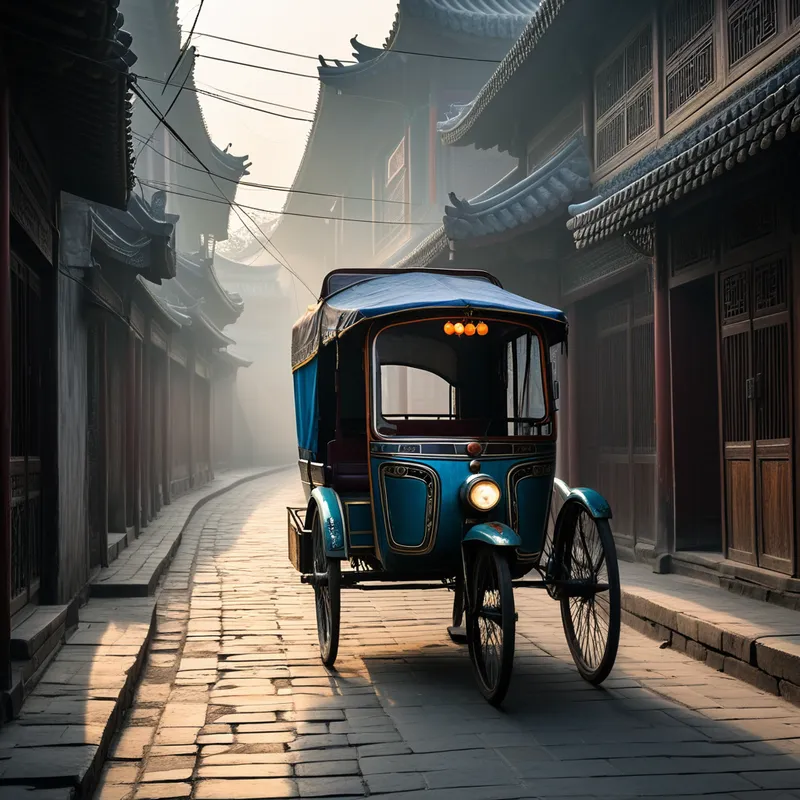
Rickshaw in 'Rickshaw Boy' Myth Meaning & Symbolism
A laborer's spirit, bound to a wooden rickshaw, endures the city's cruelty in a timeless struggle between human dignity and crushing fate.
The Tale of Rickshaw in 'Rickshaw Boy'
Listen, and you will hear the sound of worn leather soles on stone, the creak of wood under a terrible weight, and the rasp of a single breath in the vast, hungry throat of the city. This is not a story of emperors or immortals, but of a spirit named Xiangzi, and the wooden vessel that was his world, his hope, and his cage.
He emerged from the northern plains, a young titan of sinew and silence, with a dream simple and solid as an oak beam: to own a rickshaw. Not to pull one for a master, but to be master of the wheels that turned his fate. The rickshaw was no mere vehicle; it was a chariot of independence, a mobile kingdom of one. With superhuman toil, he poured his sweat into the city's stones until he clutched the handles of his own. The polished wood gleamed like a promise. For a fleeting season, he was a king, the rhythm of his running a song of freedom.
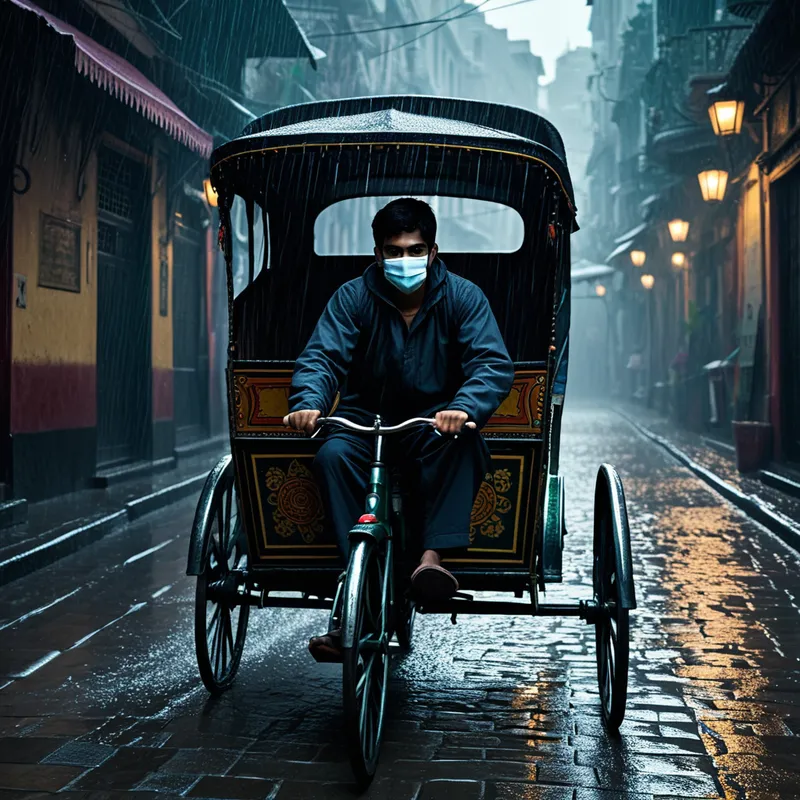
But the city is a living beast, and it feeds on dreams. Soldiers stole his chariot. Schemes stripped his coins. Illness sapped his strength. Each time, like Sisyphus, he began again, the dream of his own rickshaw the boulder he must push. He took a wife, Tigress, whose love was as fierce and complicated as the alleyways they lived in. Through her, he almost grasped a different life, a settled existence. But fate, in the form of a difficult birth, took her and their child, leaving him with nothing but the empty shafts of his grief.
The final corruption was not of his body, but of his soul. The good, honest, and doggedly hopeful Xiangzi began to fray. He learned the petty betrayals, the small cruelties necessary to simply survive. He pulled his rickshaw, but the running was joyless, the goal forgotten. The dream of ownership curdled into the reality of rent. The man who was once an unstoppable force became a ghost in the traffic, pulling any load for any price, his spirit broken by the very wheels he once worshipped. In the end, he is seen, a ragged specter at funeral processions, selling his last dignity—his strong back—to mourn the dead, while his own soul lies buried beneath the endless, turning wheels of the city.
Cultural Origins & Context
This is not an ancient myth from the classical canon, but a modern one, born in the crucible of early 20th-century China. It is the creation of novelist Lao She, who penned Rickshaw Boy (Luotuo Xiangzi) in 1936-37. Lao She acted as a mythographer for the urban poor, translating the raw, unspoken suffering of Beijing's (then Beiping's) lower depths into a national epic of the common man.
The story functioned as a devastating social critique, a mirror held up to the chaos, corruption, and profound inequality of the Republican era. It was passed down not by village elders around a fire, but through printed pages that circulated among intellectuals and, eventually, became a staple of modern Chinese literary consciousness. Its societal function was dual: to elicit empathy for the invisible laborer and to question the very possibility of individual aspiration in a system designed to crush it. It captured the death of the agrarian dream and the brutal birth of modern, alienated urban existence.
Symbolic Architecture
The myth’s power lies in its stark, brutal symbolism. The rickshaw is the central, paradoxical symbol. It represents both the dream of autonomy—a man’s direct, physical trade with the world for his livelihood—and the instrument of his enslavement. It is his extended body, his capital, and his coffin.
The rickshaw is the alchemical vessel where the base metal of hope is meant to be transmuted into the gold of selfhood, but the fire of the city burns too hot and too cruel, leaving only ash.
Xiangzi himself is the archetype of the "natural man" corrupted by society. His initial strength and purity are not virtues that lead to triumph, but vulnerabilities that make his fall more complete. His journey is an anti-quest. The city streets are his labyrinth, and the Minotaur he faces is not a monster, but the slow, grinding realization of his own powerlessness. Each loss—of the rickshaw, of Tigress, of his health—is not a test to strengthen him, but a stripping away of his humanity, layer by layer.
The Dreamer's Resonance
When this myth stirs in the modern unconscious, it rarely appears as a literal rickshaw. It manifests as the dream of the inescapable burden. The dreamer may find themselves pushing a car that will not start up an endless hill, or carrying a backpack of stones through an airport where they are perpetually late. The somatic feeling is one of immense weight, futile effort, and profound exhaustion against a backdrop of impersonal, judging structures (the city, the corporation, the system).
Psychologically, this dream pattern signals a confrontation with the Shadow of the work ethic. It asks: What am I pulling that is slowly killing my spirit? Where has my personal "rickshaw"—my career, my project, my role—transformed from a vehicle of my ambition into the load that defines and drains me? The dream is a cry from the soul's Orphan, feeling exploited by the very mechanisms it believed would grant it security and identity.
Alchemical Translation
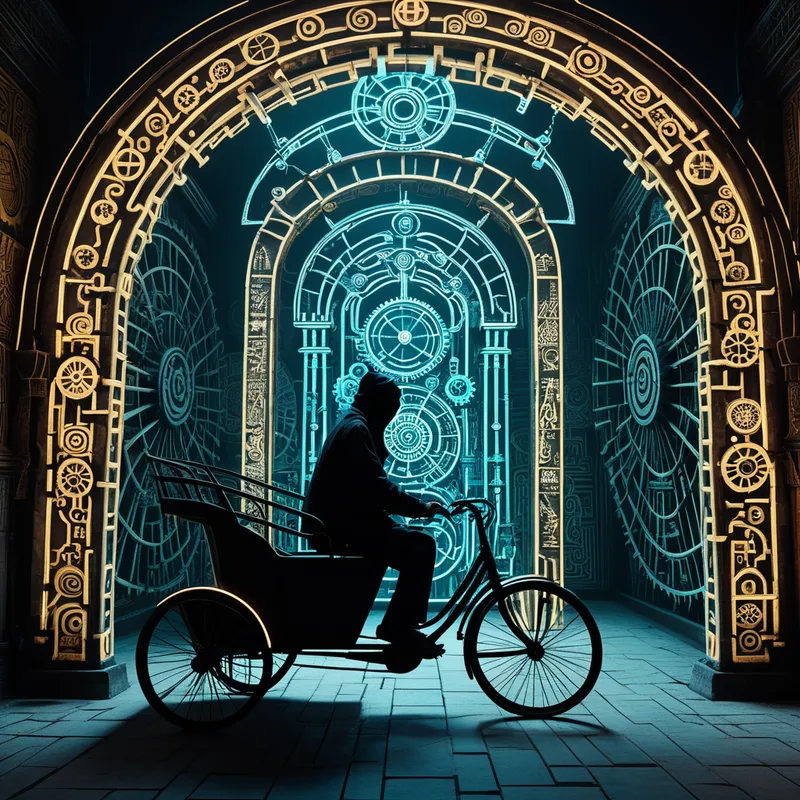
The individuation process modeled here is harrowing and non-linear. It is the alchemy of disillusionment. Xiangzi’s initial state is one of unconscious uroboric unity: he is strong, his goal is clear, he believes in a simple equation of effort and reward. The first stage of his "transmutation" is the separatio, the violent series of losses that shatter this naive wholeness.
His tragedy is that he fails the subsequent stage of nigredo, the blackening, the descent into the darkness of the soul. He encounters the shadow—in the form of societal corruption and his own growing cynicism—but instead of integrating it, he is consumed by it. He becomes identified with the burden itself.
The myth warns that the prize for winning the ego's race may be the loss of the Self. The true alchemical work begins not with pulling the load, but with having the courage to set it down and ask who you are without it.
For the modern individual, the myth’s lesson is not to avoid the struggle, but to recognize when the vessel of your striving has become your prison. The psychic transmutation occurs in the moment one differentiates between the authentic calling that moves you forward and the compulsive burden you are dragged by. It is the move from being "Rickshaw Boy"—defined entirely by your function—to reclaiming your name, your "Xiangzi," even if that name is, for a time, synonymous with loss and confusion. The triumph, ironically, may look like the failure of the initial dream, but it is the necessary death that precedes any genuine awakening. The wheel must break before the man can walk free.
Associated Symbols
Explore related symbols from the CaleaDream lexicon: