Revenant Myth Meaning & Symbolism
A universal tale of the dead who return, not as ghosts, but as physical, driven beings, embodying the psyche's demand for resolution and the weight of what was left unsaid.
The Tale of Revenant
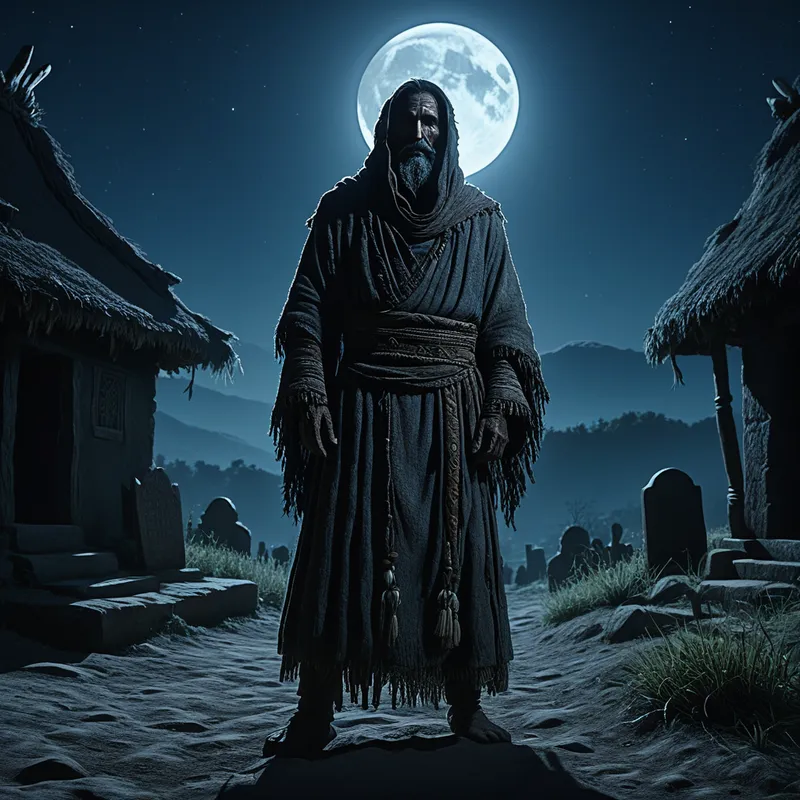
Listen, and feel the chill that is not of the wind. In the time when the hearth-fire was the sun of the home, and the boundary stone marked the edge of the known world, there walked those who should not walk. They did not drift as mist, nor wail as specters. No. They returned with the weight of the grave still upon them.
They came from the mound, from the churchyard, from the battlefield’s shallow trench. The earth of their burial clung to their clothes, a damp, dark second skin. Their eyes were not windows to another realm, but pools of a single, fixed intent—a purpose that had fermented in the silence of the tomb. They walked not through walls, but upon the road, with a heavy, deliberate tread that villagers would hear first as a distant, rhythmic thud in the dead of night.
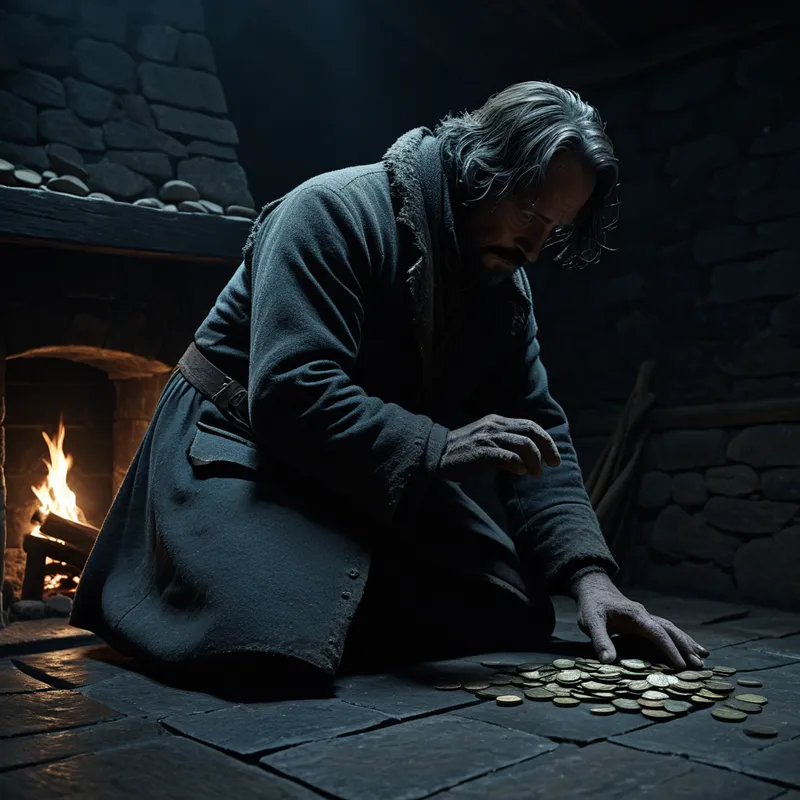
One such was a man of the northern fjords. He had drowned in the winter sea, his body recovered cold and salt-rimed. They laid him in the frozen ground with all proper rites. Yet, when the spring thaw came, so did he. He appeared at his own farmhouse door, not as a memory, but as a solid, dripping fact. Seaweed was tangled in his hair, and his skin was the blue-white of deep ice. He did not speak. He walked past his wailing wife, past his terrified children, straight to the great wooden chest in the corner. From his sodden tunic, he drew a small talisman of whalebone, one he had stolen from a shipmate in life, a debt of honor left unpaid. He placed it upon the chest with a final, dull click. Then, he turned, walked back through the door, and was seen only once more, vanishing into the mist over the burial mound, his task complete.
Another, from the deep forests of the continent, was a woman who had died with a curse upon her lips, a secret betrayal unconfessed. She returned not to her home, but to the crossroads. There, she would stand each midnight, pointing a finger of bone and gristle down the road leading to her betrayer’s village. She pointed until the first cockcrow, a silent, accusatory compass. No traveler dared pass her. Only when the guilty man, driven mad by the collective dread, finally came and fell to his knees before her, speaking the truth of his treachery, did her arm lower. Her form then crumbled, not into dust, but into a heap of forest loam and autumn leaves, returning to the earth at last.
These are the Revenants. They are the embodied echo of an unresolved chord in the song of a life. They return not for vengeance alone, but for completion. To pay a debt. To right a wrong. To speak the word that choked in the throat at the final moment. Their story is not one of horror, but of a terrible, relentless necessity. They are the past that will not stay past until it has been reckoned with.
Cultural Origins & Context
The Revenant is not the property of a single culture, but a profound human universal, a dark thread woven through the global tapestry of folklore. From the Slavic Nav to the Scandinavian Draugr, from the Germanic Wiedergänger to the restless dead of Asian and Indigenous traditions, the pattern is eerily consistent. These stories were not mere campfire frights; they were social and psychological tools.
Told by elders and griots alike, these narratives functioned as societal pressure valves and ethical guide rails. They enforced community norms: pay your debts, keep your oaths, honor your kin, confess your sins. The terror of becoming—or being haunted by—a Revenant was a powerful deterrent against antisocial acts. Furthermore, they provided a framework for understanding misfortune. A blighted crop, a sudden illness, or a string of deaths could be narratively contained by the concept of a restless dead, giving a name and a potential resolution (often ritualistic re-interment or fulfillment of the debt) to chaotic suffering. The Revenant myth gave shape to the formless anxiety that the past is never truly gone.
Symbolic Architecture
Psychologically, the Revenant is the ultimate symbol of the unintegrated complex. It is a packet of psychic energy—a trauma, a guilt, a promise, a love—that was denied proper expression or conclusion in conscious life. Because it was not dealt with, it does not dissipate. It accrues mass and momentum in the unconscious until it gains a kind of autonomy, a “life” of its own. It then returns, not as a memory, but as an active, disruptive force that demands attention.
The Revenant is the past incarnate, proving that what we bury without blessing will eventually dig its way out.
The Revenant’s physicality is key. Unlike a ghost, which represents a memory or an emotion, the Revenant’s earth-clogged, tangible body symbolizes the somatic reality of unresolved issues. This is not “all in your head”; it manifests as physical illness, chronic tension, compulsive behaviors, or a pervasive sense of being weighed down. The specific “unfinished business” of the folklore Revenant—the unpaid debt, the unspoken secret—translates directly to our modern psychic landscape: the apology never given, the grief never fully felt, the creative project abandoned, the true self betrayed for security.
The Dreamer’s Resonance
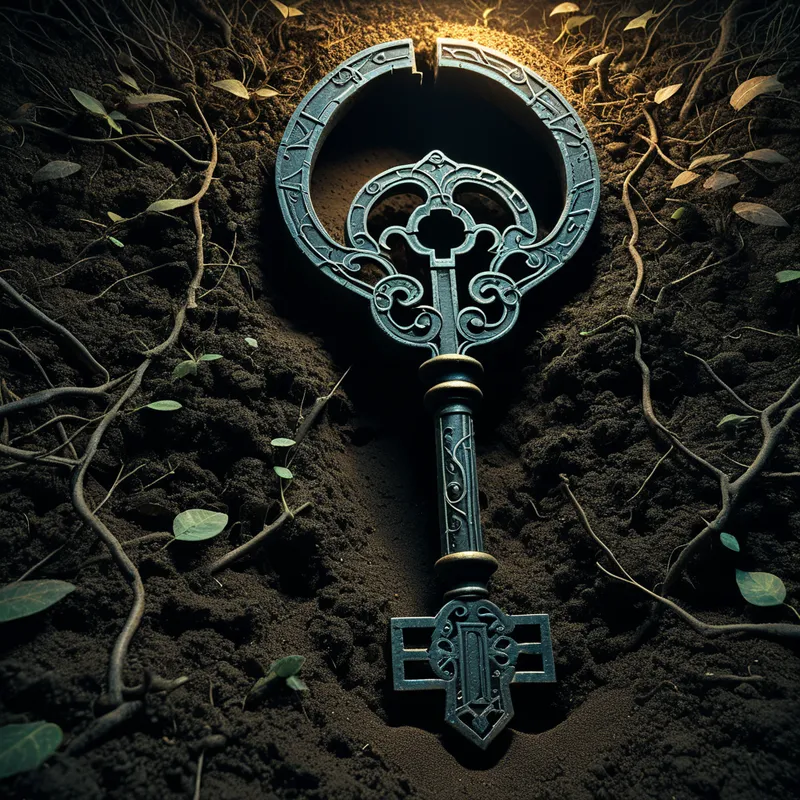
When the pattern of the Revenant stirs in the modern dreamer, it announces a profound process of psychic excavation. To dream of a solid, silent figure returning to your home, or to find yourself as that figure, walking with purpose toward something long forgotten, is to experience the unconscious mobilizing for integration.
The somatic sensation is often one of heaviness, dread, or a chilling certainty. You may dream of opening a door to find a figure from your past standing there, not as they were, but as a silent, solemn embodiment of your shared history. The environment in these dreams is frequently liminal: thresholds, hallways, empty childhood homes at night. The Revenant-dream does not chase; it presences. Its power is in its unwavering gaze and its unspoken demand. This is the psyche’s shadow-work manifesting. The dream is the stage where the buried complex makes itself known, not as an idea, but as an entity that must be confronted. The anxiety it provokes is the friction of a long-sealed chamber being forced open.

Alchemical Translation
The journey with the Revenant is a brutal but sacred alchemy. Its return initiates the process of individuation by forcing a confrontation with what we thought was dead and gone. The myth models a complete cycle of psychic transmutation.
First, Nigredo (the blackening): The Revenant appears. This is the confrontation with the black, rotting, neglected material of the soul—the guilt, the shame, the unresolved grief. It is a descent, a terrifying acknowledgement that something is very wrong.
Second, Albedo (the whitening): The Revenant communicates its need, not in words, but in symbolic action—placing the object, pointing the way. This is the clarifying moment. The chaotic dread begins to coalesce into a specific task: “I must make amends with X,” “I must finally grieve Y,” “I must acknowledge the truth of Z.”
The alchemy occurs not in banishing the Revenant, but in fulfilling its request. In doing so, you reclaim the energy it held prisoner.
Finally, Rubedo (the reddening): The fulfillment of the task. When the debt is paid, the secret spoken, the truth faced, the Revenant is transformed. It does not vanish into nothingness; it returns to earth, or dissolves into leaves. This is the integration. The psychic energy that was trapped in the complex is liberated. The heavy, dead weight is converted into fertile soil for new growth. The gold produced in this alchemy is wholeness. The once-terrifying figure from the past becomes a part of your history, finally laid to rest, its power now available to your conscious life as wisdom, resilience, or creative force. You learn the ultimate lesson the myth teaches: that to live fully, one must be willing to complete the conversations that outlast a lifetime.
Associated Symbols
Explore related symbols from the CaleaDream lexicon: