Revelation to Muhammad Myth Meaning & Symbolism
A man, burdened by the world's brokenness, retreats to a mountain cave. There, in the crushing silence, a divine command shatters his reality forever.
The Tale of Revelation to Muhammad
[The world](/myths/the-world “Myth from Tarot culture.”/) was heavy. Not with the weight of stone or sand, but with a deeper gravity—a forgetting. In the bustling caravanserai of Mecca, gods of stone were many, but the God of the heart seemed silent, lost beneath the clamor of trade and tribal pride. Among the people was a man named Muhammad, of the clan of Hashim. He was known as al-Amin, the Trustworthy, yet within him stirred a profound unease. [The world](/myths/the-world “Myth from Tarot culture.”/)’s brokenness—its orphaned children, its widows weeping, its petty wars over wells and honor—pressed upon his soul like a physical ache.
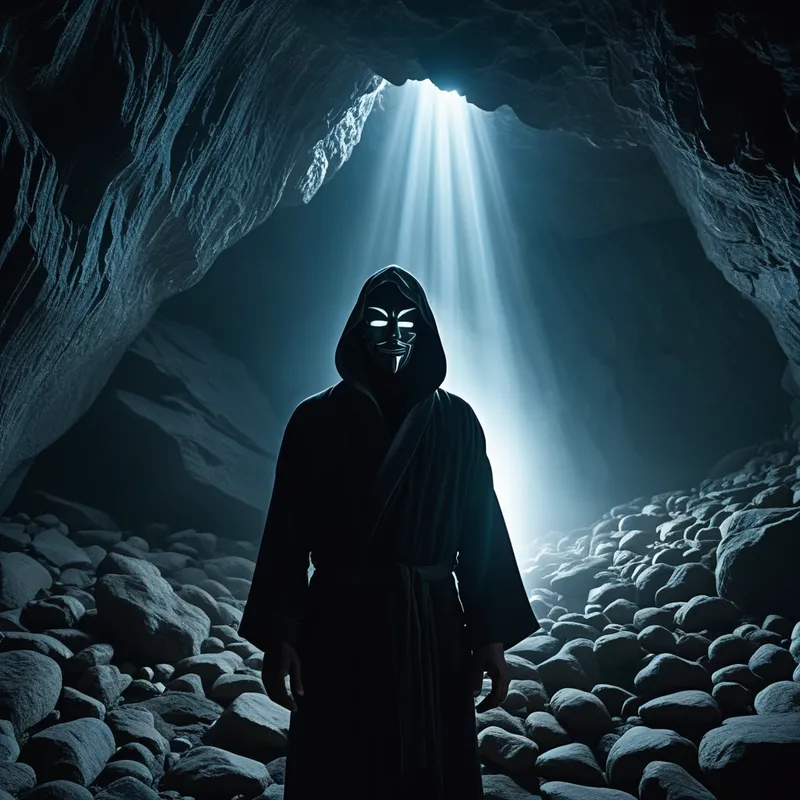
He began to seek a different air. He would leave the city’s confines and climb the jagged flanks of Jabal al-Nour, the Mountain of Light. His destination was a small cave known as Hira. It was not a place of comfort, but of raw confrontation. Here, there was no distraction, only the vast, silent sky above and the echoing chamber of his own heart within. For days and nights, he would retreat into this stony womb, practicing tahannuth—a deep, yearning contemplation. He sought not visions, but clarity; not power, but truth. He was listening for a voice in the silence that filled the universe.
Then, in the still darkness of one night in the month of Ramadan, the silence broke. It did not whisper; it seized. A presence, immense and terrifying, filled the narrow cave. It was the Angel Jibril. He did not appear as a gentle figure, but as a force that occupied all space, radiating an awe that was indistinguishable from dread. The tradition says he appeared on [the horizon](/myths/the-horizon “Myth from Various culture.”/), filling it, then drew nearer, until he was but two bow-lengths away, or closer still. The command that issued forth was not a request, but an imperative that vibrated through the very atoms of [the cave](/myths/the-cave “Myth from Platonic culture.”/) and the man’s being: “Iqra!” — “Recite!”
Muhammad, trembling, his heart pounding against his ribs, replied in his terror, “Ma ana bi-qari’” — “I am not a reciter.” He was a merchant, not a poet; a man of practical affairs, not of letters. The command came again, more immense: “Iqra!” And again, the terrified denial. Then, a third time, the angel enveloped him, and the divine words were imparted, not just to his ears, but into the core of his soul:
Recite in the name of your Lord who created— Created man from a clinging clot. Recite, and your Lord is the most Generous— Who taught by the pen— Taught man that which he knew not.
The words were seared into him. The presence withdrew, leaving behind a vacuum of silence more profound than before. Muhammad fled the cave, his limbs shaking, his mind reeling. He scrambled down the mountain path, convinced he had been overtaken by a jinn or had lost his mind. He sought refuge, crying out to be covered. He found his wife, Khadijah, who wrapped him in a cloak, the physical symbol of shelter and grounding. As he recounted the terror, she did not dismiss his fear. Instead, she became his first believer, his first anchor in the storm of the numinous, assuring him of his soundness and the truth of his experience. The Revelation had begun. The man who entered the cave seeking solace was gone; in his place stood a Prophet, burdened with a message that would shatter and remake the world.

Cultural Origins & Context
This foundational narrative is not a folktale but the axial event of Islam, meticulously preserved in the earliest biographies (Sira) and the collections of prophetic traditions (Hadith). Its primary transmitter was Muhammad himself, who recounted the experience to his closest companions. The story was then passed down through rigorously scrutinized chains of narration (isnad), ensuring its authenticity for the believing community.
Societally, the myth functions on multiple levels. For the early Muslim community, it was the origin story of their faith, validating Muhammad’s prophethood not as a choice but as a divine summons. It established the Qur’an as a revealed, transcendent text, not a human composition. The setting—the cave, the mountain, the illiterate Prophet—emphasized the purity of the transmission, untouched by human artifice. The story served to console and inspire believers, showing that even the Prophet faced profound terror and doubt, requiring human comfort (Khadijah) and divine reassurance to proceed. It modeled the necessity of retreat (khalwa) from society for spiritual clarity, a practice that would later be formalized in Sufi traditions.
Symbolic Architecture
Psychologically, the Cave of Hira represents the [temenos](/myths/temenos “Myth from Greek culture.”/)—the sacred, bounded [space](/symbols/space “Symbol: Dreaming of ‘Space’ often symbolizes the vastness of potential, personal freedom, or feelings of isolation and exploration in one’s life.”/) of the unconscious where [the ego](/myths/the-ego “Myth from Jungian culture.”/) is stripped of its social [identity](/symbols/identity “Symbol: Identity represents the sense of self, encompassing personal beliefs, cultural background, and social roles.”/). Muhammad as al-Amin is the competent, adapted ego. The cave is where that [adaptation](/symbols/adaptation “Symbol: The process of adjusting to new conditions, often involving psychological or physical change to survive or thrive.”/) breaks down, where the “burden of the world” can no longer be managed, forcing a descent into the [psyche](/myths/psyche “Myth from Greek culture.”/)’s bedrock.
The call does not come to the one who shouts for it, but to the one who has made a vessel of silence deep enough to contain its echo.
The terrifying [appearance](/symbols/appearance “Symbol: Appearance in dreams relates to self-image, perception, and how you present yourself to the world.”/) of Jibril symbolizes the autonomous, overwhelming power of [the Self](/myths/the-self “Myth from Jungian culture.”/)—the total, organizing center of the psyche—breaking into the [realm](/symbols/realm “Symbol: The symbol of ‘Realm’ often signifies the boundaries of one’s consciousness, experiences, or emotional states, suggesting aspects of reality that are either explored or ignored.”/) of the conscious ego. This is not a gentle [integration](/symbols/integration “Symbol: The process of unifying disparate parts of the self or experience into a cohesive whole, often representing psychological wholeness or resolution of internal conflict.”/) but a traumatic invasion, because the ego’s existing structures are inadequate to comprehend it. The command “Iqra!” (Recite/Read) is the archetypal demand for [consciousness](/symbols/consciousness “Symbol: Consciousness represents the state of awareness and perception, encompassing thoughts, feelings, and experiences.”/). It is the psyche insisting that the latent, unformed [knowledge](/symbols/knowledge “Symbol: Knowledge symbolizes learning, understanding, and wisdom, embodying the acquisition of information and enlightenment.”/) within must be brought to light, articulated, and made conscious. Muhammad’s protest, “I am not a reciter,” is the ego’s legitimate fear of its own [dissolution](/symbols/dissolution “Symbol: The process of breaking down, dispersing, or losing form, often representing transformation, release, or the end of a state of being.”/) and its perceived inadequacy for the [task](/symbols/task “Symbol: A task represents responsibilities, duties, or challenges one faces.”/).
The embrace by the [angel](/symbols/angel “Symbol: Angels often symbolize guidance, protection, and divine intervention, embodying a connection to higher realms.”/), culminating in the [transmission](/symbols/transmission “Symbol: A symbol of communication, transfer, or passage of energy, information, or influence between entities or states.”/) of the first verses, symbolizes the hieros gamos or sacred [marriage](/symbols/marriage “Symbol: Marriage symbolizes commitment, partnership, and the merging of two identities, often reflecting one’s feelings about relationships and social obligations.”/) between the [human](/symbols/human “Symbol: The symbol of a human represents individuality, complexity of emotions, and social relationships.”/) [capacity](/symbols/capacity “Symbol: A measure of one’s potential, limits, or ability to contain, process, or achieve something, often reflecting self-assessment or external demands.”/) for consciousness and the transpersonal [source](/symbols/source “Symbol: The origin point of something, often representing beginnings, nourishment, or the fundamental cause behind phenomena.”/) of meaning. The knowledge is “taught by the pen,” indicating that this [revelation](/symbols/revelation “Symbol: A sudden, profound disclosure of truth or insight, often through artistic or musical means, that transforms understanding.”/) is not just emotional [ecstasy](/symbols/ecstasy “Symbol: A state of overwhelming joy, rapture, or intense emotional/spiritual transcendence, often involving a loss of self-awareness.”/) but structured, intelligible [Logos](/myths/logos “Myth from Christian culture.”/)—[word](/symbols/word “Symbol: Words in dreams often represent communication, expression, and the power of language in shaping our realities.”/) become world.
The Dreamer’s Resonance
When this mythic pattern stirs in the modern dreamer, it often manifests not as angelic visions, but as profound somatic and psychological crises. One may dream of being in a confined, isolating space (an elevator, a basement, a sealed room) where an overwhelming, non-human intelligence communicates through pressure, light, or incomprehensible data streams. The dreamer wakes with a pounding heart, a sense of dread, and the haunting residue of a message they cannot decipher.
This is the psyche’s “first revelation.” It marks a point where the unconscious can no longer communicate through subtle hints or neurotic symptoms. It must command. The individual is being summoned to “read” the text of their own life—their patterns, their wounds, their destiny—in a new way. The terror is the ego’s resistance to a fundamental reorientation. The subsequent search for “Khadijah”—a grounding, containing presence (which could be a therapist, a partner, a creative practice, or an inner resource of self-compassion)—is essential. Without this container, the revelation risks being pathologized as psychosis or dismissed entirely, and the call goes unanswered.
Alchemical Translation
The alchemical process modeled here is the [nigredo](/myths/nigredo “Myth from Alchemical culture.”/) leading to the illuminatio—the crushing blackness of the cave yielding to the unbearable light. For the modern individual on the path of individuation, the myth outlines a non-negotiable sequence.
First, one must heed the impulse for retreat. This is the “withdrawal of projections,” stepping back from the collective values (Mecca’s tribal commerce) to confront the raw material of one’s own being in solitude. The ensuing confrontation with the Angel/Self is the crisis of vocation. It asks: What is the unique, imperative truth you are meant to articulate in this world? The ego’s protest—“I am not a poet, a leader, a healer”—is part of the process.
The gift of the Self is always a burden, and the bearer must first be crushed by its weight to be strong enough to carry it.
The transmutation occurs in the surrender. When Muhammad ceases to resist and receives the words, the identity of “Muhammad the merchant” dies, and “Muhammad the Prophet” is born. This is psychic death and rebirth. The individual integrates a fragment of the transpersonal Self, which then becomes the guiding center (Murshid) for their life’s journey. The revealed “word” becomes the individual’s personal mythos—the coherent narrative that makes sense of their suffering, their gifts, and their purpose. They return from the mountain cave not to escape the world, but to engage it with a transformed, unshakeable authority, carrying a message born not of personal desire, but of divine imperative.
Associated Symbols
Explore related symbols from the CaleaDream lexicon: