Render unto Caesar Myth Meaning & Symbolism
A confrontation in the temple where a teacher, asked about taxes, reveals the necessity of discerning between worldly and spiritual sovereignties.
The Tale of Render unto Caesar
The air in the Temple was thick—not with incense, but with conspiracy. It was a trap woven from legal threads and political venom, laid in the shadow of the very porticoes meant for prayer. The Pharisees, guardians of the Law, and the Herodians, collaborators with Rome, had found a common cause: not truth, but the silencing of a voice that threatened all their carefully constructed worlds.
They moved through the crowd like serpents, their robes whispering against the stone. They found him teaching, as he often did, a still point in the human current. With faces carved into masks of scholarly concern, they posed their question, a blade hidden in silk. “Teacher,” they began, their voices oiled with false deference, “we know that you are true and teach the way of God truthfully, and you do not care about anyone’s opinion, for you are not swayed by appearances.”
The flattery hung, poisonous, in the space between them. Then, the thrust: “Tell us, then, what you think. Is it lawful to pay taxes to Caesar, or not?”
A silence fell, deeper than the absence of sound. It was the silence of a snare snapping shut. To say “yes” was to alienate the people groaning under Roman tribute. To say “no” was sedition, a sentence of death by the very power whose coin jingled in every purse. All eyes turned to him. The conspirators allowed themselves the faintest ghost of a smile.
He did not rage. He did not equivocate. His voice, when it came, was clear and calm, a knife cutting through the tension. “Why put me to the test, you hypocrites?” He saw the trap for what it was—not a question of law, but a test of allegiance. “Show me the coin for the tax.”
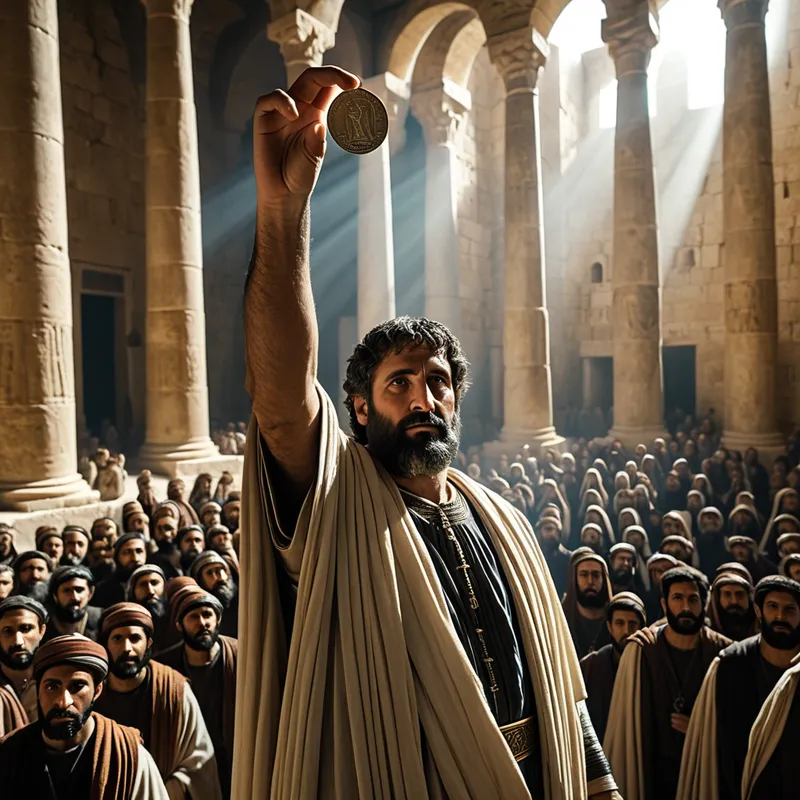
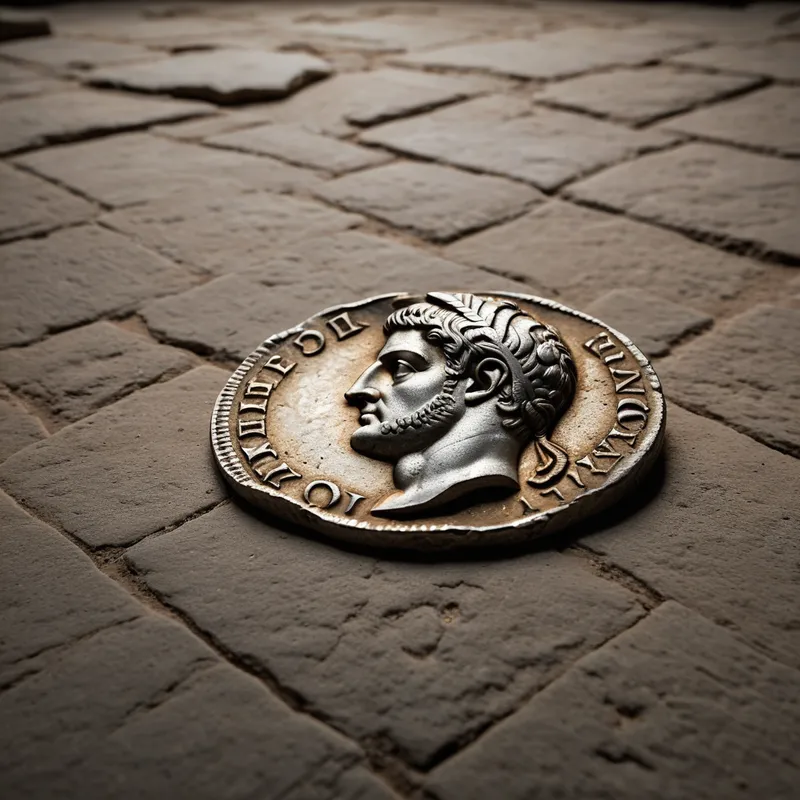
Bewildered, one of them fumbled in his girdle and produced a small silver disc. A denarius. It was a foreign thing in the holy precinct, a graven image, a profane symbol of a power that claimed divinity. He took it, holding it up so the weak sunlight caught the stamp.
“Whose likeness and inscription is this?” he asked, his finger tracing the features stamped upon the metal.
The answer was inevitable, pulled from their own lips. “Caesar’s.”
Then came the words, simple, seismic, echoing down the centuries. He returned the coin, its metallic truth acknowledged. “Therefore,” he said, his gaze encompassing both the coin and the vast Temple around them, “render to Caesar the things that are Caesar’s, and to God the things that are God’s.”
The trap lay in pieces. The conspirators were left holding the physical evidence of their own complicity, their own daily use of the imperial power they hoped to weaponize. They marveled. They slipped away, outmaneuvered not by cunning, but by a clarity that shattered the very frame of their question. He had not chosen a side in their false duality. He had revealed a greater map of reality.
Cultural Origins & Context
This narrative is embedded within the Gospel accounts, a pivotal moment in the final days of Jesus of Nazareth in Jerusalem. The context is one of extreme political and religious volatility. Judea was an occupied territory, and the tax in question—the tributum capitis—was a potent symbol of that subjugation, a direct payment to the emperor who claimed divine status.
The tellers of this tale were early Christian communities, for whom this story served multiple functions. For communities living under Roman rule, it provided a sophisticated framework for navigating dual citizenship—in the empire and in the kingdom of heaven. It was not a call to revolution, nor to blind submission, but to discernment. It also functioned as an apologetic, showing their teacher’s supreme wisdom in publicly besting the most learned and powerful opponents of the day, revealing their hypocrisy while avoiding a politically incendiary declaration. The story passed down not as a legal ruling, but as a masterclass in spiritual and intellectual sovereignty.
Symbolic Architecture
At its heart, this is a myth of radical discernment. The coin, the denarius, is the perfect symbol of the “worldly domain.” It bears the image of Caesar, and his inscription—his name, his titles, his claim. It represents the entire system of temporal power, economics, social contract, and external obligation. It is the realm of law, politics, and the necessities of embodied life.
The first act of sovereignty is to identify the stamp upon the currency of your life.
The teacher’s command to “render” (Greek: apodote, “give back”) implies a transaction. What is stamped with Caesar’s image belongs, in a sense, to Caesar’s order. To participate in society is to acknowledge its currency and its costs. The myth does not condemn this but names it clearly.
The genius, and the eternal challenge, lies in the second clause: “and to God the things that are God’s.” If the coin belongs to Caesar because it bears his image, what then bears God’s image? In the Genesis tradition, it is humanity itself that is made in the divine image. Therefore, the ultimate rendering is of the self.
The true self, the imago Dei within, is the only currency valid for the transaction of the soul.
Psychologically, this maps the critical differentiation between the persona (the socially adapted face, our “Caesar-image”) and the Self. The myth advocates for a conscious relationship with both: paying the necessary tolls to the outer world of roles and duties, while knowing that our deepest allegiance, our core identity and vitality, must be given to the inner, transcendent center.
The Dreamer’s Resonance
When this myth stirs in the modern unconscious, it often manifests as dreams of fraught transactions, counterfeit money, or being forced to choose between two oppressive authorities. A dreamer may find themselves at a border checkpoint paying a fee with coins that melt in their hand, or in an endless bureaucratic office trying to file a return for a debt they don’t understand.
Somatically, this can feel like a tearing in the chest or a pressure at the temples—the physical correlate of a divided loyalty. The psychological process at work is the conflict between inner truth and outer demand. The “Pharisees and Herodians” in the dream are often amalgams of internalized judges: parental expectations, societal “shoulds,” professional ambitions, and the critical superego. They corner the dreamer with a false binary: conform completely or be destroyed.
The healing movement in such dreams comes not from finding the “right” answer to the trap, but from the dream-ego accessing the mythic figure’s quality of witnessing. To hold the “coin,” to examine it without panic, and to name its origin is to begin the process of disentanglement. The dream is initiating a rite of discernment, asking the dreamer: What in your life bears the stamp of an alien authority? And what bears the authentic stamp of your own soul?

Alchemical Translation
The alchemical process modeled here is separatio followed by a conscious coniunctio—not a fusion, but a reconciled duality. The base metal of a confused, entangled life, where inner values and outer compulsions are hopelessly alloyed, is placed in the fire of confrontation.
First, the Recognition (The Coin is Produced): The individual must consciously bring the “coin” into the light. This is shadow work: acknowledging one’s own participation in systems of power, approval, and material validation. It is admitting, “I use this currency. I am complicit.”
Second, the Discerning Question (Whose Image?): This is the analytic stage. Through introspection or therapy, one learns to trace the “inscription” on their motivations. Is this desire mine, or is it stamped by parental expectation, cultural dogma, or the fear of the herd? This is the dissolution of false identities.
The crucible of individuation requires we mint our own currency, stamped with the image we discover in the depths.
Third, the Rendering (The Dual Return): This is the stage of conscious living. With clarity, one meets their earthly obligations—taxes, duties, relationships—not with resentful compliance or naive rebellion, but as a conscious citizen of the temporal world. Simultaneously, one begins the sacred, inner transaction: rendering time, attention, love, and creativity to the cultivation of the authentic Self. The two realms are no longer at war but exist in a tense, creative, and necessary relationship.
The ultimate transmutation is from a state of being owned by external and internalized Caesars to becoming a sovereign entity capable of engaging with multiple realms without losing your soul. You render to Caesar his coin, but you render to God your life. In that act of conscious division lies the secret of true, undivided being.
Associated Symbols
Explore related symbols from the CaleaDream lexicon: