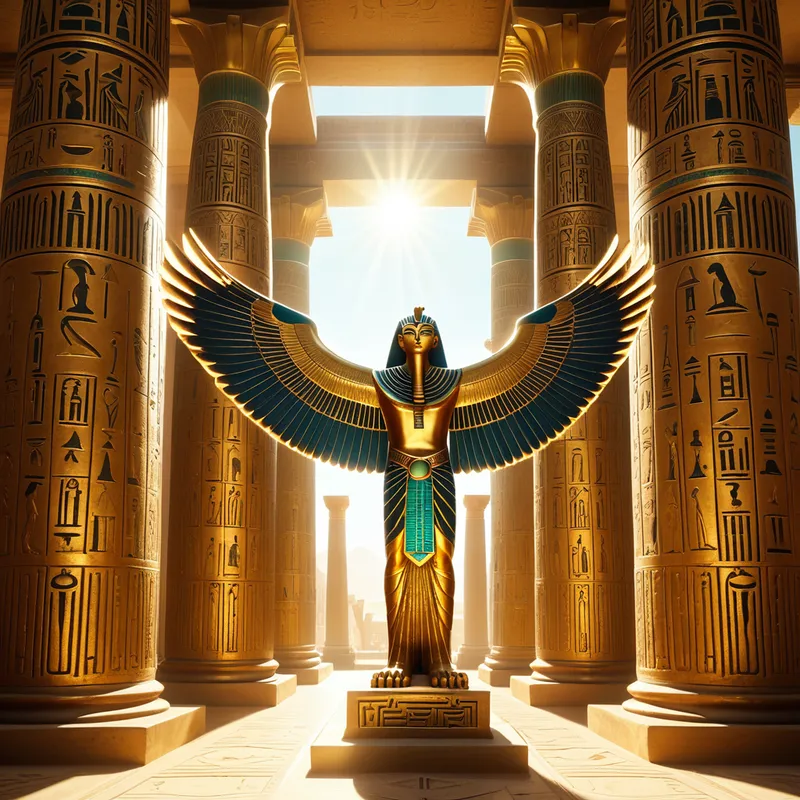
Ren Myth Meaning & Symbolism
The myth of the Ren, the secret true name of the soul, whose protection is the ultimate battle for identity and destiny in the Egyptian afterlife.
The Tale of Ren
Hear now the tale not carved on temple walls, nor sung in the sunlit courts of the living. This is a story whispered in the dark, a truth known only to the heart as it beats its final rhythm. It is the story of the Ren.
In the beginning, before the world was firm, the gods spoke names into the void, and things came to be. Ra spoke his own name, and light flooded the cosmos. But for every being—god, king, or humble farmer—there was another name, a name spoken not by the lips but by the essence itself. This was the Ren. It was the seed of your being, the map of your destiny, the sum of all you were and ever could be. To know a thing’s true name was to hold its soul in your hand. To protect your own was to ensure you would not fade into the endless, silent dark of Duat.
Now, picture the soul’s final, perilous journey. The body lies still, wrapped in linen. The Ka seeks sustenance at the tomb’s offering table. The Ba, a bird with a human face, flutters toward the sun. But the Ren? It travels a deeper, darker road.
The deceased descends into the winding, black corridors of Duat. The air is thick with the scent of damp earth and forgotten promises. Before them looms the Hall of Osiris, Lord of the Silent Land. Forty-two assessor gods line the hall, their eyes like cold stars. But this is not the final test. Beyond the weighing of the heart against the feather of Maat, a more intimate predator waits.
Her name is Apep, the serpent of chaos, the great devourer. She does not seek to crush bones or spill blood. She slithers through the shadows of memory and identity. Her goal is singular: to learn your Ren. To coil around that secret sound and swallow it whole. If she succeeds, your name is erased from the Book of Life. Your Ka will starve, your Ba will lose its way, and you will become a whisper lost in the wind of non-being—a second, final death from which there is no return.
The soul’s only shield is silence, vigilance, and cunning. It must pass by Apep’s lair, a place of echoing, tempting whispers that sound like your own mother’s voice calling your childhood name. It must guard the Ren as a traveler guards his last drop of water in a burning desert. The battle is fought not with spear or spell, but with the sheer, unyielding force of self-knowledge. To reach the Field of Reeds, to join the stars and the ancestors, one must arrive with one’s true name intact, unsullied, and unspoken. Victory is not conquest, but preservation. It is the soul presenting its most essential self to eternity, and finding it whole.

Cultural Origins & Context
The concept of the Ren is woven into the very fabric of ancient Egyptian ontology, emerging from a culture that saw language and reality as inextricably linked. This was not a single, standardized myth told in a linear narrative, but a pervasive theological principle expressed in funerary texts like the Book of the Dead, the Pyramid Texts, and the Coffin Texts.
The guardians of this knowledge were the priests and scribes, the “servants of the god’s word.” For royalty and elites, spells were meticulously inscribed on tomb walls and sarcophagi, explicitly designed to protect the Ren and confuse demonic entities. A common practice was the creation of “ushabti figures,” which could answer if the Ren was called, thus shielding the true name. For the common people, the belief was no less potent, expressed through amulets, oral traditions, and the profound hope that knowing one’s place in the cosmic order—one’s true name—was the key to a blessed eternity. Societally, the myth functioned as the ultimate affirmation of individual destiny within a collective, ordered universe. It taught that while pharaoh upheld Maat for the kingdom, every person was responsible for upholding the integrity of their own soul.
Symbolic Architecture
The Ren is the archetypal symbol of the ineffable core self. It is not the social persona, nor the shifting emotions, nor even the conscious mind. It is the immutable pattern at the center of our being, the “name” written by fate and forged by our essential choices.
The Ren is the soul’s signature, written in the ink of destiny and sealed with the wax of lived experience. To lose it is not to die, but to have never truly existed.
The journey through Duat to protect it represents the ultimate introspective ordeal. The assessor gods and the weighing of the heart symbolize the moral reckoning of the conscious ego. But Apep represents a deeper, more insidious threat: the forces of chaos, fragmentation, and existential oblivion that attack not what we have done, but who we are. This serpent is the psychological embodiment of trauma, profound shame, or societal erasure that can make a person feel their core identity is invalid, stolen, or unworthy of existence. The myth posits that the culmination of a life—and the prerequisite for any form of immortality—is the successful defense and integration of this authentic self.
The Dreamer’s Resonance
When this mythic pattern stirs in the modern unconscious, it often manifests in dreams of profound vulnerability concerning one’s identity. A dreamer may find themselves in a labyrinthine bureaucracy where they are desperately trying to prove their name or retrieve a lost ID, only to have the documents dissolve. They may dream of whispering voices trying to lure them into revealing a secret, or of a cherished personal object—a locket, a journal, a ring—being stolen by a shadowy figure.
Somatically, this can correlate with feelings of being “unreal,” dissociated, or gripped by a nameless anxiety that one’s very foundation is under threat. Psychologically, this is the process of the ego confronting the shadow and other unconscious contents that seek to dismantle a fragile or false sense of self. The dream is not merely a fear of failure, but a deeper terror of erasure. It signals a critical moment where the psyche is fighting to preserve the nascent, true identity against internalized criticism, past trauma, or societal pressures that demand conformity at the cost of authenticity.

Alchemical Translation
In the alchemical vessel of individuation, the myth of the Ren models the process of moving from the unconscious massa confusa to the lapis philosophorum, the philosopher’s stone of the integrated Self. The modern individual’s “Duat” is the descent into the unconscious through therapy, creative expression, or life crisis. The “weighing of the heart” is the necessary, often painful, moral inventory and shadow work.
The alchemical gold is not found in becoming someone new, but in recovering, recognizing, and refusing to relinquish the name you were always meant to bear.
The serpent Apep is transmuted into the very energy of resistance that forges a stronger self. Every time we resist the chaos of others’ expectations, the oblivion of addiction, or the fragmentation of self-betrayal, we are performing the ritual of protecting our Ren. The ultimate “Field of Reeds” is not an external paradise, but the achieved state of psychic wholeness. It is the condition where one’s actions, relationships, and life’s work are in authentic alignment with that core, secret name—the true self, fully embodied and eternally present. The myth teaches that our greatest task is not to build a monument, but to guard a mystery: the sacred, inviolable truth of who we are.
Associated Symbols
Explore related symbols from the CaleaDream lexicon: