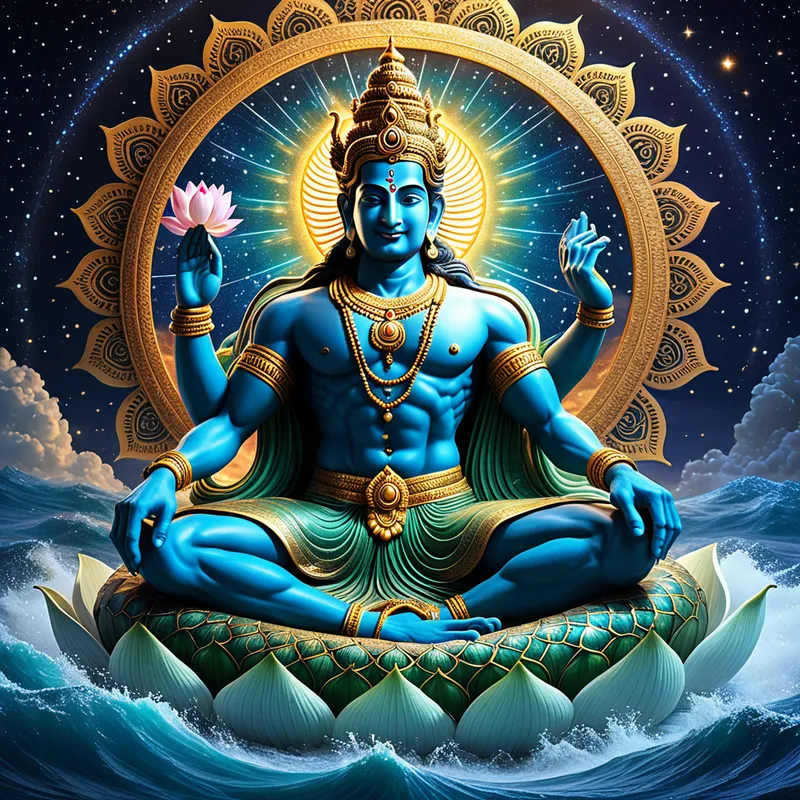
Reincarnation Myth Meaning & Symbolism
The soul's journey through countless lives, bound by action and desire, seeking the ultimate release from the wheel of rebirth into boundless unity.
The Tale of Reincarnation
Listen. Before the first word was spoken, before the first mountain rose from the primal waters, there was a breath. A single, silent exhalation from the source of all that is. And within that breath, a spark. A tiny, luminous point of consciousness—a jiva. It awoke not in a body, but in a dream of separation. It looked upon the shimmering, manifest world and felt a tremor of desire. “This,” it whispered to itself, “I wish to experience.”
And so it began. The jiva took form. First, perhaps, as a droplet in a monsoon cloud, falling to earth with the ecstasy of descent. Then as a blade of grass, tasting the sun with its whole being. Then as a creature of instinct, running, hunting, fearing, longing. With each life, actions were sown—karma. Every thought, every deed, every hidden intention was a seed planted in the fertile soil of time. Some seeds bore sweet fruit, others thorns. And the jiva, tasting the fruit, craving more, or recoiling from the thorns, was bound by the very consequences it had authored.
The wheel turned. The great recorder, Chitragupta, in his silent hall of cosmic accounts, inscribed each action in an endless scroll. The soul, laden with this accumulated weight, would stand before Yama, not as a punishment, but as a reckoning. Yama’s gaze was not cruel, but implacably just. He would pronounce the account, and the soul, still clinging to its unfulfilled desires and unresolved fears, would be drawn back. Across the dark river Vaitarani, through the womb of forgetting, and into a new life. A king in one lifetime, a beggar in the next; a lion, then a deer; a sage, then a fool. The forms were costumes, the dramas were lessons, but the actor, the jiva, remained, trapped in the theater of its own making.
This is the great journey, samsara—the wandering. The soul travels through the three worlds, the svarga, the earth, and the nether realms, driven by the winds of its past. It forgets its origin, identifies wholly with its temporary role, and suffers the inevitable loss when the curtain falls on each act. Birth is an entry into amnesia, death an exit from a role, but never a final bow. The wheel, the kalachakra, spins on, powered by the engine of desire and action.
Yet, in the deepest recess of the soul’s memory, a faint echo persists. A nostalgia for the breath before the first breath. A longing for the stillness before the first motion. This echo is the pull of Brahman, the silent source from which it came. And this longing is the beginning of the end of the wandering.
Cultural Origins & Context
The doctrine of reincarnation, or punarjanma, is not a single myth with one author, but a foundational metaphysical truth woven into the very fabric of Hindu thought. Its earliest seeds are found in the later portions of the ancient Vedas, but it flowers fully in the mystical dialogues of the Upanishads, composed between 800 and 200 BCE. Here, it moves from ritual speculation to a central pillar of philosophy.
It was passed down not merely as a story, but as a lived cosmology by the gurus and sages in forest hermitages. It was taught to disciples through parable, dialogue, and direct experiential inquiry into the nature of the self. Its societal function was profound: it provided a framework for ethics (karma as moral cause and effect), explained social stratification (the varna system was often interpreted karmically), and offered a grand, purposeful narrative for human suffering and inequality. More importantly, it placed the ultimate responsibility for one’s destiny squarely on the individual soul, making liberation (moksha) the highest human goal, surpassing even worldly success or heavenly pleasure.
Symbolic Architecture
The myth of reincarnation is a vast symbolic map of the psyche’s journey through time and identity. The jiva is the core of consciousness itself, the “I am” that mistakenly identifies with its temporary contents—the body, the personality, the story.
The wheel of samsara is the psyche’s compulsive repetition of unresolved complexes. Each lifetime is a new dream, a new attempt to solve an old equation with the same flawed logic of desire and aversion.
Karma is the law of psychic cause and effect. It is the memory of the unconscious, the unprocessed emotional and volitional residue that shapes our perceptions and compulsions. It is not fate, but the gravitational pull of our own past choices. The river Vaitarani and the womb symbolize the threshold of forgetting, the necessary dissolution of the ego-personality so a new one can coalesce, carrying the deep, karmic impressions (samskaras) forward.
Yama represents the inner judge, the super-ego or the objective psyche that holds us accountable to our own deepest truths. The ultimate goal, moksha, is the realization that the jiva is none other than Brahman—that the drop remembers it is the ocean. This is the dissolution of the fundamental complex of separation.
The Dreamer’s Resonance
When this mythic pattern stirs in modern dreams, it speaks of a profound psychological process of integration and release. You may dream of living multiple lives in one night, of being different people in a single narrative, or of meeting versions of yourself from other times.
Such dreams often surface during life transitions—endings, births, career shifts, or after significant losses. They indicate the somatic and psychic death of an old identity. The psyche is showing you that the “you” you currently cling to is but one incarnation of a deeper, flowing consciousness. Dreaming of past-life memories (whether literal or symbolic) often points to carrying forward unresolved emotional patterns, fears, or talents (samskaras) that are seeking resolution in your current life situation. The feeling of being trapped in a cycle, replaying the same relationship drama or professional setback, is the direct dream-language of samsara.
Alchemical Translation
For the modern individual, the alchemical translation of this myth is the process of individuation through conscious responsibility and self-knowledge. The wheel we seek to escape is not of physical births, but of psychological rebirths into the same patterns of thought, emotion, and behavior.
The first alchemical step is to become Chitragupta of your own soul—to keep ruthless, compassionate account of your actions and their inner consequences. This is shadow-work.
Every time you observe a compulsive reaction without identifying with it, you burn a thread of karma. Every time you forgive yourself and another, you alter the karmic ledger. The goal is not to accumulate “good karma” for a better next life, but to exhaust karma altogether—to act in the world without the binding residue of selfish desire or aversive fear.
The ultimate transmutation is the realization of the sakshi, the silent witness within. This is the part of you that has watched all your “lives”—the child you were, the adolescent, the professional, the partner. It is the seat of consciousness that is unchanging amidst the cycle. Anchoring in this witness is the modern moksha. It means living a life fully engaged, yet not bound by its outcomes; loving deeply, yet not possessed by loss. You step off the wheel not by leaving life, but by realizing you were never truly on it. You were the space in which the wheel turned, the awareness in which the eternal story of the jiva unfolds and, finally, dissolves into its own source.
Associated Symbols
Explore related symbols from the CaleaDream lexicon: