Red String of Fate Myth Meaning & Symbolism
An ancient myth of an old lunar deity who invisibly binds destined lovers with an unbreakable crimson thread, guiding them through life to their ultimate union.
The Tale of the Red String of Fate
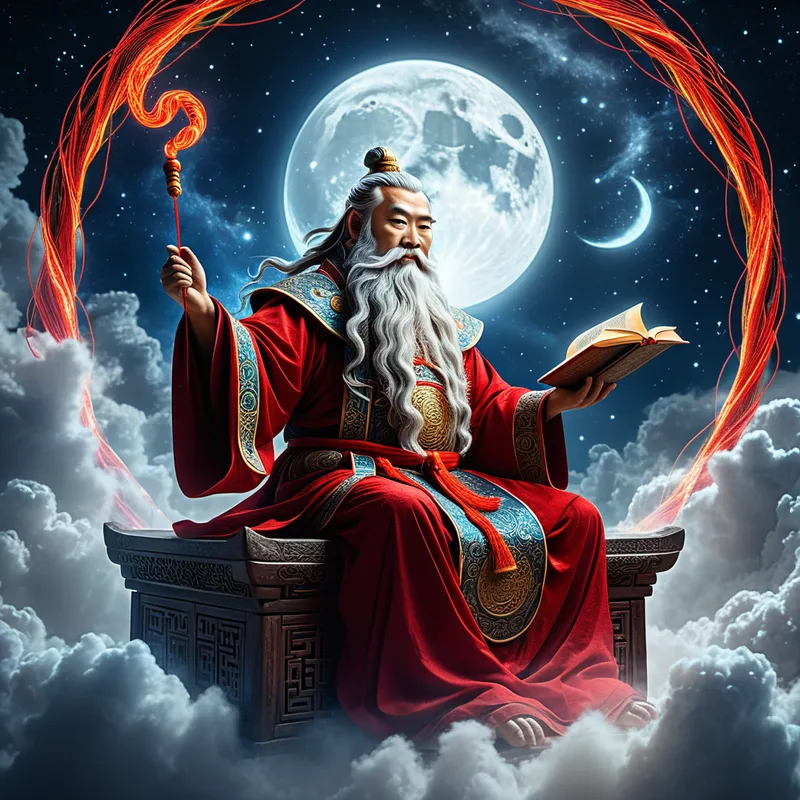
Beneath the cold, watchful eye of the moon, in a realm where time is a river and human lives are but ripples upon its surface, there dwells an ancient one. He is known as Yue Xia Lao. His beard is the color of winter frost, and his eyes hold the gentle patience of ten thousand cycles. His palace is not of jade or gold, but of silence and intention, perched upon the silver crescent itself.
His sole, sacred duty is recorded in a tome of impossible weight—the Book of Marriages. Within its pages, written in starlight and shadow, are the names of every soul destined to walk the earth. But names are not enough. For destiny is not a declaration; it is a weaving.
From a spool that never empties, Yue Xia Lao draws a thread of the purest crimson. It is not the red of blood, but of the vital spark, of the heart’s deepest chamber. In the profound quiet, he begins his work. He takes the name of a child just born, a girl wailing in a humble village, and with a touch both infinitely gentle and irrevocably firm, he ties one end of the red string around her tiny ankle. The thread is invisible to mortal eyes, weightless to mortal touch, yet it carries the tensile strength of fate itself.
He then turns the pages of his book. His finger traces the lines of destiny until it rests upon another name—a boy taking his first breath in a city far across mountains and rivers. To this infant’s ankle, the old man ties the other end of the very same crimson thread. The connection is made. The knot is sealed. The two souls, now separated by the vast theatre of the world, are irrevocably bound.
The thread does not pull them together. It does not shorten the miles. Instead, it lies in wait, a latent potential humming beneath the noise of life. It can tangle, it can stretch taut across continents, it can lie slack in the dust for decades. But it cannot break. Not by sword, not by storm, not by the most fervent denial. When the time appointed in the stars arrives, the thread will grow taut. It will guide their steps through the labyrinth of chance—a missed turn here, a chosen path there, a glance across a crowded market. It orchestrates the seemingly random collision that is, in truth, the universe remembering its own pattern. They will meet. They will recognize, in a way deeper than memory, the one to whom they have been connected since before memory began.
Cultural Origins & Context
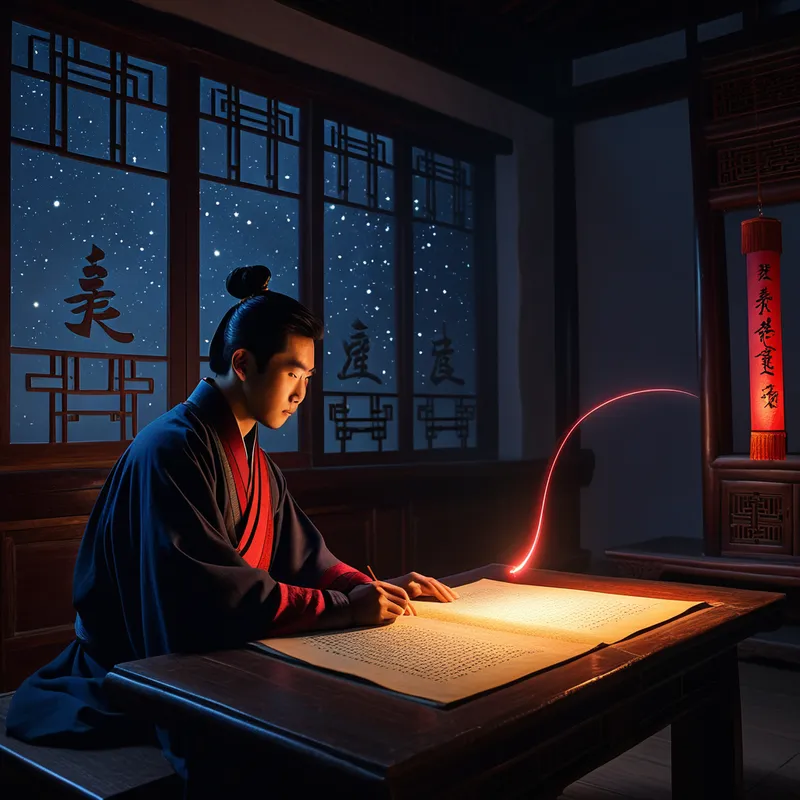
The myth of the Red String of Fate finds its roots in Tang Dynasty folklore, crystallizing around the figure of Yue Xia Lao. He is not a major celestial emperor but a specialized, deeply personal deity. His domain is the intimate, human-scale drama of love and partnership. The story was not confined to temple scriptures but lived in the oral tradition—told by grandmothers to granddaughters, by storytellers in tea houses, and whispered as comfort to hearts aching with loneliness.
Its societal function was multifaceted. In a culture where marriages were often arranged for social, economic, or political alliance, the myth served as a profound psychological and spiritual counter-narrative. It asserted that beyond the pragmatic contract, there existed a sacred, pre-ordained connection. It offered solace, suggesting that one’s current loneliness or unhappy union was not the final word, but merely a tangle in the thread that would one day be straightened. It transformed the anxiety of finding a partner into a trust in a cosmic process, placing the agency in the hands of a benevolent, if inscrutable, lunar matchmaker. The myth provided a framework for understanding “fated” encounters and the uncanny sense of recognition that can accompany meeting one’s spouse.
Symbolic Architecture
The Red String is one of humanity’s most elegant symbols for the invisible architecture of relationship. It represents the synchronicitic principle made tangible—the hidden order within apparent chaos.
The thread is not a chain, but a covenant written in the language of the soul. It signifies that our deepest connections are not accidents, but recognitions.
The ankle as the binding point is significant. It is not the heart (too volatile) nor the wrist (too conscious). The ankle is foundational; it is what connects us to the earth, what allows us to walk our path. The binding happens at the level of our journey, our dao. Yue Xia Lao himself symbolizes the transcendent function of the psyche—the inner archetype that works beyond ego-consciousness to orchestrate wholeness. He is the personification of the Self, that central organizing principle which knows the totality of our being and guides us toward the connections necessary for our completion. The thread’s invisibility speaks to the unconscious nature of this guiding force; we feel its pull long before we understand its source.
The Dreamer’s Resonance
When this myth surfaces in modern dreams, it often signals a profound somatic and psychological process related to coniunctio—the deep yearning for, or movement toward, psychic union. One might dream of finding a red thread tied to their finger, of following a glowing filament through a dark forest, or of struggling to untangle a knotted mess of crimson yarn.
Such dreams frequently arise during periods of existential loneliness, after the end of a significant relationship, or on the cusp of meeting a transformative partner. The somatic process is one of attunement. The dream-ego is becoming aware of the latent connections that bind it to the world, of the invisible ties that pull at the foundations of the self. A dream of a taut, vibrating thread may indicate a destiny felt as an imminent, compelling call. A dream of a tangled, frayed thread may reflect anxiety about lost chances, misalignment, or the complex web of past relational trauma that must be understood before one can find the true strand. The psyche is using the ancient symbol to map the modern individual’s navigation of intimacy, destiny, and the search for the “other” who is, paradoxically, part of one’s own wholeness.

Alchemical Translation
The myth models the alchemical process of psychic transmutation, where the base metal of isolated ego-consciousness is turned into the gold of the integrated Self through relationship. The journey is not one of a hero slaying a dragon, but of a soul learning to feel the pull.
The initial state is one of separation and ignorance. We are born tied, yet unaware. The first stage of the work (nigredo) is the longing, the loneliness, the sense that something essential is missing. This is the thread lying slack but felt as a haunting absence. The subsequent life journey—with its trials, wrong turns, and failed connections—is the mortificatio, the burning away of illusions about what love and partnership are, the untangling of psychic knots formed by parental complexes and cultural expectations.
The ultimate goal is not merely to find the other, but to consciously embody the connection—to become, together, the living manifestation of the thread itself.
When one finally begins to align with their own true nature (individuation), they vibrate at a frequency that resonates with the other end of their thread. The meeting, when it comes, is the coniunctio, the sacred marriage. But the alchemy does not end there. The true transmutation is in the conscious living of that bond. It is the realization that the thread is not just between two people, but is the central, connecting filament of one’s own destiny. To honor the bond is to honor the path it has laid out, transforming a fated attachment into a chosen, sacred union. In this light, Yue Xia Lao is the inner alchemist, and the Book of Marriages is the unique, unwritten formula of our own complete Self.
Associated Symbols
Explore related symbols from the CaleaDream lexicon: