Raven Creates the World Myth Meaning & Symbolism
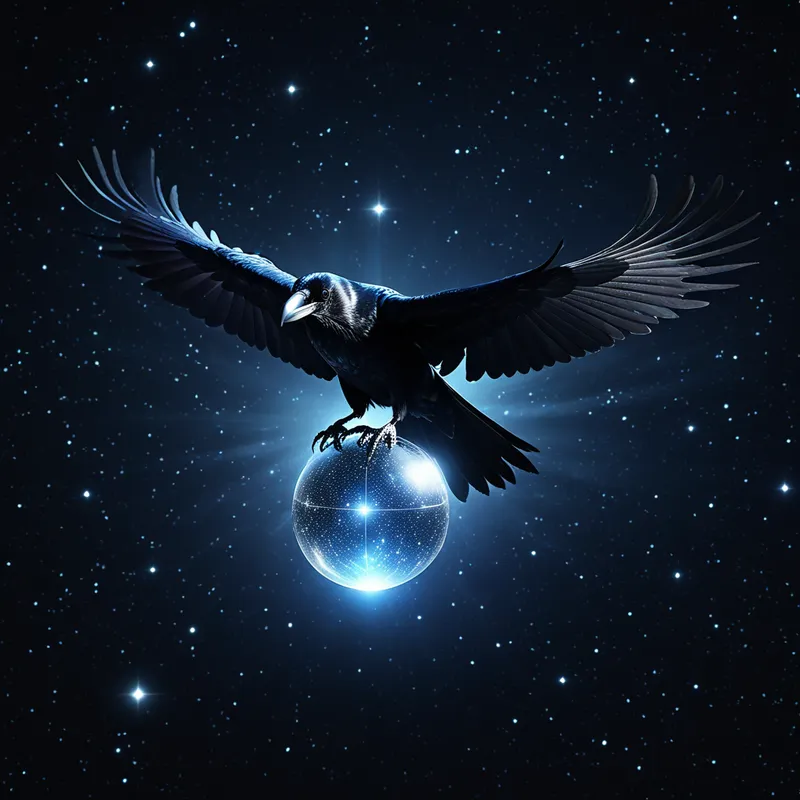
In primordial darkness, a cunning Raven steals the sun, moon, and stars, scattering them to create the world and awaken consciousness from the void.
The Tale of Raven Creates the World
In the beginning, there was no beginning. There was only the Darkness, a deep and silent ocean of nothing, and a single, great house floating upon it. Inside that house lived a being of immense power, the Man, and his daughter. He kept the sources of all light locked away in a set of nested boxes, hoarding the sun, the moon, and the stars for himself, leaving the world outside in perpetual, formless night.
Into this stillness came a thought. It was not yet a sound, but a stirring. From the nothing, a speck of consciousness took form: Raven. He was born of the dark itself, a creature of pure potential and cunning hunger. He saw the house, sensed the light within, and desired it not to possess, but to unfold. Raven transformed himself. He became a speck of dust, a mote floating on a breath of wind, and he slipped through a crack in the wall of the house.
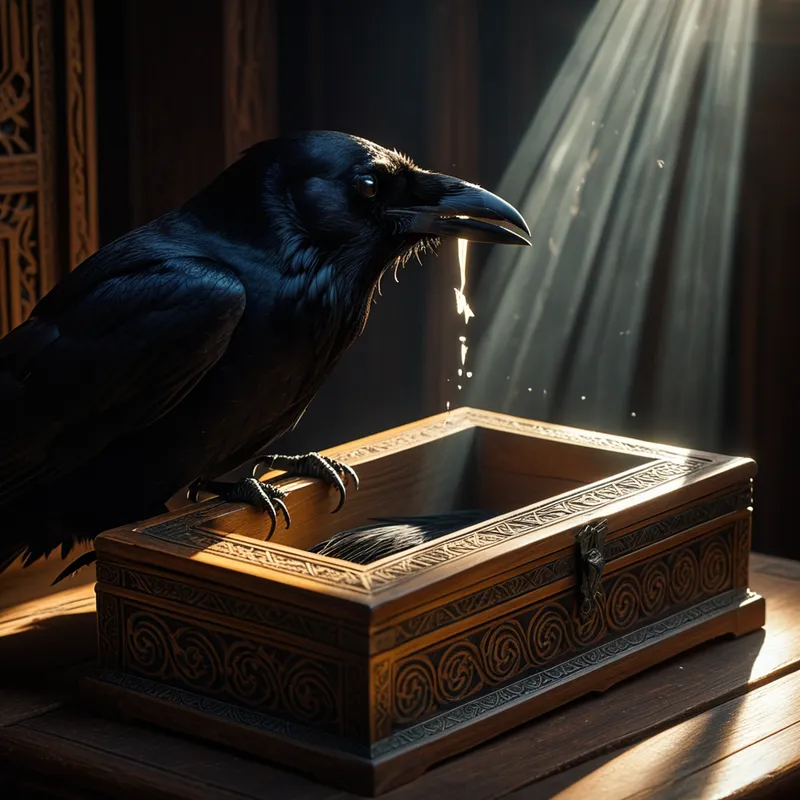
Inside, he found the daughter. With a trickster’s patience, he let himself be swallowed by her drinking water. He grew within her, a strange and clever seed, and was born again as a human child—a dark, curious boy who brought a strange energy to the silent home. The Man doted on this strange grandson, and the boy cried and fretted for the shiny boxes that held the light. To soothe his cries, the Man gave him one box to play with. Then another. And another.
The child-Raven played, shaking the boxes, listening to the light rattle inside. His cries turned to whines, his whines to demands. Finally, worn down by love or annoyance, the old Man relented. He opened the largest box. Inside was the sun, a ball of searing, glorious fire. In that instant, Raven shed his human form. With a triumphant cry, he seized the blazing sphere in his black beak. He burst through the roof of the house, shattering the eternal night.
He flew, not to hide the light, but to scatter it. He flung the sun into the sky, where it began its first journey from east to west. He returned, stole the moon and set it on its slower, cooler path. He took the stars and cast them like glittering sand across the vault of heaven. With light now painting the world, Raven saw the vast, dark ocean below. He flew low, his wings beating the waters, calling forth the first lands—rocky shores, towering mountains, rolling tundra. He pecked at the emerging earth, forming valleys and rivers. He called animals from the mud and stones. Where his shadow fell, life stirred. He did not create from nothing; he revealed what the darkness had always contained, waiting for the light of consciousness to see it.
Cultural Origins & Context
This myth, in its many regional variations, is central to the Inuit cultures across the Arctic, from Alaska to Greenland. It was not written but breathed, passed down through generations by elders and storytellers during the long winter nights, a vital thread in the oral tapestry that taught cosmology, ethics, and survival. The storyteller’s voice, the crackle of the seal-oil lamp, and the howl of the wind outside were all part of its transmission. Its function was profound: it explained the origins of the stark, beautiful, and demanding world the Inuit lived within. More than an explanation, it established a relationship with that world. It presented a universe not made by a distant, perfect god, but by a clever, imperfect, and engaged being—a Trickster who operated through wit and desire, mirroring the human necessity for ingenuity and adaptability in the Arctic.
Symbolic Architecture
The myth presents a creation not of divine fiat, but of cunning emergence. Raven is the archetypal Trickster, the agent of necessary chaos who punctures the stasis of the hoarded, potential-filled void. He is not “good” or “evil”; he is the catalyst. The primordial Darkness and ocean represent the unconscious, the unmanifest potential of the psyche. The Man in his house is the egoic consciousness that seeks to control and contain this potential, keeping the luminous contents of the unconscious locked away for itself.
Creation is not a gentle act of will, but a daring act of theft from the complacent self.
Raven’s method is alchemical: he enters the system (the house/ego) from within, via transformation (the dust, the birth). He uses relationship (as the beloved grandson) to achieve his end. The light he steals is consciousness itself—the illuminating power of awareness that allows the hidden contents of the psyche (the world) to be seen, differentiated, and lived in. He does not keep it; he liberates and scatters it, initiating the cyclical processes of time (sun and moon) and the unique patterning of an individual’s soul (the stars).
The Dreamer’s Resonance
When this myth stirs in modern dreams, it often signals a profound psychic upheaval where something long-held in darkness is demanding release. Dreaming of a Raven pecking insistently at a closed container, or of finding a sealed box that radiates warmth, speaks to this process. Somatic sensations might include a tightness in the chest (the hoarded light) or a sudden, inexplicable energy (the moment of theft and flight). Psychologically, this is the Self pushing against the ego’s rigid control. The dreamer may be hoarding a talent, repressing a memory, or living in a psychological “eternal night” of depression or stagnation. The Raven-dream is the psyche’s cunning plot to break open the nested boxes of defense and release the vital, luminous energy within, even if it initially feels like a violation or a chaotic disruption.
Alchemical Translation
The myth perfectly models the individuation process—the psychic transmutation of unconscious potential into conscious life. We all begin in a kind of internal Darkness, with our deepest potentials and gifts locked away, often by a parental or internalized voice (the Man) that says “this is not safe, keep it hidden.” The first step is the arrival of the Trickster spirit—a disruptive thought, a crisis, a rebellious impulse that refuses the status quo.
The journey to wholeness requires the courage to steal fire from the gods of our own limitations.
This trickster energy must be clever; it cannot attack directly but must transform and work from within (changing one’s habits, perspective, or self-narrative). The “theft” is the courageous act of claiming one’s own light—owning one’s creativity, anger, love, or power despite internalized prohibitions. The final, crucial stage is Raven’s flight: not hoarding the light as a personal trophy, but scattering it, integrating it into the fabric of one’s world. This is the translation of insight into action, of woundedness into art, of personal truth into a life lived authentically in relationship with the world. The world created is the individual’s own authentic life, shaped from the raw material of the soul by the light of hard-won consciousness.
Associated Symbols
Explore related symbols from the CaleaDream lexicon:
- Raven — The cosmic Trickster and catalyst, representing the cunning, transformative intelligence that mediates between darkness and light, potential and form.
- Darkness — The primordial, undifferentiated state of unconscious potential from which all forms of consciousness and life ultimately emerge.
- Light — The stolen sun, moon, and stars, symbolizing awakened consciousness, differentiated awareness, and the cyclical patterns of time and psyche.
- Water — The formless, dark ocean of the beginning, representing the unconscious, the source of all life and possibility, waiting to be shaped.
- Trickster — The archetypal principle embodied by Raven, denoting the necessary disruptive force that breaks stasis and initiates change through cleverness and rule-breaking.
- Chaos — The fertile, disruptive state Raven introduces, which is not mere disorder but the vital precursor to a new and more complex order.
- Creation — The act of revealing and shaping the latent world, modeled not as a command but as an act of liberation and cunning engagement.
- Journey — Raven’s flight across the void, representing the soul’s necessary movement away from containment and into the expansive, often terrifying, process of becoming.
- Sky — The vast canvas created by Raven’s scattering of the celestial bodies, symbolizing the realm of spirit, thought, and infinite possibility.
- Earth — The land called forth from the waters by Raven’s flight, representing the manifested world, the grounded reality shaped by conscious action.
- Shadow — Raven himself, as a black bird, embodies the creative potential of the psychological shadow—the rejected, dark, or clever parts that hold the key to transformation.
- Rebirth — Raven’s transformation from dust to child, symbolizing the death of an old state of being and the birth of a new form capable of achieving a great purpose.