Ratha Myth Meaning & Symbolism
The Ratha, a celestial chariot, embodies the soul's journey through cosmic order, divine will, and the ultimate union of consciousness with its source.
The Tale of Ratha
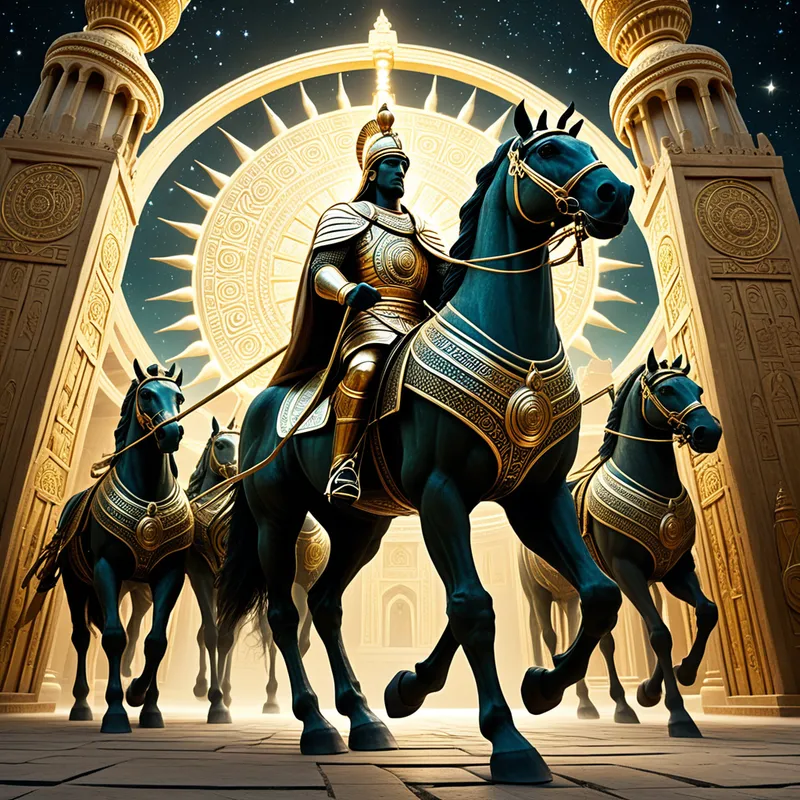
Listen. Before time was measured in breaths, when the cosmos was a great, humming loom, the gods fashioned a vehicle of destiny. It was not born of earth or fire alone, but from the very breath of Brahma and the resolve of [Vishnu](/myths/vishnu “Myth from Hindu culture.”/). They called it the Ratha.
Picture it: a vessel of gleaming Hiranya, its spokes like captured sunbeams, its axle the unbreakable axis of [the world](/myths/the-world “Myth from Tarot culture.”/). To pull this celestial wonder, they yoked not ordinary beasts, but the Seven Horses—each a torrent of raw, elemental power, their manes streaming with the colors of dawn and storm. Their hooves did not strike earth, but the fabric of space itself, ringing with the sound of constellations being born.
And who would dare to hold the reins of such a force? Only one whose will was diamond, whose sight pierced illusion. Often, it was the great Arjuna, standing in [the chariot](/myths/the-chariot “Myth from Tarot culture.”/)‘s heart as the dust of Kurukshetra rose around him. But the true charioteer was [Krishna](/myths/krishna “Myth from Hindu culture.”/). His hands, calm upon the reins, were the only anchor against the hurricane of the horses’ might and the tsunami of approaching armies.
The conflict was not merely of clashing armies; it was the war within the soul. Arjuna’s bow, [Gandiva](/myths/gandiva “Myth from Hindu culture.”/), felt heavy as a mountain. Doubt, thick and cloying as monsoon fog, filled the chariot. The horses stamped, sensing the paralysis of their rider. The great Ratha, built for victorious motion, stood still at the precipice of destiny.
Then, the charioteer spoke. His voice was not a shout over the war-drums, but a discourse that unfolded in the silent space between heartbeats—the Bhagavad Gita. As the words flowed—of duty, of the eternal soul, of surrender to the divine will—a transformation occurred. The Ratha was no longer just a vehicle of war. It became the Sharira-Ratha, the body-chariot. The senses were the horses, wild and untamed. The intellect was the reins. And the soul within was the passenger, guided by the divine charioteer of consciousness itself.
With understanding dawning like a new sun, Arjuna’s doubt fell away. He took up his bow. Krishna, the perfect charioteer, urged the horses forward. The Ratha surged into the fray, not as an instrument of blind destruction, but as a focal point of cosmic order, Dharma, reasserting itself through aligned action. Its journey across the battlefield was a sacred geometry, tracing the path of a soul moving from confusion to clarity, from inaction to righteous action, guided by the supreme wisdom within.
Cultural Origins & Context
The symbol of the Ratha is woven deep into the fabric of Hindu thought, appearing across millennia in Vedic hymns, epic narratives like the Mahabharata and Ramayana, and in profound philosophical texts. Its most iconic and elaborated narrative setting is [the Bhagavad Gita](/myths/the-bhagavad-gita “Myth from Hindu culture.”/), set in the Mahabharata.
This was not a myth confined to temple walls; it was a living doctrine transmitted through the oral tradition of storytellers and gurus. A traveling Kathakar would not merely describe the chariot; he would become the chariot, his voice the thunder of its wheels, his gestures mapping the struggle between duty and despair. The myth served a critical societal function: it was a master metaphor for self-governance. In a culture deeply structured by Svadharma, the Ratha provided a vivid, memorable model for how an individual—a king, a warrior, a householder—should conduct themselves: mastering their inner faculties (the horses) through discernment (the reins) to fulfill their cosmic role, guided by a higher principle.
Furthermore, this metaphor materialized spectacularly in culture through the Ratha Yatra festival. Here, the myth steps off the page and into the streets, as immense, towering chariots carry deity icons, pulled by thousands of devotees. This is the myth in collective motion—the entire community becoming [the force](/myths/the-force “Myth from Science Fiction culture.”/) that moves the divine vehicle on its journey, blurring the line between the individual soul-chariot and the body of the community.
Symbolic Architecture
The Ratha is a perfect symbolic engine, each component a key to understanding the [human](/symbols/human “Symbol: The symbol of a human represents individuality, complexity of emotions, and social relationships.”/) [condition](/symbols/condition “Symbol: Condition reflects the state of being, often focusing on physical, emotional, or situational aspects of life.”/).
The body is a chariot, the soul is the rider, the senses are the horses, and the mind is the reins. He who lacks understanding, whose mind is unrestrained, has senses that are uncontrollable, like wild horses for a charioteer.
This ancient [verse](/symbols/verse “Symbol: A structured poetic line or stanza, often representing rhythm, order, and creative expression in dreams.”/) from the Katha Upanishad lays bare the myth’s core [architecture](/symbols/architecture “Symbol: Architecture in dreams often signifies structure, stability, and the framing of personal identity or life’s journey.”/). The [Chariot](/symbols/chariot “Symbol: The chariot signifies control, direction, and power in one’s journey through life.”/) itself is the Sthula Sharira, the temporary [vehicle](/symbols/vehicle “Symbol: Vehicles in dreams often symbolize the direction in life and the control one has over their journey, reflecting personal agency and decision-making.”/) for the eternal [passenger](/symbols/passenger “Symbol: A passenger often represents dependence or a feeling of being guided by others in life’s journey.”/), the Atman. It is well-crafted but perishable.
The Seven Horses represent the five senses, plus the mind and intellect—the entire apparatus of [perception](/symbols/perception “Symbol: The process of becoming aware of something through the senses. In dreams, it often represents how one interprets reality or internal states.”/) and cognition. They are powerful, beautiful, but inherently restless and directionless. Left unmastered, they will drag the chariot into [chaos](/symbols/chaos “Symbol: In Arts & Music, chaos represents raw creative potential, uncontrolled expression, and the breakdown of order to forge new artistic forms.”/).
The Reins symbolize the disciplined intellect, Buddhi. This is not suppression, but conscious, focused [direction](/symbols/direction “Symbol: Direction in dreams often relates to life choices, guidance, and the path one is following, emphasizing the importance of navigation in personal journeys.”/). It is the [application](/symbols/application “Symbol: An application symbolizes engagement, integration of knowledge, or the pursuit of goals, often representing self-improvement and personal development.”/) of will and wisdom to guide raw [energy](/symbols/energy “Symbol: Energy symbolizes vitality, motivation, and the drive that fuels actions and ambitions.”/) toward a chosen [destination](/symbols/destination “Symbol: Signifies goals, aspirations, and the journey one is on in life.”/).
Finally, the Charioteer is the ultimate master. In the Gita, it is Krishna, representing the supreme [consciousness](/symbols/consciousness “Symbol: Consciousness represents the state of awareness and perception, encompassing thoughts, feelings, and experiences.”/), Paramatman, or the integrated, enlightened [aspect](/symbols/aspect “Symbol: A distinct feature, quality, or perspective of something, often representing a partial view of a larger whole.”/) of [the self](/myths/the-self “Myth from Jungian culture.”/). The charioteer does not fight the horses; he understands their [nature](/symbols/nature “Symbol: Nature symbolizes growth, connectivity, and the primal forces of existence.”/) and channels it. The entire [system](/symbols/system “Symbol: A system represents structure, organization, and interrelated components functioning together, often reflecting personal or social order.”/) is a map of psychodynamics: the struggle between id-like sensory impulses, egoic control, and the guiding wisdom of [the Self](/myths/the-self “Myth from Jungian culture.”/).
The Dreamer’s Resonance
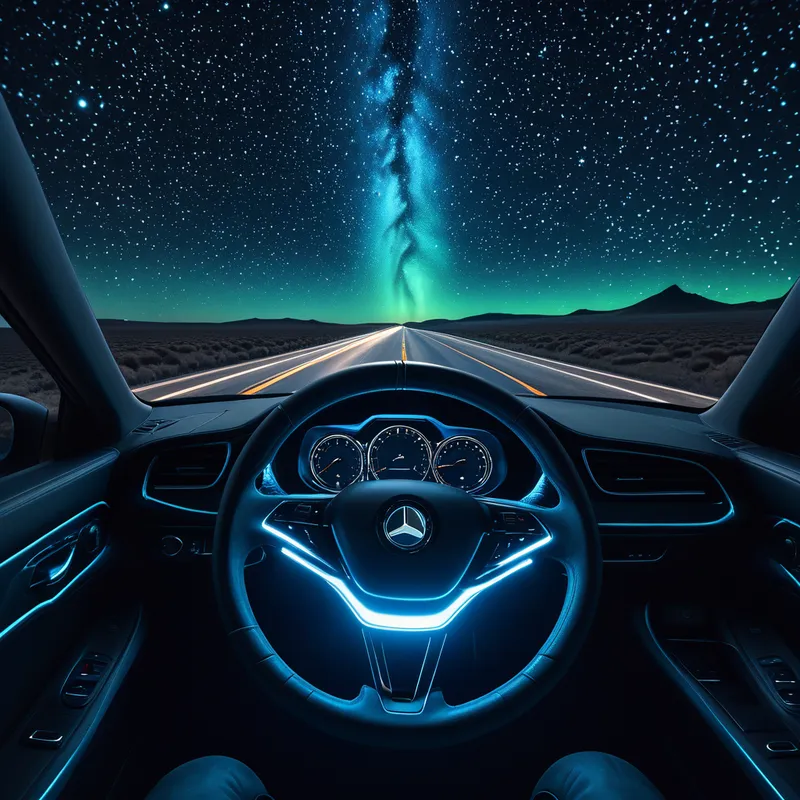
When the Ratha appears in modern dreams, it rarely comes as a literal golden chariot. Its form is translated by the unconscious into contemporary symbols of journey, control, and propulsion.
You may dream of driving a car with faulty brakes down a mountain road—the terror of the runaway senses, the intellect (the braking system) failing. You might dream of a bicycle with a wildly spinning wheel detached from the frame—the feeling of immense energy (the horses) utterly disconnected from the structure of the self (the chariot), leading to exhausting, futile motion. Alternatively, you could dream of being a passenger in a vehicle driven by a eerily calm, knowing figure through a storm—the somatic relief of surrendering a desperate, egoic need for control to a deeper, guiding intelligence.
These dreams signal a critical psychological process: the recalibration of the relationship between impulse, control, and direction. The body (the chariot) may feel out of alignment, carrying the dreamer toward destinations they do not consciously choose. The dream is a somatic snapshot of this dysregulation and, in its more resolved forms, a rehearsal for the reintegration where the passenger (the self) reclaims its rightful relationship with the driver (consciousness) and the vehicle’s power.
Alchemical Translation
The myth of the Ratha models the alchemical opus of individuation—the process of forging a coherent, conscious Self from the fragmented elements of the [psyche](/myths/psyche “Myth from Greek culture.”/).
The initial state is [Nigredo](/myths/nigredo “Myth from Alchemical culture.”/), the blackening: Arjuna’s despair on the battlefield, the paralysis of conflicting duties and desires. The chariot is stalled. The horses chafe. This is the necessary, dark night of the soul where old identities collapse.
The discourse of the Gita initiates the Albedo, the whitening: the illuminating insight that separates the eternal passenger (Self) from the temporary vehicle (ego, body, roles). “You are not the chariot,” the wisdom whispers. This is the dawn of discernment.
The alchemical gold is not found in controlling the wildness, but in realizing you are the space in which the wildness and the stillness coexist. The charioteer does not conquer the horses; he marries their power to the chariot’s purpose.
The ensuing righteous action is Citrinitas, the yellowing: the application of this insight. The disciplined intellect (reins) now guides the vital energies (horses) with purpose. The chariot moves, not randomly, but along the dharmic path. Energy is no longer wasted in internal conflict but is focused and expressed.
Finally, the battle’s end—not as mere victory, but as realized understanding—is [Rubedo](/myths/rubedo “Myth from Alchemical culture.”/), the reddening: the culmination. The soul, having fully inhabited its journey, achieves union. The distinction between passenger, charioteer, and chariot softens. One moves through the world as an integrated being—a embodied soul, a conscious vehicle. The journey of the Ratha becomes the journey of the Self, traveling through the world of manifestation while forever anchored to, and guided by, its divine source. The vehicle and the destination become one.
Associated Symbols
Explore related symbols from the CaleaDream lexicon: