Rasa Myth Meaning & Symbolism
The myth of Krishna's celestial dance with the Gopis, a story of divine love, cosmic play, and the soul's ecstatic yearning for ultimate union.
The Tale of Rasa
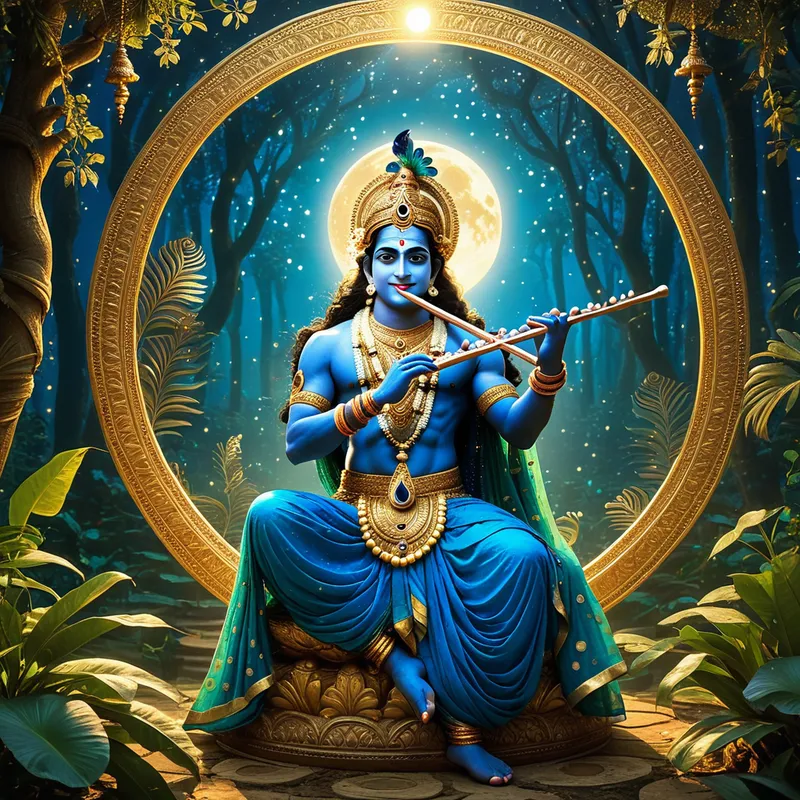
Listen. The night is not empty. It is full of a sound that is not a sound, a call that pulls not at the ear, but at the very marrow of the soul. It is the autumn moon, swollen and ripe, hanging over the forests of Vrindavan. The air is thick with the scent of jasmine and damp earth, and the river Yamuna flows like a ribbon of silvered obsidian.
And then, it begins. A melody. It seeps from the bamboo, from the roots of the ancient trees, from the heart of the moon itself. It is the song of the flute of Krishna. It is a call that cannot be ignored. In the villages, the women—the Gopis—stir from their sleep. They are wives, mothers, daughters, bound by duty and hearth. But this melody speaks to a deeper duty, an older love. It whispers of a union that precedes all names and forms. One by one, they rise. They abandon their sleeping husbands, their crying children, their half-spun yarn. They run into the dark forest, their anklets chiming a frantic counterpoint to the flute’s serene pull, their silks catching on thorns, their hearts a wild drum in their chests.
They find him in a moon-drenched clearing. He stands there, dark as a monsoon cloud, adorned with peacock feathers and a smile that holds the secret of creation. He is one, yet for each Gopi who arrives, breathless and yearning, he multiplies himself. A Krishna for each soul. He takes them by the hand, and the Rasa Lila, the dance of divine essence, begins.
They form a great, circling mandala under the stars. Krishna and Radha are at the center, the axis of this whirling universe. The Gopis circle them, a galaxy of devotion. They dance not with their feet, but with their entire beings. The boundary between dancer and dance dissolves. The sound of the flute becomes the rhythm of their breathing, the beating of their hearts. The moonlight becomes the sweat on their skin. In this ecstatic circle, time stops. There is no past, no future, only the eternal present of union.
But the play of the divine is one of presence and absence, fulfillment and longing. To taste the nectar of union, one must also know the agony of separation. Krishna vanishes. In an instant, the music stops. The circle is broken. The Gopis are alone in the sudden, crushing silence of the forest. They wander, bereft, calling his name into the indifferent trees. They weep, they search, they enact his memory in their despair, finding his footprints, then losing them. This viraha, this passionate separation, becomes a new, deeper form of worship—a love that burns even in absence.
And when the longing reaches its peak, when their souls are purified in the fire of seeking, he reappears. Not as a reward, but as the natural flowering of that very longing. The dance resumes, more profound than before. The night, the forest, the Gopis, and Krishna are not separate entities. They are one pulsating organism of bliss, a single, breathing testament to the truth that the lover and the beloved are, in the deepest reality, one.
Cultural Origins & Context
The myth of the Rasa Lila is enshrined primarily in the Bhagavata Purana, a foundational text of the Vaishnava devotional tradition that blossomed in the early centuries of the Common Era. It was not merely a story to be read, but a sacred drama to be performed, a theology to be felt. The Goswamis of Vrindavan and later saints like Chaitanya Mahaprabhu saw in the Rasa the ultimate blueprint of the soul’s relationship with the divine.
Its societal function was revolutionary. In a culture bound by strict varna and gender roles, the Rasa Lila presented a path where the only qualification was intense, self-surrendering love (bhakti). The Gopis were simple cowherd women, not priests or scholars. Their ecstatic, all-consuming love for Krishna became the model for the devotee, democratizing access to the divine. The myth was passed down through song, dance, poetry, and elaborate ritual re-enactments, particularly in regions like Braj, ensuring it lived not in books, but in the collective heartbeat of the culture.
Symbolic Architecture
The Rasa is not a historical event but a perennial drama of consciousness. Krishna represents the ultimate reality, the Brahman, the divine source that is both transcendent and immanently personal. His flute is the call of this reality to the individual soul (jivatma), symbolized by the Gopis. It is the irresistible pull of the absolute, the sound that awakens us from the slumber of mundane life.
The forest of Vrindavan is the psyche itself—dense, mysterious, and teeming with both beauty and shadow. To enter it is to embark on the inner journey.
The Gopis’ abandonment of their domestic duties signifies the necessary renunciation of egoic attachments and social personas to answer the soul’s deepest call. The circular dance, the Rasa Mandala, is a symbol of the cosmos in harmonious, joyful motion around its divine center. It represents the ideal state of existence, where all individual souls are in perfect, ecstatic relationship with the source, each playing their unique part in the divine play (lila).
Most crucially, the cycle of union and separation (viraha) embodies the core dynamic of spiritual life. Union represents the peak experience of enlightenment or grace. Separation is not punishment, but the state of yearning that deepens the soul, purifies desire, and makes the eventual reunion not a possession, but a recognition of a truth that was always there.
The Dreamer's Resonance
When this myth stirs in the modern dreamer, it often manifests as a profound somatic and emotional longing. One might dream of hearing a beautiful, haunting melody with no discernible source, or of searching desperately through a labyrinthine, nocturnal landscape for a lost beloved or a vital, missing part of oneself. The dreamer may find themselves in a round dance where faces blur and identities merge, or experience the sudden, heartbreaking disappearance of a central, luminous figure.
Psychologically, this is the process of the soul awakening to its own divine core. The “abandoned home” in the dream represents the outgrown structures of the ego and persona. The frantic search through the forest is the often-confusing, shadow-filled work of depth psychology—sifting through complexes and unconscious material. The intense longing (viraha) felt in the dream is the ache of the Self for conscious integration. It is the psyche’s way of signaling that a deeper, more authentic union—with the inner divine, with the anima/animus, with life itself—is both necessary and imminent.
Alchemical Translation
The Rasa Lila is a master blueprint for psychic transmutation, a map of the individuation process. The first alchemical stage, the Nigredo, is the Gopis’ initial awakening and their chaotic, painful flight into the dark forest—the confrontation with the shadow and the dissolution of the old, rigid personality.
The multiplication of Krishna is the alchemical Multiplicatio: the realization that the divine center is not a singular, external object to be possessed, but a reality that can relate to every facet of the complex self.
The circular dance itself is the Albedo and Citrinitas—the purification and illumination. In the dance, all opposites (male/female, human/divine, joy/sorrow) are held in a dynamic, harmonious balance. The ego, represented by the individual Gopi, does not vanish; it finds its true purpose and ecstasy by orbiting the Self.
Krishna’s disappearance initiates the crucial stage of Mortificatio—the death of the illusion that enlightenment is a permanent, static state of possession. The soul must learn to love the divine essence in its very absence, to find the sacred in the seeking itself. This purifies desire into devotion.
The final return is not a repetition, but the Rubedo, the reddening, the achievement of the philosopher’s stone. It is the embodied realization of non-duality. The modern individual undergoing this alchemy learns that wholeness is not a static condition of “having it all,” but a dynamic, playful, and sometimes painful dance. It is the understanding that our deepest longing is not a flaw, but the engine of our evolution, and that the beloved we seek externally is, in truth, the very consciousness with which we seek. We are, each of us, both the dancer and the dance, the flute and the song, eternally circling the divine center that we also are.
Associated Symbols
Explore related symbols from the CaleaDream lexicon: