Ra's Solar Barque Myth Meaning & Symbolism
The sun god Ra journeys through day and night on his barque, battling the serpent Apophis to ensure the world's rebirth each dawn.
The Tale of Ra’s Solar Barque
Listen, and hear the story written in light and shadow, the oldest rhythm of [the world](/myths/the-world “Myth from Tarot culture.”/).
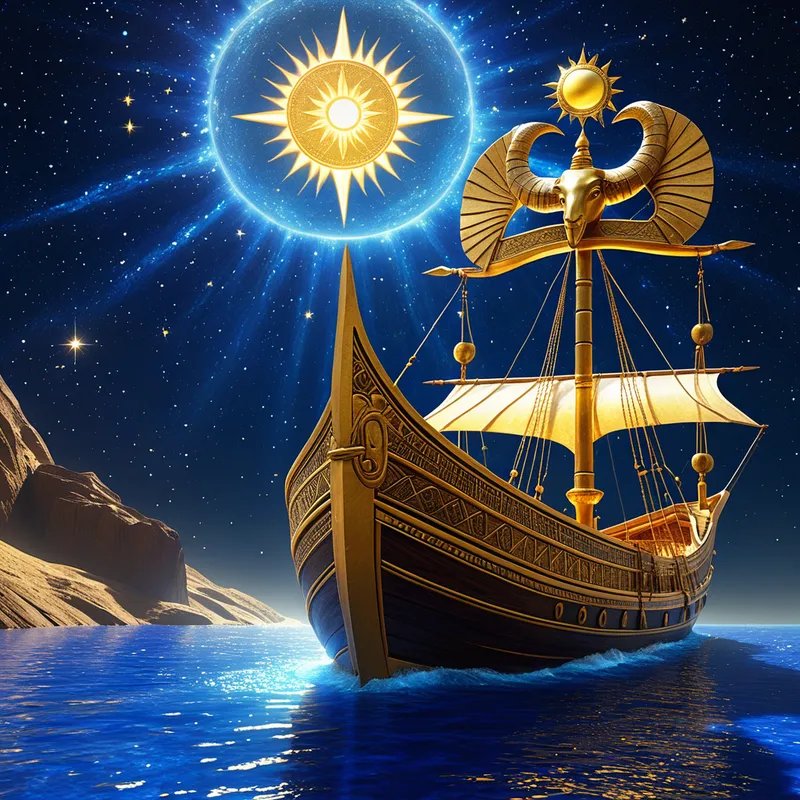
Before the first dawn, the great god Ra stirs within the primordial waters of Nun. From his own essence, he fashions a vessel of imperishable spirit and celestial fire—the Mandjet, the Day Barque. He steps aboard, and with him comes a crew of gods: [Thoth](/myths/thoth “Myth from Global/Universal culture.”/), the scribe who charts their course; Maat, whose feather-light presence keeps the boat true; and the fierce warrior Set, who stands at the prow, spear ready.
The barque lifts. It does not sail on [water](/myths/water “Myth from Chinese culture.”/), but on the bright river of [the sky](/myths/the-sky “Myth from Persian culture.”/). Ra, now manifest as the blazing sun disk, fills the heavens. His light is not merely illumination; it is the very breath of life, causing [the lotus](/myths/the-lotus “Myth from Hindu culture.”/) to bloom, the grain to rise, and the hearts of men to beat in time. For twelve hours, the Mandjet journeys from the eastern horizon to the western peak, a triumphant procession witnessed by all creation.
But as the barque dips below the western mountains, the air chills. The colors of the world bleed into indigo and black. The Day Barque transforms, its golden timbers taking on the sheen of polished obsidian. It is now the Mesektet, the Night Barque. The crew’s faces grow solemn. They have entered Duat.
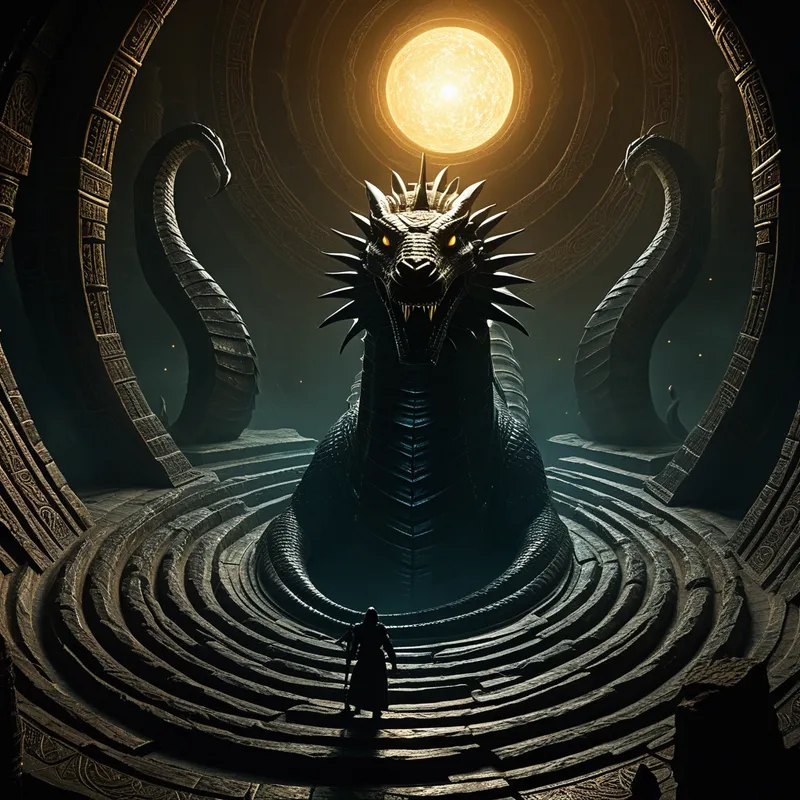
Here, [the river](/myths/the-river “Myth from Buddhist culture.”/) flows through caverns of silent, watching dead and past islands of fire. The only light is the dim, fearful glow of the barque itself. And from the deepest, coldest blackness, it comes. A ripple of absolute void. Then, the emergence of the Serpent Apophis. Mountainous coils of scaled nothingness block [the river](/myths/the-river “Myth from Buddhist culture.”/). A maw opens, vast enough to swallow stars, seeking to devour Ra, drink the Nile, and return all to the silent, formless Nun.
This is the moment. Set roars, driving his spear into the serpent’s hide. Thoth speaks spells of binding that crackle in the air. The other gods strain against the coils with ropes of magic. Ra himself, aged and weary from his daily labors, must summon his last reserves of heka. A battle without witness rages in the belly of the world. It is not a battle for conquest, but for continuation. Should Apophis win, the sun will not rise. Time will stop.
After hours of struggle, the serpent is repelled—wounded, hissing, sinking back into [the abyss](/myths/the-abyss “Myth from Kabbalistic culture.”/), but never destroyed. The Mesektet, battered but unbroken, sails on. As it approaches the eastern horizon, a miracle occurs. Within the barque, the aged Ra merges with the [scarab](/myths/scarab “Myth from Egyptian culture.”/) god, [Khepri](/myths/khepri “Myth from Egyptian culture.”/). The old sun dies, and the new sun is born from its own substance. The prow of the barque breaks through [the veil](/myths/the-veil “Myth from Various culture.”/) of night. The first ray of dawn touches the peak of the Benben stone. The Mandjet is golden once more. Ra, renewed, rises. The world breathes again. The cycle is complete. For now.
Cultural Origins & Context
This was not merely a story for the ancient Egyptians; it was the fundamental operating system of reality. The myth is pieced together primarily from a collection of funerary texts known as the Amduat, the Book of Gates, and the Book of the Dead, inscribed on tomb walls and papyri.
Its primary tellers were the priesthood, particularly of Heliopolis, and its audience was both the divine and the mortal. [The Pharaoh](/myths/the-pharaoh “Myth from Egyptian culture.”/) was the living embodiment of this cycle on earth, ensuring maat prevailed over chaos (isfet). For the common person, the myth provided the ultimate template for their own journey after death. The deceased hoped to join the crew of [the solar barque](/myths/the-solar-barque “Myth from Egyptian culture.”/), to be among the “blessed dead” who aided Ra against Apophis, thus securing their own eternal rebirth. The daily sunrise was a communal sigh of relief—cosmic order had been maintained for another day.
Symbolic Architecture
The myth is a dense symbolic map of the [psyche](/myths/psyche “Myth from Greek culture.”/) and the [cosmos](/symbols/cosmos “Symbol: The entire universe as an ordered, harmonious system, often representing the totality of existence, spiritual connection, and the unknown.”/), seen as one.
The [Solar Barque](/myths/solar-barque “Myth from Egyptian culture.”/) itself is the [vessel](/symbols/vessel “Symbol: A container or structure that holds, transports, or protects something essential, representing the self, emotions, or life journey.”/) of [consciousness](/symbols/consciousness “Symbol: Consciousness represents the state of awareness and perception, encompassing thoughts, feelings, and experiences.”/). It is the structured self—[the ego](/myths/the-ego “Myth from Jungian culture.”/), [personality](/symbols/personality “Symbol: Personality in dreams often symbolizes the traits and characteristics of the dreamer, reflecting how they perceive themselves and how they believe they are perceived by others.”/), and [life](/symbols/life “Symbol: The symbol of ‘Life’ represents a journey of growth, interconnectedness, and existential meaning, encompassing both the joys and challenges that define human experience.”/)-force—navigating the waters of existence. The Day [Journey](/symbols/journey “Symbol: A journey in dreams typically signifies adventure, growth, or a significant life transition.”/) represents the conscious [life](/symbols/life “Symbol: The symbol of ‘Life’ represents a journey of growth, interconnectedness, and existential meaning, encompassing both the joys and challenges that define human experience.”/): visible, active, generative, and outwardly focused. The [Night](/symbols/night “Symbol: Night often symbolizes the unconscious, mystery, and the unknown, representing the realm of dreams and intuition.”/) Journey plunges into the Duat, the [underworld](/symbols/underworld “Symbol: A symbolic journey into the unconscious, representing exploration of hidden aspects of self, transformation, or confronting repressed material.”/), which is a perfect analogue for the personal and [collective unconscious](/symbols/collective-unconscious “Symbol: The Collective Unconscious refers to the part of the unconscious mind shared among beings of the same species, embodying universal experiences and archetypes.”/). Here, [logic](/symbols/logic “Symbol: The principle of reasoning and rational thought, often representing order, structure, and intellectual clarity in dreams.”/) fails, and [the self](/myths/the-self “Myth from Jungian culture.”/) encounters its own [depths](/symbols/depths “Symbol: Represents the subconscious, hidden emotions, or foundational aspects of the self, often linked to primal fears or profound truths.”/) and its primordial fears.
Apophis is not an external [monster](/symbols/monster “Symbol: Monsters in dreams often symbolize fears, anxieties, or challenges that feel overwhelming.”/), but the embodiment of [entropy](/symbols/entropy “Symbol: In arts and music, entropy represents the inevitable decay of order into chaos, often symbolizing creative destruction, impermanence, and the natural progression toward disorder.”/), [dissolution](/symbols/dissolution “Symbol: The process of breaking down, dispersing, or losing form, often representing transformation, release, or the end of a state of being.”/), and the psyche’s own [resistance](/symbols/resistance “Symbol: An object or tool representing opposition, struggle, or the act of pushing back against external forces or internal changes.”/) to growth. It is [the force](/myths/the-force “Myth from Science Fiction culture.”/) of depression, nihilism, and the terrifying pull toward non-being. The battle is never won because this [shadow](/symbols/shadow “Symbol: The ‘shadow’ embodies the unconscious, repressed aspects of the self and often represents fears or hidden emotions.”/) is an eternal part of the whole.
The hero’s task is not to slay the dragon of chaos, but to engage it anew each night, transforming its threat into the necessary friction for rebirth.
Khepri, the [scarab](/symbols/scarab “Symbol: The scarab symbolizes transformation, protection, and the cycle of life and death, often invoking feelings of awe and respect.”/), holds the key. The scarab rolls its [ball](/symbols/ball “Symbol: The ball symbolizes playfulness, joy, and the cyclical nature of life, often representing the search for balance and wholeness.”/) of dung, from which new life emerges, symbolizing self-generation, transformation, and the [idea](/symbols/idea “Symbol: An ‘Idea’ represents a spark of creativity, innovation, or realization, often emerging as a solution to a problem or a new outlook on life.”/) that the new self is born from the decomposed matter of the old. Ra’s transformation into Khepri at [dawn](/symbols/dawn “Symbol: The first light of day, symbolizing new beginnings, hope, and the transition from darkness to illumination.”/) is the alchemical [moment](/symbols/moment “Symbol: The symbol of a ‘moment’ embodies the significance of transient experiences that encapsulate emotional depth or pivotal transformations in life.”/) where the ego, having faced the unconscious, is not just restored but renewed from within.
The Dreamer’s Resonance
When this myth stirs in the modern dreamer, it often signals a profound passage through a psychological Duat. You may not dream of Egyptian gods, but the architecture remains.
Dreaming of a boat on a dark river, especially one that feels both sacred and perilous, echoes the Mesektet. A flickering or dying light source on that boat is your conscious identity (your inner Ra) growing weak. Dreams of being stalked or encircled by a formless, massive, dark presence—a shadow in the water, a coiling blackness—are encounters with your personal Apophis: perhaps a consuming anxiety, a deep grief, or a latent depression.
Somatically, this process may feel like a “dark night of the soul”—fatigue, heaviness, a sense of being stripped bare. The psyche is in its night journey. The dream is not a warning of failure, but a map showing you are in the process. The presence of other figures (helpful or hostile) in the dream represents internal resources or complexes, your own psychic “crew” engaging the struggle.

Alchemical Translation
For the individual, the myth models the non-negotiable rhythm of individuation. We are all captains of a solar barque.
Our daytime consciousness is our public self, creating, working, relating. But to grow, we must willingly descend into our own Duat—through introspection, therapy, creative expression, or confronting life crises. This is the “night sea journey.” Here, we meet Apophis in the form of repressed memories, unlived potentials, shame, or trauma. The battle is the hard, often painful, work of facing these contents, not to annihilate them, but to prevent them from swallowing our conscious light entirely.
Individuation is the daily ritual of sailing the barque. The ego that emerges from the underworld is not the same ego that entered; it is humbled, enlarged, and tempered by the darkness it has faced.
The renewal at dawn is the insight, the new perspective, the creative solution that arises only after the struggle. It is the “aha” moment born of incubation. We integrate a piece of our shadow, and our consciousness is subtly but permanently altered—renewed like Khepri from its own substance. The myth teaches that this is not a one-time heroic feat, but a perpetual cycle. Each day’s conscious life is built upon the battles fought in the previous night’s depths. Our psychological health depends on honoring both the journey in the light and the essential, terrifying, and regenerative journey through the dark.
Associated Symbols
Explore related symbols from the CaleaDream lexicon: