Rapunzel's Tower Myth Meaning & Symbolism
A maiden, a tower, and a braid of hair. An ancient tale of stolen life, impossible ascent, and the fall that leads to freedom.
The Tale of Rapunzel’s Tower
Listen, and hear a tale not of kingdoms, but of a garden. In a time when [the world](/myths/the-world “Myth from Tarot culture.”/) was closer to the soil, there lived a man and a woman whose window looked upon a walled garden, a place of deep green and forbidden blooms. The garden belonged to a woman of power, a sorceress or a witch, whose name was known only in whispers. The woman with child looked from her window and was consumed by a craving, a longing so deep it gnawed at her soul. She desired the green, leafy rampion that grew in that garden, and she told her husband she would perish without it.
Driven by love and fear, the man scaled the wall. The leaves were cool and vital in his trembling hands. He stole them once, and then again. But on the second moonlit foray, a shadow fell upon him. The witch stood before him, not with rage, but with a cold, knowing smile. “You take what is mine,” she said, her voice like rustling thorns. “For your theft, you will give. [The child](/myths/the-child “Myth from Alchemy culture.”/) your wife carries shall be mine.”
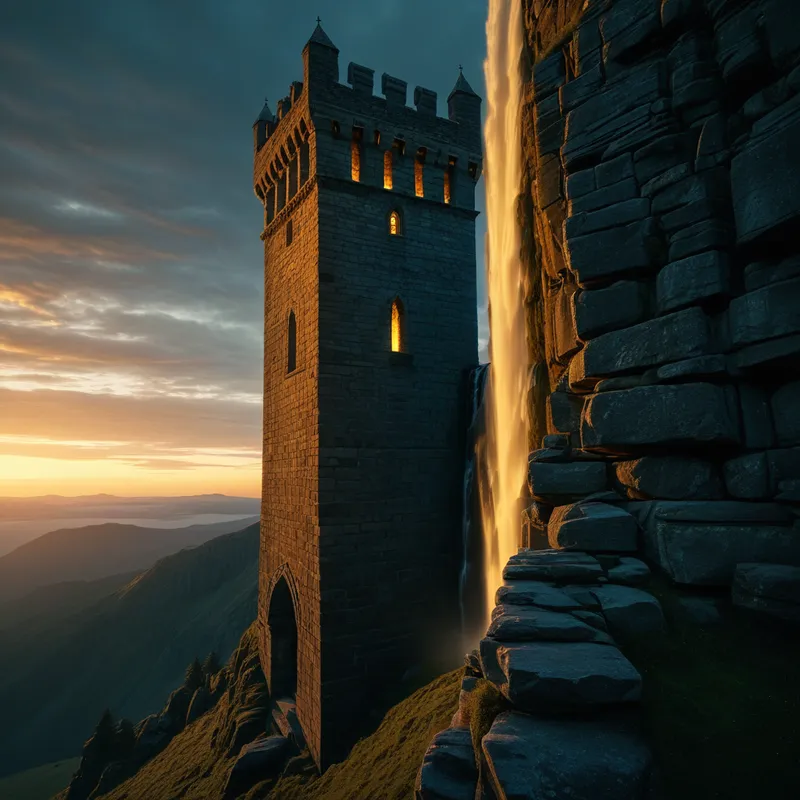
And so it was. The girl was born, and they named her [Rapunzel](/myths/rapunzel “Myth from Fairy Tale culture.”/), after the very plant that was her price. The witch took her, not to a dungeon, but to a tower. A tower with neither door nor stair, rising from the deep forest like a single, accusing finger pointed at [the sky](/myths/the-sky “Myth from Persian culture.”/). Its only feature was a single, high window.
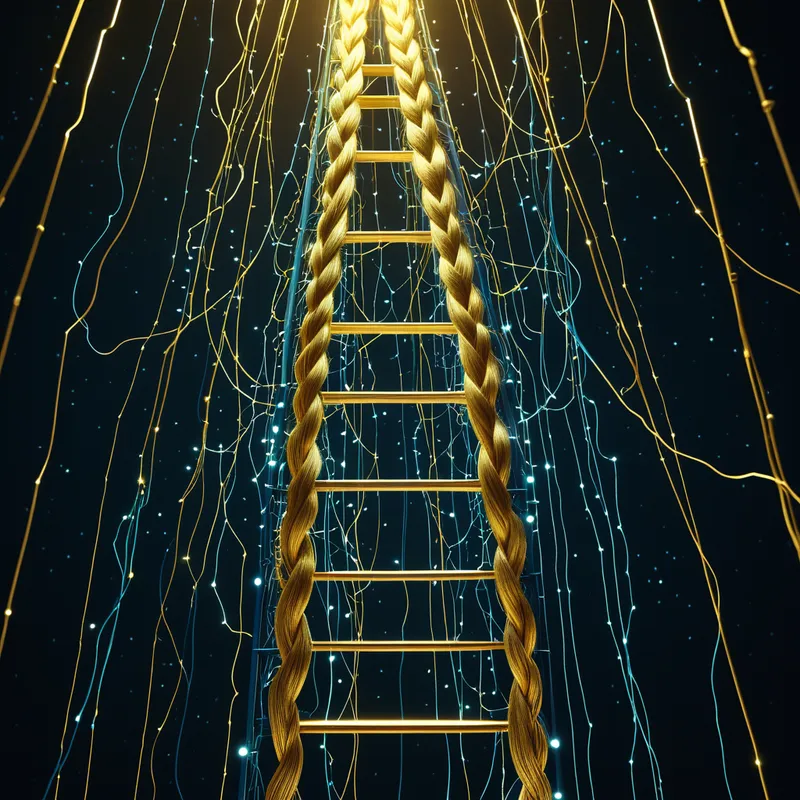
There, Rapunzel grew. Her world was the round room, the view of sky and treetops, and the voice of the witch who came to visit. “Rapunzel, Rapunzel, let down your hair,” the witch would call. And Rapunzel, whose hair had grown long and wondrous, the color of spun sunlight, would braid it, fasten it to a hook, and let the golden ladder fall. The witch would climb, and [the tower](/myths/the-tower “Myth from Tarot culture.”/) remained sealed.
Years flowed like a silent river. Rapunzel sang to pass the time, her voice a pure, lonely [thing](/myths/thing “Myth from Norse culture.”/) that drifted over the forest. And it was this voice that caught the ear of a prince, riding lost and searching for he knew not what. He followed the siren song to the foot of the impossible tower and witnessed the witch’s ritual. He waited, his heart a trapped bird.
When the witch left, he stepped into the clearing. “Rapunzel, Rapunzel, let down your hair.” The braid tumbled down. He climbed, hand over hand, the strands both strong and fragile. When he pulled himself into the room and she turned, two worlds collided: the confined and the free. In that sun-drenched room, they made promises. He would bring silk each visit, so she might weave a ladder for her escape.
But the body betrays secrets. “Tell me, Godmother,” Rapunzel asked one day, “why are you so much heavier to pull up than the young prince?” The silence that followed was colder than stone. “You have forsaken me!” the witch screamed, her love curdling into absolute possession. In a fury, she seized shears and cut—the golden braid fell, severed. She banished Rapunzel to a barren wilderness to wander in desolation.
When the prince came calling, it was the witch who let down the dead rope of hair. When he reached [the summit](/myths/the-summit “Myth from Taoist culture.”/), he found not his love, but her jailer’s triumphant scorn. In despair, he threw himself from the window. He did not die, but the thorns below took his sight, leaving him to wander the world in darkness, a hollow man haunted by a lost song.
For years they wandered their separate wastelands, until one day, in the depths of the wilds, a blind man heard a voice singing a lullaby to twins. He stumbled toward it. Rapunzel saw him, and in that moment of recognition, her tears fell—not tears of sadness, but of wholeness. They fell upon his sightless eyes. And he saw. He saw her, the children, the world remade. The tower was gone, but they were, at last, free.
Cultural Origins & Context
The tale of Rapunzel belongs to the vast, oral tapestry of European folk tales, collected and codified most famously by the Brothers Grimm in the 19th century. Its roots, however, sink much deeper, with variants found across cultures, often featuring a maiden in a high, inaccessible place. This was not merely children’s entertainment but a cultural dream, told by [the hearth](/myths/the-hearth “Myth from Norse culture.”/) to adolescents, particularly young women, on the cusp of adulthood.
The story functioned as a stark map of the perils of the feminine transition from the parental sphere to the conjugal one. It dramatized the dangers of uncontrolled desire (the mother’s craving), the absolute power of the patriarchal or matriarchal guardian (the witch as a dark mother figure), the value and vulnerability of female sexuality (the magically long hair), and the catastrophic consequences of its premature or secret discovery. The tower is the ultimate symbol of sheltered adolescence, a gilded cage that is both protection and prison, maintained by a figure who is both caretaker and captor. The telling of the tale was a ritual in itself, a way for the culture to process the anxiety, excitement, and inherent violence of this life passage.
Symbolic Architecture
The myth’s power lies in its stark, almost brutal, [symbolism](/symbols/symbolism “Symbol: The use of symbols to represent ideas or qualities, often conveying deeper meanings beyond literal interpretation. In dreams, it’s the language of the unconscious.”/). Each element is a psychic [landmark](/symbols/landmark “Symbol: A recognizable feature that marks a significant point in a journey, representing achievement, orientation, or a turning point in life’s path.”/).
The [Tower](/symbols/tower “Symbol: The tower symbolizes protection, aspirations, and isolation, representing both stability and the longing for higher achievement.”/) is the central [symbol](/symbols/symbol “Symbol: A symbol can represent an idea, concept, or belief, serving as a powerful tool for communication and understanding.”/). It is the isolated ego, the [personality](/symbols/personality “Symbol: Personality in dreams often symbolizes the traits and characteristics of the dreamer, reflecting how they perceive themselves and how they believe they are perceived by others.”/) [structure](/symbols/structure “Symbol: Structure in dreams often symbolizes stability, organization, and the framework of one’s life, reflecting how one perceives their environment and personal life.”/) built by parental or societal conditioning. It has no [door](/symbols/door “Symbol: A door symbolizes transition, opportunity, and choices, representing thresholds between different states of being or experiences.”/); [identity](/symbols/identity “Symbol: Identity represents the sense of self, encompassing personal beliefs, cultural background, and social roles.”/) is imposed from the outside (“let down your [hair](/symbols/hair “Symbol: Hair often symbolizes identity, power, and self-expression, reflecting how we perceive ourselves and how we wish to be perceived by others.”/)”), not developed from within. It is a [monument](/symbols/monument “Symbol: A structure built to commemorate a person, event, or idea, often representing legacy, memory, and cultural identity.”/) to [safety](/symbols/safety “Symbol: Safety represents security, protection, and the sense of being free from harm or danger, both physically and emotionally.”/) that becomes a tomb of potential.
The tower is not built to keep the world out, but to keep the self in. Its height is the measure of our alienation from the ground of our own being.
Rapunzel’s Hair is her vital [connection](/symbols/connection “Symbol: Connection symbolizes relationships, communication, and bonds among individuals.”/), her only means of relating to the world. It represents her latent [life](/symbols/life “Symbol: The symbol of ‘Life’ represents a journey of growth, interconnectedness, and existential meaning, encompassing both the joys and challenges that define human experience.”/) force, her creativity, and her sexuality—all still in service to the ruling complex (the [witch](/symbols/witch “Symbol: The image of a witch embodies the archetype of the outlawed or misunderstood, often associated with feminine power, magic, and the unknown.”/)). It is both her power and her chain. The [prince](/symbols/prince “Symbol: A prince symbolizes nobility, leadership, and aspiration, often representing potential or personal authority.”/)’s climb is the incursion of the [animus](/symbols/animus “Symbol: In Jungian psychology, the masculine inner personality in a woman’s unconscious, representing logic, action, and spiritual guidance.”/), the [spirit](/symbols/spirit “Symbol: Spirit symbolizes the essence of life, vitality, and the spiritual journey of the individual.”/) of [consciousness](/symbols/consciousness “Symbol: Consciousness represents the state of awareness and perception, encompassing thoughts, feelings, and experiences.”/) and relatedness that seeks to awaken the dormant self.
The Witch is the negative [mother complex](/symbols/mother-complex “Symbol: A deep psychological pattern where unresolved maternal relationships influence identity, spirituality, and emotional life, often manifesting as dependency, idealization, or rebellion.”/), the internalized voice of the [parent](/symbols/parent “Symbol: The symbol of a parent often represents authority, nurturing, and protection, reflecting one’s inner relationship with figures of authority or their own parental figures.”/) who claims ownership of the [child](/symbols/child “Symbol: The child symbolizes innocence, vulnerability, and potential growth, often representing the dreamer’s inner child or unresolved issues from childhood.”/)‘s life under the guise of protection. She is not pure evil; she is the [archetype](/symbols/archetype “Symbol: A universal, primordial pattern or prototype in the collective unconscious that shapes human experience, behavior, and creative expression.”/) of possession, the part of the [psyche](/myths/psyche “Myth from Greek culture.”/) that would rather see the [soul](/symbols/soul “Symbol: The soul represents the essence of a person, encompassing their spirit, identity, and connection to the universe.”/) starve in safety than risk it in the dangerous world of growth.
The Shearing and the Blinding are the crucial, alchemical wounds. The cutting of the hair is the violent end of [childhood](/symbols/childhood “Symbol: Dreaming of childhood often symbolizes nostalgia, innocence, and unresolved issues from one’s formative years.”/), the severing from the old way of being. The blinding is the [loss](/symbols/loss “Symbol: Loss often symbolizes change, grief, and transformation in dreams, representing the emotional or psychological detachment from something or someone significant.”/) of outer, directed consciousness—the prince can no longer seek his goal in the old way. He must descend into darkness, into the [wilderness](/symbols/wilderness “Symbol: Wilderness often symbolizes the untamed aspects of the self and the unconscious mind, representing a space for personal exploration and discovery.”/) of the unconscious, to be healed not by [sight](/symbols/sight “Symbol: Sight symbolizes perception, awareness, and insight, representing both physical and inner vision.”/), but by feeling.
The Dreamer’s Resonance
When the imagery of Rapunzel’s Tower arises in a modern dream, it signals a profound somatic and psychological process of confinement and the longing for release. The dreamer may find themselves in a high room with no exit, or at the base of an impossible wall, or gripping a rope that is also their own hair.
This is the psyche illustrating a state of psychic imprisonment. The dreamer is experiencing a life situation—a job, a relationship, an internalized belief system—that feels like a gilded cage. It may be safe, even comfortable, but it stifles growth. The body often responds with sensations of tightness in the chest or throat, a literal feeling of being unable to breathe freely or speak one’s truth.
The dream may also present the act of cutting or being cut. This is not a nightmare of violence, but a profound symbol of necessary severance. The psyche is preparing to cut the braid—to end the old pattern of relating, the dependency, the identity that is sustained only by allowing others to climb it. It is a terrifying but vital dream of impending, life-altering change.
Alchemical Translation
The myth of Rapunzel is a perfect model of the individuation process, the psychic transmutation from a state of unconscious containment to conscious, grounded wholeness.
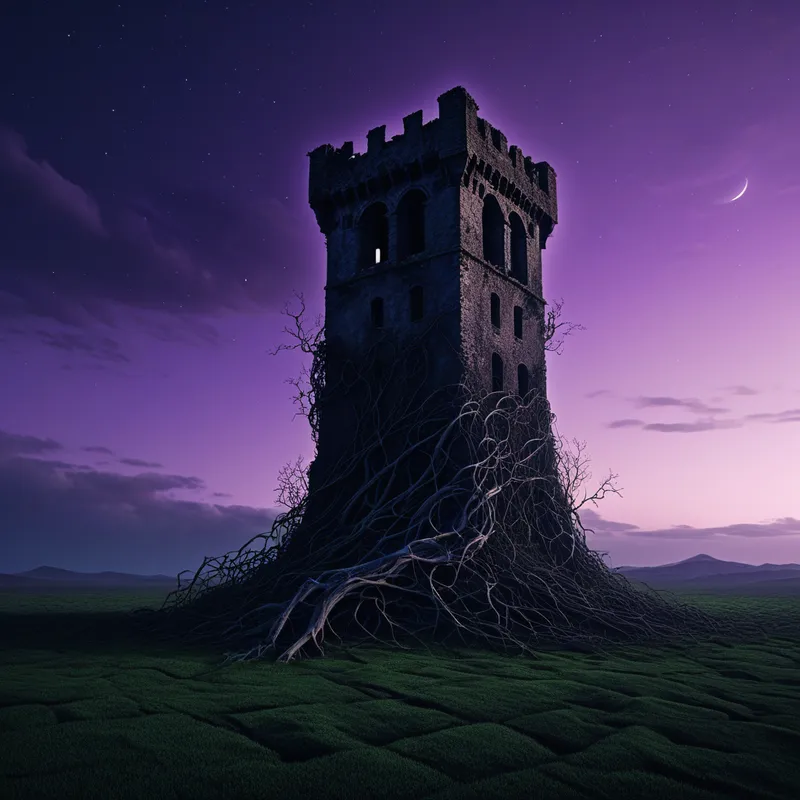
[The first stage](/myths/the-first-stage “Myth from Alchemical culture.”/), Confinement (in the Tower), represents the initial, necessary stage of development. [The ego](/myths/the-ego “Myth from Jungian culture.”/) is formed in isolation, a distinct entity separate from the world. The problem is not the tower itself, but the failure to leave it. The witch represents the [prima materia](/myths/prima-materia “Myth from Alchemical culture.”/)—the raw, possessive, undifferentiated psychic energy that must be confronted.
The Ascent (of the Prince) is the arrival of consciousness, the eros principle that seeks connection. It is the first inkling that there is more, that the isolated self is not complete. Their secret planning—the weaving of the silk ladder—is the nascent, fragile beginning of a conscious plan for liberation, a new structure built from the inside.
The fall from the tower is not a failure, but the only true beginning. Wholeness is not found by building a taller tower, but by descending, wounded, to the common earth.
The crucial Catastrophe (Shearing and Blinding) is the [nigredo](/myths/nigredo “Myth from Alchemical culture.”/), the blackening. All previous forms are destroyed. The old identity (the hair) is cut away. The old way of seeing (the prince’s sight) is lost. This is [the dark night of the soul](/myths/the-dark-night-of-the-soul “Myth from Christian Mysticism culture.”/), [the wilderness](/myths/the-wilderness “Myth from Biblical culture.”/) experience where both protagonists are stripped bare.
The final Integration (Tears and Healing) is the albedo and [rubedo](/myths/rubedo “Myth from Alchemical culture.”/). Rapunzel, in her exile, has grounded herself in the wilderness (the unconscious). She has borne fruit (the twins, symbolizing new, reconciled potentials). Her tears are not the salt [water](/myths/water “Myth from Chinese culture.”/) of the old, lonely tower, but the aqua permanens, the divine water of the alchemists that heals and unites. They heal the prince’s sight, not to restore the old vision, but to grant a new one—a vision that sees the world and the beloved not as objects to be attained, but as subjects with whom to share a life. The tower is gone because the need for it has been transcended. The soul is no longer in a tower; it is of [the earth](/myths/the-earth “Myth from Hindu culture.”/), whole, and seeing clearly for the first time.
Associated Symbols
Explore related symbols from the CaleaDream lexicon: