Raphael Myth Meaning & Symbolism
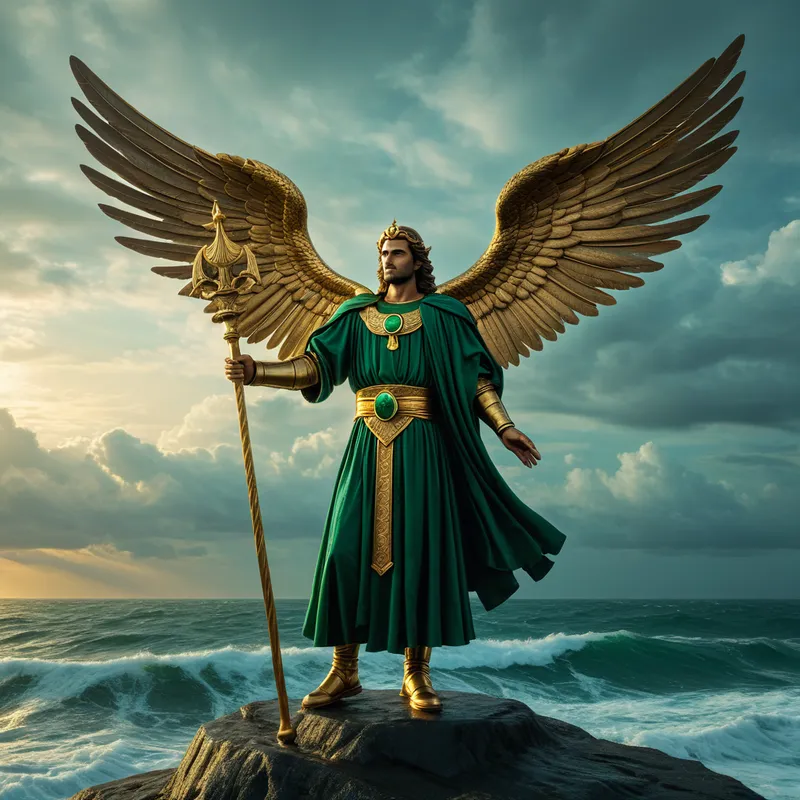
The archangel Raphael, whose name means 'God Heals', binds primordial chaos, guides the righteous, and embodies the divine principle of restoration and wholeness.
The Tale of Raphael
Listen, and hear the tale of the Binder of the Great Deep, the Companion of the Wayfarer, the One Whose Name is Raphael.
Before the first dawn, when the world was a formless void and darkness brooded over the face of the abyss, the Word called forth the Host. Among the first and mightiest was he, a pillar of living light, a being of six wings that sang with the sound of rushing waters and distant thunder. His task was not to create, but to order; not to speak light, but to bind the chaos that writhed beneath. He was sent to the face of the Tehom, the great deep. With authority not of sword but of presence, he pressed upon the roiling, formless waters. Where his light touched, the chaos stilled, not into dead rock, but into potential, into a foundation that could bear the weight of mountains and the roots of cedars. He was the healer of the foundation of the world, setting the bones of creation so life could grow.
Ages passed. The world was made, and humankind walked upon it, often stumbling. In the days of a righteous man named Tobit, who sat in darkness, his eyes blinded by misfortune, a prayer rose like incense. And the One Who Hears sent the Healer. Raphael descended, not in blinding glory, but in the guise of a man—Azariah, a kinsman, a fellow traveler. His voice was warm, his step sure. He took the man's son, young Tobias, on a perilous journey to reclaim a family debt.
The road was long, dust choking the air, sun beating upon their backs. At the Tigris river, as Tobias washed his feet, a monstrous fish, a creature of the old, untamed deep, lunged from the waters to devour him. Raphael, the ancient binder of chaos, did not strike it down with celestial fire. Instead, he called out practical instructions: "Seize the fish! Hold fast!" And when the youth, heart pounding, dragged the thrashing beast to shore, the guide showed him the hidden medicine within the monster. "Take the heart, the liver, the gall," he said. "These are powerful things." The poison of the deep held its own antidote.
The journey continued, to a house shadowed by a different kind of chaos—a young woman named Sarah, whose bridal chamber was a tomb, for a demon, Asmodeus, slew any who came to her. Using the heart and liver of the fish, Raphael instructed Tobias to make a smoldering incense. The smoke drove the demon of jealousy and death to the remotest parts of Egypt, bound not by force of arms, but by the alchemy of courage, obedience, and the transformed poison. The marriage was blessed.
The journey home was lighter. And when they returned to Tobit, who sat in the darkness of his blindness, Raphael gave the final instruction: "Take the gall of the fish. Anoint your father's eyes." The bitter bile, the last extract of the chaotic beast, became a salve. The scales fell away. Light returned. Only then, with the journey complete, the demon banished, the family restored, and sight returned, did Raphael reveal his true name. "I am Raphael, one of the seven who stand in the glorious presence of the Most High." And in a flash of silent, awe-inspiring light, he was gone, leaving behind not a command, but a restored world.

Cultural Origins & Context
The primary narrative of Raphael as an active, disguised guide is found not in the canonical Hebrew Bible or the New Testament, but in the Book of Tobit, a work of Jewish wisdom literature and pious fiction composed likely in the 2nd century BCE. It belongs to a body of texts cherished in the Jewish diaspora and later adopted into the Christian Old Testament by Catholic and Orthodox traditions. This was an era of exile, persecution, and questioning—how does one remain faithful when God seems distant? The story of Raphael provided an answer: divine help is real, but it often comes incognito, through the wisdom of a companion, the trials of a journey, and the unexpected medicines found within life's monsters.
Raphael's identity was further elaborated in non-canonical Jewish mystical and apocalyptic literature, such as the Book of Enoch, where he is named as one of the four (or seven) principal archangels, given authority over the spirits of humanity and the pains of the dead. His societal function was multifaceted: he was a theological comfort (God provides healing guides), a narrative device for teaching piety and familial duty, and a mystical bridge between the overwhelming transcendence of God and the tangible needs of suffering people.
Symbolic Architecture
Raphael is the archetype of the Healer Who Binds. His symbolism operates on multiple, interconnected levels.
He does not erase the wound or deny the monster; he provides the means to transform its essence into the cure.
First, he is Divine Order imposed on Primal Chaos. His pre-temporal act of pressing upon the Tehom establishes him as a principle of foundational healing. The chaos is not destroyed; it is bounded, made manageable, its raw power contained so that life can be built upon it. This speaks to the psychological necessity of integrating our own formless, chaotic unconscious impulses—not by repression, but by creating a stable ego-structure (the "firmament") that can contain them.
Second, he is Guidance in Disguise. Raphael never appears to Tobit or Tobias in his full angelic splendor until the work is done. He is "Azariah," the helpful cousin. This symbolizes the healing wisdom that often comes from unexpected, humble, or mundane sources: a friend's advice, a book found by chance, a lesson learned through hardship. The divine healer within the psyche often speaks through the voice of intuition, synchronicity, or inner knowing, not through grandiose revelation.
Third, he is the Alchemist of the Shadow. The great fish is a classic symbol of the unconscious, the unpredictable, devouring aspect of the unknown. Raphael's instruction to capture it and extract its organs is a perfect metaphor for engaging with the "shadow" self. The very parts of our experience that seem monstrous and threatening—our rage, our grief, our primal fears—contain, if confronted and "cooked" with conscious understanding (the smoke of the incense), the power to ward off inner demons (like Asmodeus, the spirit of jealous self-destruction) and restore vision (the gall as salve).

The Dreamer's Resonance
When the pattern of Raphael stirs in the modern dreamer, it signals a profound process of psychic mending underway. This is not about a quick fix, but a deep, integrative healing.
To dream of a trusted, calming guide on a difficult journey—especially one who offers practical, if strange, advice—suggests the conscious ego is being supported by the Self (the total, organizing center of the psyche) through a period of transition or recovery. The dream ego is in the role of Tobias, learning to trust a wisdom beyond its own.
Dreams of confronting a large fish or sea creature in a river, particularly if you are instructed to take something from it, point directly to an engagement with the personal unconscious. The somatic feeling is often one of fear mixed with determination—a visceral, gut-level confrontation. The act of retrieving the heart or gall is the psyche's innate knowledge that the solution to an emotional or spiritual blindness lies within the troubling complex itself.
A dream of anointing someone's eyes with a strange substance, or having your own anointed, speaks to the final stage of this healing cycle. It represents the moment of insight, of "seeing clearly" the truth of a situation that was previously obscured by projection, pain, or ignorance. The medicine often feels bittersweet (like gall), because true sight requires acknowledging what was previously unseen or denied.
Alchemical Translation
The myth of Raphael is a complete manual for the alchemical process of individuation, the journey toward psychic wholeness. It maps the Opus onto the human journey.
1. The Nigredo (Blackening): Blindness & Bondage. Tobit's blindness and Sarah's marital curse represent the initial state of suffering, depression, or stuckness—the massa confusa of the soul. The conscious attitude is in darkness, bound by a repeating, destructive pattern (Asmodeus).
2. The Albedo (Whitening): The Journey & The Guide. The call to journey is the stirring of the Self. Raphael, as the disguised guide, is the emerging archetype of the inner healer, the transcendent function that mediates between consciousness and the unconscious. The long road is the necessary work of confronting life's realities.
3. The Citrinitas (Yellowing): Confronting the Shadow-Beast. The fight with the fish is the crucial confrontation with the shadow. It is not a battle to the death, but an act of seizing, mastering, and discerning the useful components within the chaos. This is the heart of psychological alchemy: finding the prima materia for transformation in our own lowest, most instinctual nature.
The demon is not slain by the sword of willpower, but is transfixed by the smoke of transformed pain.
4. The Rubedo (Redding): Integration & Sacred Marriage. Using the fish's organs to banish Asmodeus allows for the coniunctio, the sacred marriage of Tobias and Sarah. This symbolizes the integration of opposites within the psyche—perhaps the union of logos and eros, or consciousness with the anima/animus—resulting in new life and creativity.
5. The Completion: Return of Sight & Revelation. The application of the gall is the final, integrative insight. The bitter experience, once consciously processed, becomes the salve that heals the original wound. Only when the cycle is complete does the guide reveal his true name: the healer was not an external force, but the very intelligence of wholeness within the psyche itself. The archetype re-assimilates, and the individual stands healed, whole, and conscious, having participated in their own divine restoration.
Associated Symbols
Explore related symbols from the CaleaDream lexicon: