Rally Cries & War Dances Myth Meaning & Symbolism
A primal myth of a people finding their unified voice and rhythm, turning fear into a sacred force that shapes their destiny.
The Tale of Rally Cries & War Dances
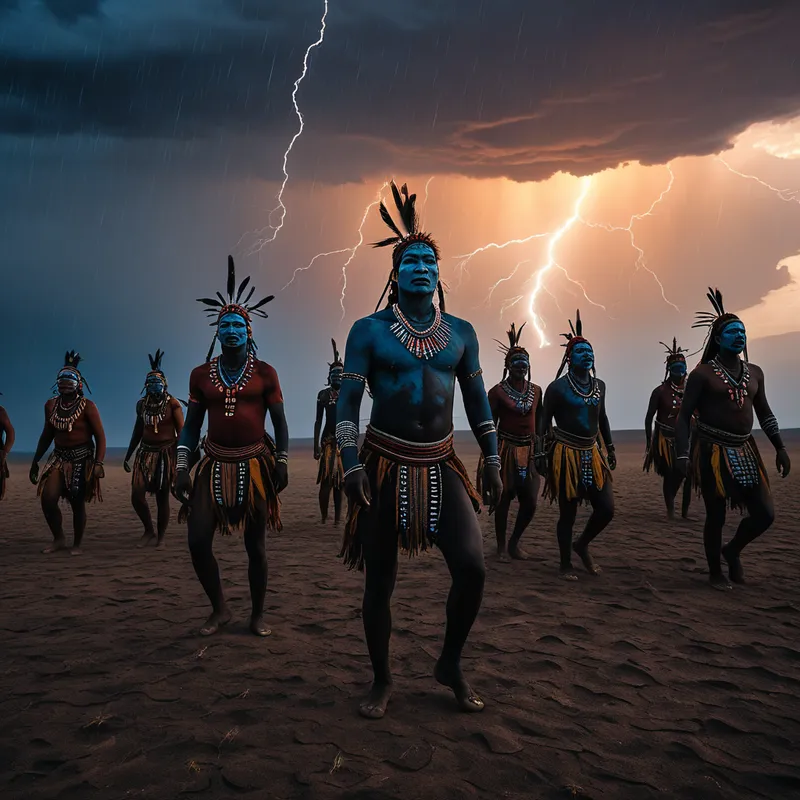
Listen. Before the first wall was built, before the first name for a nation was spoken, there was the Silence. It was not a peaceful quiet, but a heavy, waiting stillness. The people were scattered, like seeds thrown on stone. They knew fear—the sharp-toothed fear of the hunting beast in the dark, the cold, gnawing fear of the empty belly, the vast, echoing fear of the storm that spoke a language they could not understand.
They had no strength, for their strength was divided. A man would shout, and his voice would die against the wind. A woman would stamp her foot, and the earth would not answer. Their hearts beat out of rhythm, a cacophony of solitary pulses.
Then came the Time of Gathering. Not by decree, but by a pull, a deep, somatic knowing that drew them to a great, flat basin under the watchful eyes of the mountains. They came not as a tribe, but as fragments. They stood in the dust, looking at one another, and saw only their own terror reflected in a thousand pairs of eyes.
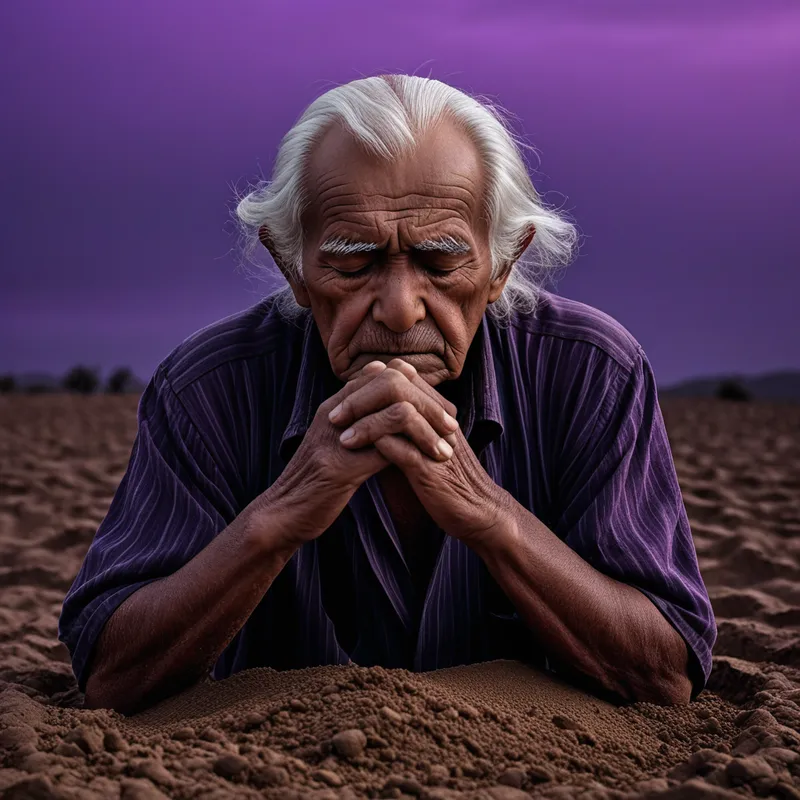
An elder, her back bent like an old root, stepped into the center. She did not speak. She placed her bare feet firmly on the ground, closed her eyes, and simply breathed. A long, slow inhale that seemed to draw in the anxiety of the multitude. She held it. And then, she released it—not as a sigh, but as a low, guttural tone, a vibration that started in her belly and hummed through the earth.
A young hunter, his nerves frayed from a recent chase, felt it in his soles. Without thought, his foot tapped. Once. Twice. Then it stamped, matching the rhythm of her exhale. Thump. Another joined. Thump. Thump. A rhythm was born, clumsy at first, a heartbeat finding its twin.
Then the elder opened her eyes, filled with a fierce light. She lifted her face to the threatening sky and from that same deep place, she did not shout a word. She released a sound—a raw, open-voweled cry that was both defiance and supplication. It was not pretty. It was truth given voice.
The hunter, his blood now singing with the drumming of his own feet, echoed her. His cry was different, sharper, laced with his personal fear of tooth and claw. Another voice wove in, a higher pitch, the cry of a mother fearing for her children. Another, and another. The individual fears did not vanish; they met. They braided together in the air above the dancing feet.
The scattered cries began to harmonize around the elder’s central tone. The stamping feet found a unified rhythm, a powerful, driving stomp-thump-thump that shook the dust into a cloud around their ankles. They were no longer a crowd. They were a single organism. The dance was not a performance; it was a becoming. Arms swung in unison, bodies pivoted as one. The Rally Cry was no longer a scream into the void, but a collective declaration to the heavens: We are here.
And the world answered. The hunting beasts at the tree line slunk back, confused by the single, massive vibration of life. The storm clouds, which had gathered to overwhelm, seemed to pause, their thunder now just an echo of the human thunder below. The people danced their fear into fuel, and cried their isolation into a bond. When they finally stilled, sweat-sheened and breathless in the sudden quiet, they were not who they had been. They were a people. They had found their voice, and it was the voice of the many, made one.
Cultural Origins & Context
This is not a myth belonging to one scroll or one epic. It is a foundational pattern, a psychic blueprint found in the marrow of countless cultures across millennia. We see its echoes in the <abbr title="A traditional Māori posture dance involving rhythmic shouts, stomping, and fierce facial expressions">Haka</abbr> of the Māori, performed to summon tribal strength and welcome or challenge. We hear it in the coordinated <abbr title="A rhythmic shout or chant, often used by soldiers in ancient Greece to maintain morale and pace">Paean</abbr> of Spartan phalanxes, in the drum circles and spirituals that fortified communities facing oppression, and in the unified chants of sports stadiums.
Its origin is pre-literary, born in the oral and somatic traditions of communal life. It was not “told” in the conventional sense by a single bard; it was enacted and remembered in the body. Elders and ritual leaders held the space, but the myth lived in the collective muscle memory and the shared breath of the group. Its societal function was multifaceted: to forge social cohesion from disparate individuals, to transmute paralyzing fear into usable adrenaline and courage before a hunt or battle, and to enact a sacred ritual where the community literally sounded and moved itself into existence. It was a technology of unity, older than the wheel.
Symbolic Architecture
At its core, this myth is about the alchemy of the collective shadow. The initial, silent fear represents the unintegrated, chaotic aspects of the individual and group psyche—the <abbr title="In Jungian psychology, the unknown or repressed parts of the personality">shadow</abbr>, the <abbr title="A primal, instinctual pattern of behavior present in the collective unconscious">archetype</abbr> of chaos. The dance floor or gathering basin is the <abbr title="The vessel in alchemy where transformation occurs; in psychology, the contained space for inner work">vas</abbr>, the sacred container where this raw material can be worked.
The Rally Cry is the individual ego-sound surrendering to the group’s greater harmonic. It is the moment the personal wound finds a shared frequency and becomes a source of power, not isolation.
The War Dance is not merely preparation for external conflict. It is the externalized ritual of internal ordering. The chaotic, nervous energy of the body (trembling, flight response) is given a strict, repetitive form. In mastering the collective rhythm, the individual masters their own inner tumult. The unified stomp is a symbolic claiming of territory—both the physical land beneath their feet and the psychological ground of their own being. The deities here are not anthropomorphic figures, but the emergent properties of the group itself: <abbr title="The spirit or distinctive atmosphere of a group">Esprit de Corps</abbr>, <abbr title="A shared feeling of emotional oneness">Communitas</abbr>, and the <abbr title="The vital life force or energy of a community">Genius Loci</abbr> of the people.
The Dreamer’s Resonance
When this myth stirs in the modern dreamer, it often surfaces during times of profound isolation within a crowd—feeling unheard at work, disconnected in social media throngs, or powerless within societal systems. The dream may manifest as trying to shout in a meeting but producing no sound, while one’s body moves involuntarily to a compelling, primal beat.
Somatically, this signals a psyche grappling with the tension between individual expression and the need for belonging. The blocked cry points to a repressed voice, a truth or emotion that fears it will not be received. The compelling dance represents the deep, instinctual pull toward synchronization, toward finding one’s place in a larger rhythm. The dream is an invitation from the unconscious to locate the “tribe”—not necessarily a literal group, but the internal and external community where one’s authentic rhythm and cry can be harmonized, not silenced. It is the psyche’s rehearsal for finding its power through connection, rather than in spite of it.

Alchemical Translation
For the individual on the path of <abbr title="The Jungian process of integrating the conscious and unconscious to become a whole, indivisible self">individuation</abbr>, this myth models the crucial stage of integrating the social and collective layers of the psyche. We begin in silence—the unexamined life, conforming to external rhythms without an authentic voice. The fear is the anxiety of differentiation, the terror that speaking or moving to our own beat will exile us.
The alchemical fire is lit not in solitude, but in the friction and resonance between the self and the other. The true ‘gold’ is a personality that is both fully individual and fully capable of profound communion.
The first step is the inner elder—the Self, the guiding center—who grounds us (the breath, the connection to the earth of our own nature). It gives permission for the first, ugly, authentic sound. The dance is the discipline of daily practice, the rituals and habits that shape our chaotic energies into a coherent life structure. The cry is the expression of our unique value, our wound, our passion. The process is iterative: we find our rhythm, we test our voice in smaller “tribes” (relationships, communities of interest), we listen for the harmonies and discords, and we adjust.
Ultimately, the triumph is not over an external enemy, but over the internal state of fragmented, silent fear. The individual becomes a coherent, vibrating entity whose self-expression naturally contributes to and is amplified by the right collective, transforming the personal struggle into a note in a grander, more beautiful song. We perform the war dance against our own disintegration, and our rally cry announces our arrival to our own life.
Associated Symbols
Explore related symbols from the CaleaDream lexicon: