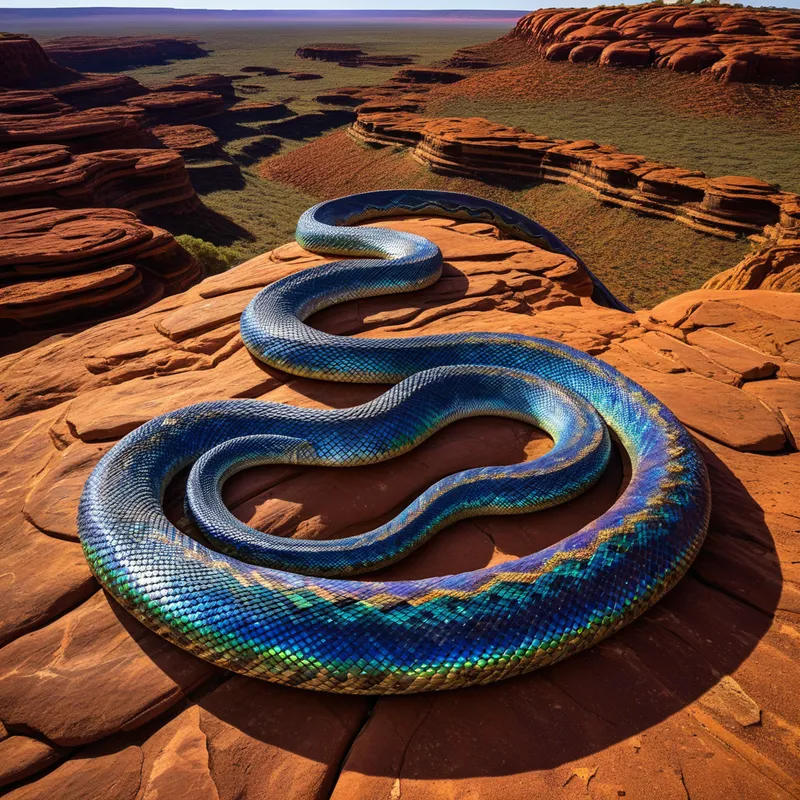
Rainbow Serpent Myth Meaning & Symbolism
The primordial Rainbow Serpent carves the world from the Dreamtime, embodying the creative-destructive force that shapes land, law, and the human psyche.
The Tale of Rainbow Serpent
In the beginning, there was the Dreamtime. A flat, featureless plain slept under a silent sky. Then, from deep within the earth’s dreaming heart, it stirred. The Rainbow Serpent awoke.
It was vast, older than time, its skin holding the memory of the first storm and the first sunrise. With a mighty heave, it pushed up from the subterranean darkness and began its journey. It did not slither; it swam through the solid earth as if it were water, its colossal body carving great winding tracks. Where it rested, its weight pressed down, forming valleys. Where it pushed upwards, mountains rose. It called out to the sky, and the rains came, filling its tracks to become the lifeblood of the land: the rivers, the billabongs, the sacred waterholes.
The Serpent traveled on, and as it moved, it sang. Its song was the law, vibrating through the stone and the sap. It sang of the connections between the kangaroo and the grass, between the honey-ant and the sun, between the people who were yet to come and the stars above. From its breath, the first plants unfurled. From the sparks in its eyes, the animals were dreamed into being.
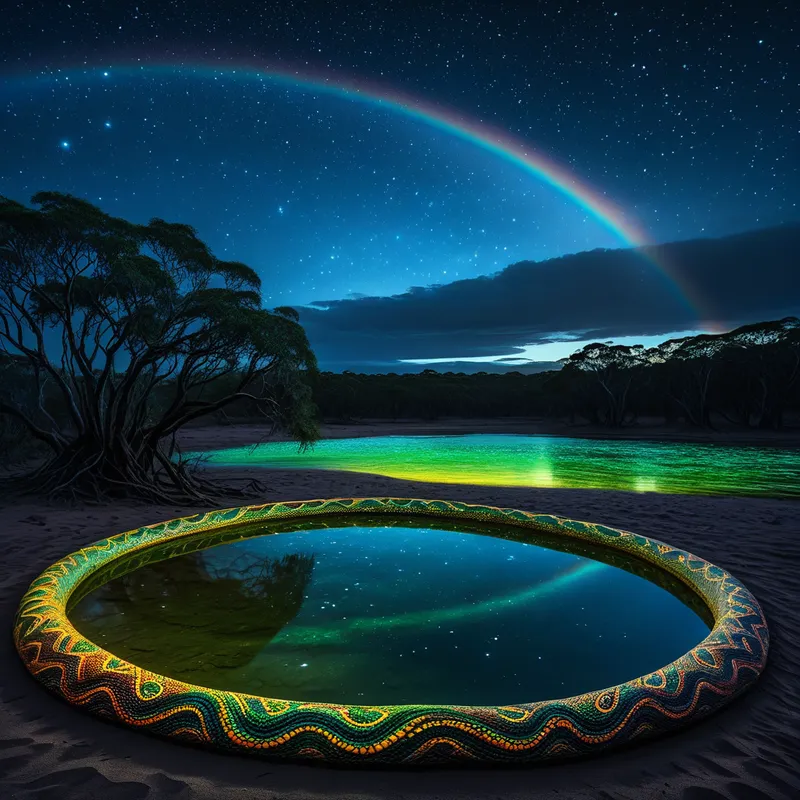
But the Rainbow Serpent was not only a creator. It was a sovereign. It settled at a particularly deep, clear waterhole, declaring it its home. The new animals, in their innocence and play, sometimes disturbed its rest. They splashed too loudly, they fought near its banks. A deep rumble would echo from the depths—a warning. Most heeded it.
Then came two young brothers, bold and careless with the newness of life. They came to the Serpent’s waterhole to hunt. They ignored the signs, the unnatural stillness of the water. They speared fish, they shouted, they stirred up the mud. The water, once crystal, turned dark with their disruption.
The silence that followed was absolute. Then, the world split open. The Rainbow Serpent erupted from the pool in a cataclysm of water, color, and sound. Its mouth was a cavern of storm. It did not merely consume the brothers; it drew in the very essence of their transgression—the chaos, the disrespect for the law it had sung into the world. It swallowed them whole.
A terrible stillness returned. The Serpent, its anger spent, surveyed the land. It saw the fear in the eyes of the other creatures, the imbalance its wrath had caused. It began to move again, not in anger, but in solemn duty. It traveled to a flat, open plain and disgorged the brothers. But they were not as they were. Transformed by their passage through the belly of the law, they stood now as the first great human ancestors, their bodies reshaped, their spirits imprinted with the knowledge of the law and the consequence of breaking it. They were now part of the story, part of the land the Serpent had made. The Rainbow Serpent returned to its waterhole, sinking beneath the surface. It did not sleep, but watched, a perpetual, creative force woven into the very fabric of the world it had shaped, its rainbow a bridge between the earth and the sky, between the law and life.
Cultural Origins & Context
The narrative of the Rainbow Serpent is not a single, monolithic myth but a profound archetype that resonates across many of the hundreds of distinct Aboriginal language groups and nations of Australia, from the Ngarinyin to the Arrernte. Known by many names—Ngalyod, Wollunqua, Ungur—its essence remains consistent: the primordial shaper.
This is an oral tradition, carried not in books but in the living breath of community. Elders, the custodians of Dreamtime knowledge, pass the stories through ceremony, song, dance, and art. The myth is not mere history; it is a living map. The Serpent’s journey physically created the local topography—that river bend, that mountain range, that waterhole. Therefore, to know the story is to know the land, and to know the land is to know the law (Tjukurrpa or Wangarr). The myth functions as the foundational constitutional and ecological document, encoding rules for social conduct, resource management, and spiritual relationship with country. It binds people to place in an unbreakable covenant of responsibility.
Symbolic Architecture
The Rainbow Serpent is the ultimate symbol of the unitary world soul, the anima mundi, from which all differentiation emerges. It represents the fundamental, paradoxical force that contains all opposites within itself.
It is the chaos of potential that precedes form, and the fierce intelligence that imposes order. It is the womb and the tomb, the giver of life and the enforcer of consequence.
Its serpentine form symbolizes the Kundalini-like energy of creation itself—a coiled, latent power that uncoils to manifest reality. The rainbow embodies the bridge between realms (earth/sky, water/land, conscious/unconscious) and the spectrum of possibilities. The waterhole is its dwelling place, representing the deep, often hidden well of the unconscious from which creative and destructive forces erupt. The act of swallowing and transformation is not punitive annihilation, but a severe form of alchemical initiation. The brothers are not destroyed; they are digested by the system of reality itself and reconstituted as conscious participants within it. They are integrated into the story, losing their individual, chaotic agency to become part of the collective, ordered myth.
The Dreamer’s Resonance
When the Rainbow Serpent surfaces in modern dreams, it signals a profound encounter with the foundational, shaping forces of the dreamer’s own psyche. It is not a gentle symbol.
To dream of the Serpent carving landscapes often coincides with periods of intense, involuntary life-change—a career upheaval, a relational ending, a deep internal restructuring. The psyche is literally being re-formed, and the process can feel violent, as old, flat “lands” of identity are rivered by new emotional truths. Dreaming of the Serpent resting in a waterhole may call the dreamer to attend to their own depths, to the still, sacred places of intuition and soul that they may have been neglecting or polluting with mental “noise.”
The most potent and alarming dream is the swallowing. This is the somatic signature of being consumed by a process larger than the ego. It may feel like depression, a loss of control, or being overwhelmed by a fate or illness. Psychologically, it is the ego’s submission to the transformative will of the Self. The dreamer is in the belly of the whale, being broken down so they can be remade according to a deeper, more authentic pattern. The fear is real, but the myth promises it is not an end—it is a severe rebirth.
Alchemical Translation
The myth of the Rainbow Serpent provides a stark map for the Jungian process of individuation—the journey toward psychic wholeness. The journey begins in the prima materia: the flat, undifferentiated state of unconscious identification with family, society, or persona.
Individuation is not about becoming perfect, but about becoming whole; it requires being carved by the serpent of one’s own deepest nature, wounds and all.
The Serpent’s awakening is the stirring of the Self, the central archetype of order and totality. Its creative travel is the opus, the lifelong work of shaping a unique personality from the raw material of the soul. It carves out our values (rivers), establishes our centers of meaning (waterholes), and raises up our defining struggles (mountains).
The critical alchemical stage is the confrontation at the waterhole—the nigredo. The careless brothers represent the immature, entitled, or ignorant aspects of the ego that exploit the psyche’s resources without respect for its intrinsic law. Their swallowing is the inevitable, often painful, collapse of this attitude. The ego is dissolved in the corrosive waters of reality and self-confrontation.
The final act—the disgorging and transformation of the brothers into ancestors—is the albedo and rubedo. The purified elements of the personality are returned to the world, but now as elders of one’s own inner community. They are no longer chaotic boys but integrated parts of a conscious, responsible Self. The individual is reborn, not as a lord over their psyche, but as a respectful custodian of the inner landscape the Serpent has shaped. The Rainbow Serpent then retires to the depths, not absent, but immanent—the creative-destructive principle now recognized as the eternal, awe-inspiring core of one’s own being, connecting the mud of instinct to the light of spirit.
Associated Symbols
Explore related symbols from the CaleaDream lexicon: