Rainbow Bridge Myth Meaning & Symbolism
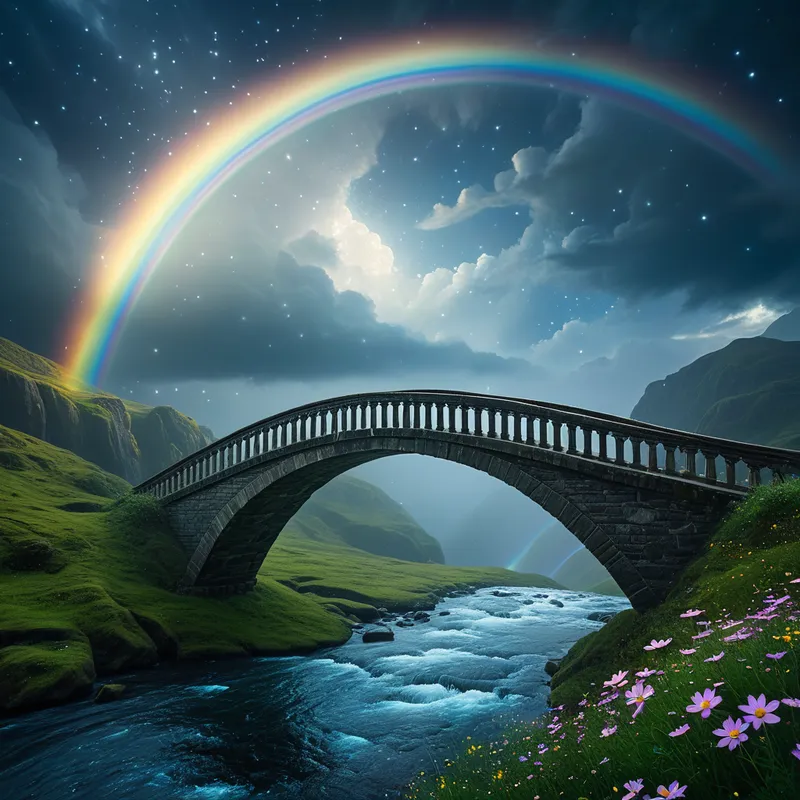
A myth of a bridge of light, built from tears and hope, connecting the sundered worlds of the living and the departed, awaiting a final reunion.
The Tale of Rainbow Bridge
Listen. Listen to the wind that carries the first and final sigh. In the time before time, when the world was one breath, there was no here and no there. The Great Unity pulsed, a single heart beating in the chest of the cosmos. The Sky Father and the Earth Mother were not two, but one—a boundless embrace where thought was form and love was law.
But a whisper, a tremor of a thought, passed through the Unity. It was the thought of knowing—the desire to see one’s own face reflected in another’s eyes. From this longing, the First Severing was born. The Sky Father drew upward, becoming vaulted heavens, thunder, and distant, burning stars. The Earth Mother condensed downward, becoming deep forests, rolling hills, and the silent, patient stone. Between them stretched a yawning, silent gulf: the Void of Longing.
Their children, the first people, were born into this sundered world. They knew the solid comfort of the earth, but their eyes were forever turned upward, aching for the sky. And when their brief, bright lives flickered out, their spirits, untethered, would drift like mist into the gulf, lost and crying out—a sound that became the wind and the rain.
The Earth Mother wept. Her tears fell as endless, grey rain, flooding the valleys. The Sky Father mourned. His grief flashed as silent, aching lightning in the perpetual twilight between them. Their sorrow was the weather of the world.
Then, in the depth of that shared despair, the Earth Mother looked upon her falling tears, catching a glimmer of her beloved’s light within each drop. The Sky Father saw his fractured light, softened and given form by her falling sorrow. A realization, slow and painful as dawn, broke upon them. Their separation was not an end, but a space. And in that space, their very grief could become the means of connection.
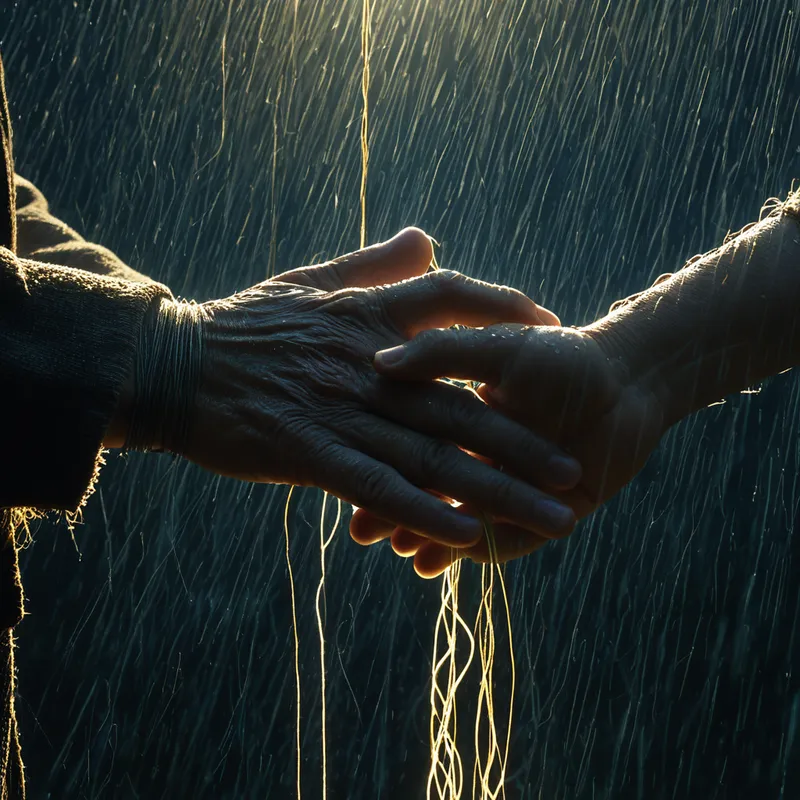
With a will that moved mountains, the Earth Mother gathered her tears—not to shed them, but to offer them. She stretched them into luminous threads of water and memory. The Sky Father, in turn, gathered his shattered light—rays fractured by storm clouds—and wove them into threads of fire and promise. From opposite shores of the abyss, they began to weave. Not towards each other, for they could not close the gap, but across it.
Thread by thread, sob by silent flash, they built it. A bridge. Not of stone or wood, but of rainbows born from weeping, of starlight filtered through pain. It arched, tremulous and glorious, over the Void of Longing. It was the Rainbow Bridge.
They decreed its law: It is not a road for the living in body, nor a path for the gods in power. It is a passage for the love that survives death. When a mortal’s life ends, if the love they left behind is true and their name is called by a grieving heart, a single, perfect raindrop—a tear from the living—will fall. And where it falls on the bridge, a corresponding star—a memory from the departed—will ignite. In that moment of mirrored sorrow and love, the spirit finds the path, walking the bridge from the mists of the gulf to the shores of a tranquil, united realm beyond, where the Sky Father and Earth Mother embrace once more in spirit.
The bridge stands, eternal and waiting. A promise woven not from the absence of pain, but from its transfiguration. A covenant that the greatest chasms are spanned not by forgetting our wounds, but by weaving them into a covenant of light.
Cultural Origins & Context
The myth of the Rainbow Bridge is a foundational narrative in the oral traditions of numerous cultures, earning its “Universal” designation not from a single source, but from its profound resonance across human experience. It is not the property of priests or kings, but of the hearth and the deathbed. This story was most commonly told by Story-keepers and Weepers, those tasked with guiding the community through the raw terrain of loss.
Its primary societal function was twofold: to explain the existential pain of separation (why must we lose what we love?) and to provide a psychic container for grief that prevented despair. It transformed passive mourning into an active, sacred practice. The act of remembering the dead, speaking their names, and shedding tears was not seen as a private weakness, but as a sacred duty—a necessary ritual to “water the bridge” and guide the loved one home. This myth served as the psychological underpinning for rituals of remembrance, from simple nightly prayers to elaborate annual feasts where the departed were symbolically invited across the bridge to join the living in celebration.
Symbolic Architecture
At its core, the Rainbow Bridge is the ultimate symbol of the liminal—the threshold state that is neither one shore nor the other, but the transformative passage between. It represents the psyche’s own capacity to build a structure of meaning across the abyss of trauma, loss, and irreconcilable opposites.
The bridge is not built where the ground is solid, but where the chasm is deepest. It is a testament that connection is forged not in spite of separation, but because of it.
The Sky Father and Earth Mother represent the archetypal opposites inherent in existence: spirit and matter, conscious and unconscious, eternal and temporal. Their separation is the birth of individual consciousness, which is always accompanied by a sense of primal loss—the nostalgia for paradise. The bridge is the symbol of the transcendent function, the psychic process that mediates between these opposites to generate a new, third thing that contains both.
The materials are critical: tears (emotion, suffering, the fluidity of the soul) and light (consciousness, memory, spirit). The myth asserts that raw, unprocessed grief is chaotic and flooding, but when consciously woven with the light of memory and love, it undergoes an alchemical change. It becomes a pathway.
The Dreamer’s Resonance
When this myth activates in the modern dreamscape, it rarely appears as a literal, colorful bridge. Instead, the dreamer encounters its architecture during periods of profound transition, grief, or when grappling with seemingly irreconcilable inner conflicts.
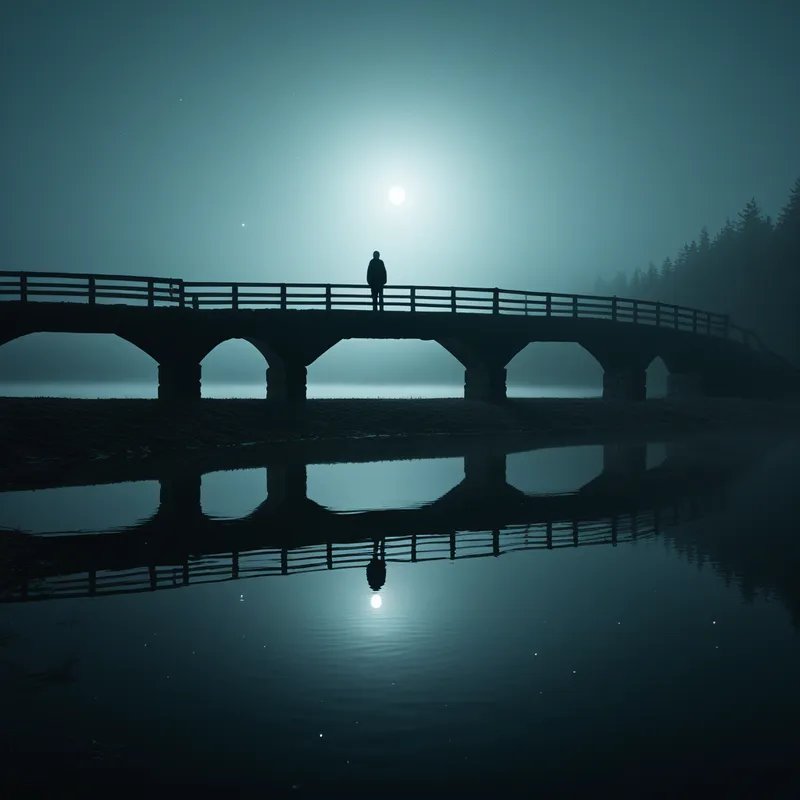
Common dream motifs include: standing at the edge of a vast canyon, knowing a crossing is necessary but seeing no way; discovering a fragile, glowing pathway over a dark body of water; or trying to repair or build a broken walkway between two isolated places. The somatic experience is often one of vertigo, mixed with a determined, aching pull from the “other side.”
Psychologically, this dream pattern signals that the psyche is engaged in the arduous work of building a structure of meaning. The two shores in the dream represent polarized aspects of the self (e.g., professional ambition vs. family care, logic vs. emotion, a past identity vs. a future one). The dream is evidence of the unconscious labor of the transcendent function, attempting to synthesize these opposites. The feeling of fragility reflects the nascent, vulnerable state of this new psychic structure. To dream of successfully crossing is to experience a moment of profound inner resolution.
Alchemical Translation
For the individual on the path of individuation, the myth of the Rainbow Bridge is a direct map for psychic transmutation. It models the process of turning the lead of suffering into the gold of wisdom and connection.
The first stage is the acknowledgment of the Void of Longing—the conscious acceptance of one’s inner divisions, losses, and unmet yearnings. This is the “Earth Mother’s rain,” the honest descent into feeling. The second stage is the “Sky Father’s light”: bringing conscious reflection, active imagination, and memory to bear upon that raw emotion. This is not analyzing the pain away, but holding it in the light of awareness.
The alchemy occurs in the weaving. One must become both the weeper and the weaver, the one who feels the tear and the one who sees its potential as a thread of light.
The bridge that results is the newly integrated aspect of the Self. It might be a creative work born from sorrow, a deeper capacity for empathy forged in loss, or a hard-won philosophical perspective that can hold life’s contradictions. The myth assures us that the departed “spirit” guided across—in the inner world—is often a lost part of ourselves: a forgotten passion, a neglected talent, or a childhood wound that finally finds peace and integration in the “reunited realm” of the mature personality. We do not cease to feel the rain of life’s sorrows, but we learn to see, and to build, with the rainbows hidden within them.
Associated Symbols
Explore related symbols from the CaleaDream lexicon: