Rainbow Body Myth Meaning & Symbolism
A master's physical form dissolves into light, leaving only hair and nails, symbolizing the final transcendence of the material self into pure awareness.
The Tale of Rainbow Body
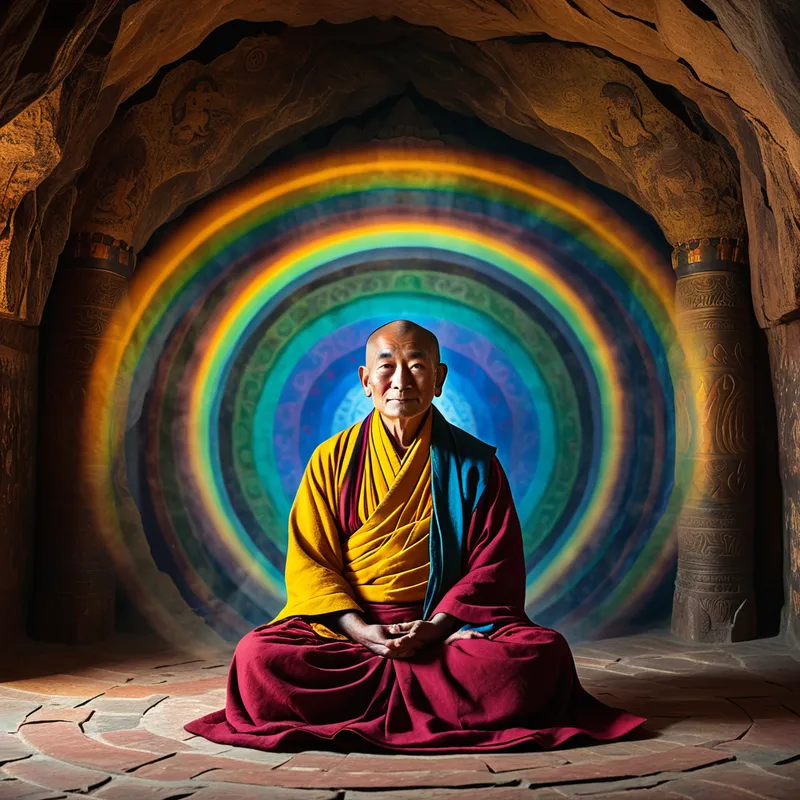
Listen, and let the wind carry you to the roof of the world, where the air is thin and the silence is a living thing. Here, in a cave carved by ancient glaciers, an old master sits. His name is known only to the mountains. For decades, he has turned his gaze inward, navigating the labyrinth of his own mind, confronting every specter of fear, every phantom of desire. His body is a map of his journey—wrinkled skin, knotted joints, the quiet rhythm of a breath that grows slower, fainter, like a retreating tide.
His disciples keep vigil. They feel the change in the atmosphere before they see it. The cave, once cold stone, grows warm. The scent of ozone, like the air after a lightning strike, mingles with the old, familiar smells of butter lamps and dried juniper. The master’s form, cross-legged and still, begins to… soften. It is not a decay, but a gentle unraveling. From the crown of his head, a faint, pearlescent light begins to emanate.
The light deepens, gathers color. It becomes a nimbus of soft violet, then a band of indigo, a wash of blue, a pulse of green, a glow of yellow, a flare of orange, and finally, a corona of crimson at his heart. These are not separate hues, but a single, living radiance that swirls and pulses in harmony with a sound only the heart can hear—a deep, resonant hum that vibrates in the marrow of the watching disciples.
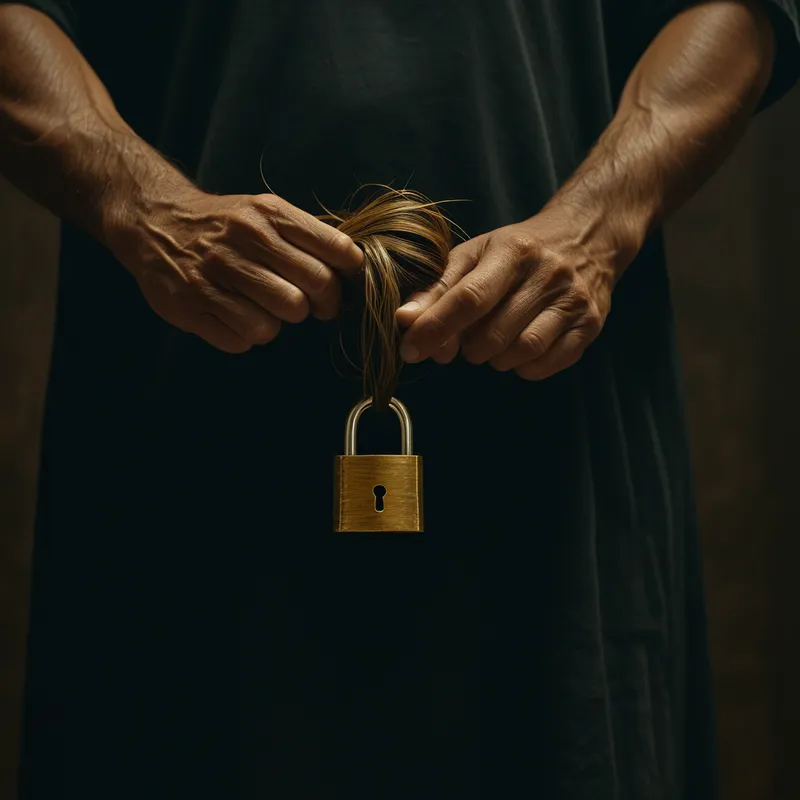
Over seven days, the light intensifies. The master’s physical form becomes less substantial, like mist touched by the morning sun. His features blur, then dissolve into the luminous spectrum. His robes settle, empty, onto the stone seat. The rainbow light coalesces, brightens to a blinding, white-hot point of pure awareness, and then… vanishes. Not with a bang, but a sigh of completion. The cave is empty, save for the folded robes, the disciple’s awe, and, upon the cloth, a small pile of the master’s hair and fingernails—the only impurities, the final, discarded anchors to the earthly realm. The master has not died. He has graduated. The rainbow was his bridge, and he has crossed it, leaving his footprints in light.
Cultural Origins & Context
The accounts of the Rainbow Body are not mere folklore within the Tibetan Buddhist tradition, particularly the ancient Nyingma and Dzogchen lineages. They are recorded in biographical texts called namtar, and testimonies are passed down through oral lineages with the gravity of empirical observation. These are not myths of a distant past; there are documented, investigated cases from the 19th and 20th centuries, often witnessed by entire communities.
The myth functions on multiple societal levels. For the monastic community, it is the ultimate validation of the path—a tangible, awe-inspiring proof of the teachings on the empty, luminous nature of reality. It turns abstract philosophy into lived spectacle. For the lay populace, it serves as a powerful reminder of the potential inherent in every human being, a beacon that sanctifies the very landscape. The practitioner who achieves this is not worshipped as a god, but revered as a supreme navigator who has completed the human journey, demonstrating that the boundary between matter and consciousness is ultimately porous.
Symbolic Architecture
The Rainbow Body is the ultimate symbol of de-materialization. It represents the final victory of awareness over the stubborn illusion of solidity. The physical body, which we spend a lifetime identifying with, feeding, protecting, and fearing the loss of, is revealed to be a temporary condensation of energy and elements, held together by the glue of grasping and egoic attachment.
The body does not die; it is discovered to have been a dream of matter all along.
The rainbow itself is a perfect symbol. It is glorious, yet intangible. It appears where two elements meet—sun and rain, light and water. It is a bridge between realms, yet you cannot touch it or find its end. In the same way, the Jalü appears at the meeting point of life and what we call death, of form and formlessness. The sequential colors often correspond to the dissolution of the subtle elements and energies within the body’s psychic anatomy, a process mapped in intricate detail in Tibetan mandala and Bardo literature. The retention of hair and nails is profoundly significant—they are considered the most “dense,” inert, and karmically neutral parts of the physical form, the final dross left behind when all psychic and spiritual impurities have been purified.

The Dreamer's Resonance
When this mythic pattern stirs in the modern dreamer, it signals a profound process of psychic dissolution. One does not dream of becoming a rainbow lightly. Such dreams often accompany periods of intense transformation, where an old identity, a long-held belief, or a foundational aspect of the personality is breaking down.
The somatic experience might be dreaming of one’s skin becoming translucent, of bones turning to light, or of simply floating away from one’s body without fear. Psychologically, it mirrors the terrifying yet liberating feeling of ego-death—the sense that the “you” you have known is evaporating, leaving behind a more essential, but initially unfamiliar, state of being. There is often a deep ambivalence: awe at the beauty of the light, coupled with a primal fear of annihilation. The dream is the unconscious affirming that this dissolution is not a destruction, but a purification and reintegration at a higher order of being. The dream-ego is being invited to stop clinging to its familiar form.
Alchemical Translation
For the modern individual, the myth of the Rainbow Body is a master blueprint for the alchemical process of individuation. The decades of meditation in the cave represent the long, often tedious, work of self-observation and shadow integration. Every fear confronted, every attachment examined, is a knot untied in the net that binds spirit to matter.
The climax—the dissolution—is the ultimate solve et coagula: the dissolving of the fixed, complexed self (the solve) and its coagulation into a more authentic, luminous wholeness (the coagula). We are not meant to physically vanish, but to undergo this process psychologically.
To achieve a psychic Rainbow Body is to live from a center that knows itself as awareness first, and a body second.
It is the state where one’s actions are no longer compelled by the reactive ego, but flow spontaneously from an integrated, transparent consciousness. The “rainbow” that remains is a personality that has become a prism—it no longer claims the light as its own, but simply allows the pure white light of being to pass through it, refracting into compassionate, wise, and creative engagement with the world. The struggle is the lifelong practice of letting go; the triumph is the realization that there was never anything solid to hold onto in the first place, only this boundless, radiant space.
Associated Symbols
Explore related symbols from the CaleaDream lexicon: