Ragnarök Survivors Myth Meaning & Symbolism
After the twilight of the gods, a handful of beings survive the world's end, emerging from hiding to inherit a green and peaceful earth.
The Tale of Ragnarök Survivors
Listen. The final note of [the Gjallarhorn](/myths/the-gjallarhorn “Myth from Norse culture.”/) has faded into the screaming wind. The great bridge, Bifröst, is ash and shattered crystal underfoot. [The sky](/myths/the-sky “Myth from Persian culture.”/) is rent, and from the wounds pour the legions of Muspell. [The earth](/myths/the-earth “Myth from Hindu culture.”/) shakes, the seas boil and rise to swallow the mountains. In the final, desperate clash, the old world dies. Odin is consumed by the maw of [Fenrir](/myths/fenrir “Myth from Norse culture.”/). Thor slays [the World](/myths/the-world “Myth from Tarot culture.”/)-Serpent [Jörmungandr](/myths/jrmungandr “Myth from Norse culture.”/) only to drown in its venom. Loki and [Heimdall](/myths/heimdall “Myth from Norse culture.”/) cut each other down. The sun is swallowed, the stars vanish, and a silence, deeper than any tomb, falls upon the steaming, broken corpse of [Midgard](/myths/midgard “Myth from Norse culture.”/).
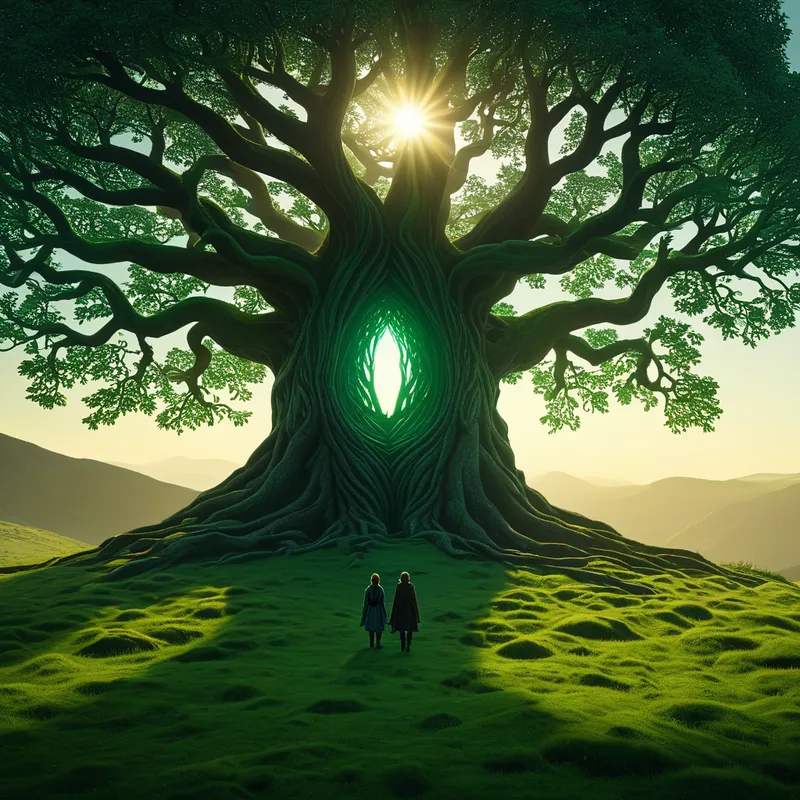
Fire has scoured the land. Ice has gripped the seas. The great tree [Yggdrasil](/myths/yggdrasil “Myth from Global/Universal culture.”/) trembles, its leaves burnt, its bark scorched—but its roots, deep in the hidden places, hold. And in one of those roots, in a hallowed hollow named [Mímisbrunnr](/myths/mmisbrunnr “Myth from Norse culture.”/), two forms stir. They are not gods. They are not giants. They are Líf and Lífþrasir, Life and Life’s Yearning. They hid there, shielded by the tree’s final strength, as the world died above them. They slept a sleep untouched by fire or frost, cradled in the memory of the earth.
Now, they emerge. The air is cool and clean. The waters have receded, calm and clear. The ground is soft, covered in a dewy, vibrant green—a green that has not been seen since the world’s first dawn. A new sun, daughter of the old, rides in the sky. They stand on the fresh soil, the only sound the sigh of [the wind](/myths/the-wind “Myth from Various culture.”/) through new grass and the distant, gentle lap of [water](/myths/water “Myth from Chinese culture.”/). They are alone, and they are everything. In their eyes is the memory of the twilight, and in their hearts, the unspoken promise of the dawn. They see, far across the gentle waves, the golden hall of Gimlé shining, and walking towards them from the southern brightness are the gods Vidar and Vali, and Magni and Modi, who hold their father’s mighty hammer. They have returned. The world is made whole again, not as it was, but as it could be. And from Líf and Lífþrasir will spring the generations that will fill this green and silent land.
Cultural Origins & Context
This epilogue to the cataclysm is preserved primarily in the Prose Edda of Snorri Sturluson, drawing from older poetic fragments like the Völuspá. It was not a comforting bedtime story, but a foundational eschatology recited by skalds and poets. In the harsh, cyclical reality of the Norse world—where winters could mean death and summers were a fleeting reprieve—the idea of total destruction followed by a fragile, hard-won renewal was not pessimistic, but profoundly realistic. The myth served as a cosmic model for individual and communal resilience. It acknowledged that everything, even the gods, must fall, but it fiercely asserted that life itself, in its most essential, human form, is irrepressible. The survivors are not triumphant heroes; they are refugees who become ancestors. This story was told in longhouses during the darkest months, a ritual reminder that even after the battle is lost, the seed of the future remains, hidden and protected.
Symbolic Architecture
The survivors, Líf and Lífþrasir, are not active agents in the battle. Their power lies in their passivity, their concealment. They represent the indestructible core of the [psyche](/myths/psyche “Myth from Greek culture.”/), the primal [life](/symbols/life “Symbol: The symbol of ‘Life’ represents a journey of growth, interconnectedness, and existential meaning, encompassing both the joys and challenges that define human experience.”/)-force and the innate drive toward continuation that exists beneath ego, [identity](/symbols/identity “Symbol: Identity represents the sense of self, encompassing personal beliefs, cultural background, and social roles.”/), and even conscious hope.
The most profound resilience is not found in the armor of the hero, but in the soft, hidden seed that sleeps through the wildfire.
Their hiding place is crucial: the hollow of Yggdrasil, the World [Tree](/symbols/tree “Symbol: In dreams, the tree often symbolizes growth, stability, and the interconnectedness of life.”/). This situates them at the [axis](/symbols/axis “Symbol: A central line or principle around which things revolve, representing stability, orientation, and the fundamental structure of reality or consciousness.”/) of the [cosmos](/symbols/cosmos “Symbol: The entire universe as an ordered, harmonious system, often representing the totality of existence, spiritual connection, and the unknown.”/), protected by the very [structure](/symbols/structure “Symbol: Structure in dreams often symbolizes stability, organization, and the framework of one’s life, reflecting how one perceives their environment and personal life.”/) that holds [reality](/symbols/reality “Symbol: Reality signifies the state of existence and perception, often reflecting one’s understanding of truth and life experiences.”/) together. They are sheltered by [memory](/symbols/memory “Symbol: Memory symbolizes the past, lessons learned, and the narratives we construct about our identities.”/) (Mímisbrunnr) itself. Psychologically, this signifies that our [capacity](/symbols/capacity “Symbol: A measure of one’s potential, limits, or ability to contain, process, or achieve something, often reflecting self-assessment or external demands.”/) to survive total psychic [dissolution](/symbols/dissolution “Symbol: The process of breaking down, dispersing, or losing form, often representing transformation, release, or the end of a state of being.”/)—deep depression, [trauma](/symbols/trauma “Symbol: A deeply distressing or disturbing experience that overwhelms the psyche, often manifesting in dreams as unresolved emotional wounds or psychological injury.”/), the “[death](/symbols/death “Symbol: Symbolizes transformation, endings, and new beginnings; often associated with fear of the unknown.”/)” of a former self—depends on our [connection](/symbols/connection “Symbol: Connection symbolizes relationships, communication, and bonds among individuals.”/) to the deep, impersonal structures of the unconscious (the [Tree](/symbols/tree “Symbol: In dreams, the tree often symbolizes growth, stability, and the interconnectedness of life.”/)) and the wisdom of what has been, even in ruin (the Well). They are the archetypal seed, containing the entire [pattern](/symbols/pattern “Symbol: A ‘Pattern’ in dreams often signifies the underlying structure of experiences and thoughts, representing both order and the repetitiveness of life’s situations.”/) of the future world in latent form.
The Dreamer’s Resonance
When this myth stirs in the modern dreamer, it often manifests not as a grand battle, but in its aftermath. Dreams of emerging from a bunker, a basement, or a dense forest into a calm, empty, sun-drenched landscape. Dreams of being one of a very few survivors after a global catastrophe, feeling a mix of profound loneliness, eerie peace, and overwhelming responsibility. Somaticly, this can correlate with the body emerging from a period of illness, burnout, or depression—the fever breaks, the fatigue lifts, and there is a fragile, quiet clarity.
The psychological process is one of emergence from protective collapse. [The ego](/myths/the-ego “Myth from Jungian culture.”/), like the old world, has undergone a necessary ruin. The dreamer has been “hidden in the tree root,” in a state of psychic hibernation where only the most essential processes continue. To dream of the survivors is to sense the end of that hibernation. It is the first inkling that the internal winter is over, and a new, albeit vastly different, psychic landscape must now be inhabited. The dominant emotions are not joy, but awe and a solemn sense of duty toward the future self that must now be built.
Alchemical Translation
In the alchemy of individuation, [Ragnarök](/myths/ragnark “Myth from Norse culture.”/) represents the [nigredo](/myths/nigredo “Myth from Alchemical culture.”/)—the blackening, the utter dissolution of the conscious personality and its cherished structures. It is [the dark night of the soul](/myths/the-dark-night-of-the-soul “Myth from Christian Mysticism culture.”/) in its most absolute form. The survival of Líf and Lífþrasir models the critical phase that follows: the discovery of the scintilla—the imperishable spark of [the Self](/myths/the-self “Myth from Jungian culture.”/) that survives the ego’s death.
The psyche’s ultimate act of creation is not building a fortress, but becoming a fertile plain after the fortress has burned.
The process is one of radical simplification. All superfluous complexities, defenses, and outdated identities are consumed in the fire of crisis. What remains is the bare, essential duo: the instinct to be (Life) and the instinct to become (Life’s Yearning). This is the core of the transcendent function. The new world they inherit—green, peaceful, with a new sun—symbolizes the albedo, the whitening, the dawn of a consciousness reborn on a more authentic, grounded level. The returning gods like Magni and Modi (Strength and Courage) no longer exist as external forces to worship, but as integrated psychic capacities within the renewed individual. The myth thus maps the journey from catastrophic disintegration to a renewal where one does not rebuild the old city on the same plan, but instead learns to live, humbly and consciously, in the fertile field that grows in its ashes.
Associated Symbols
Explore related symbols from the CaleaDream lexicon: