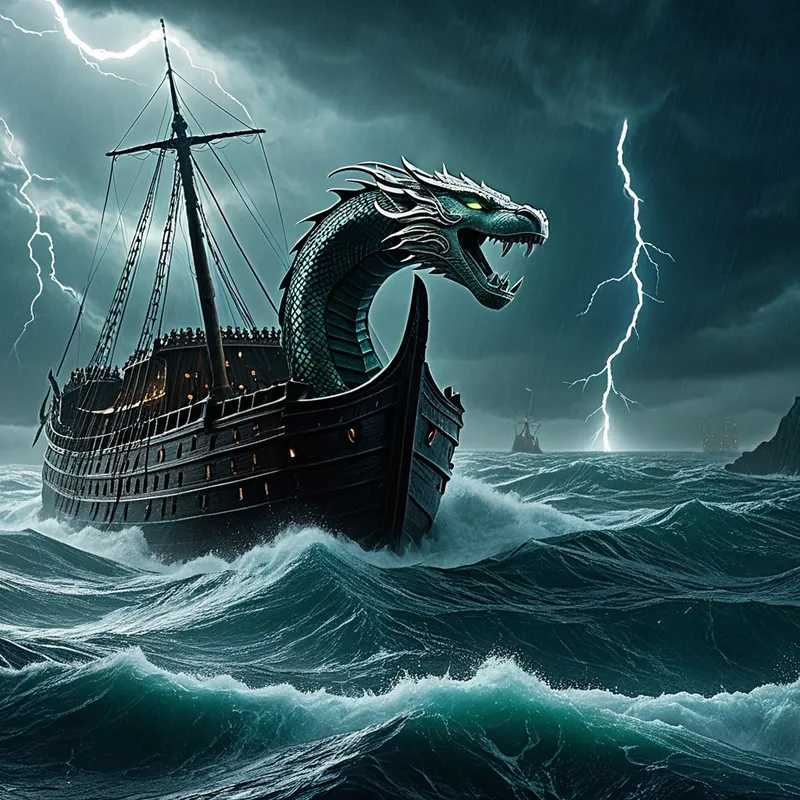
Ragnarök Cycle Myth Meaning & Symbolism
The prophesied end and renewal of the world, where gods and monsters clash in a final battle, leading to a new green earth rising from the ashes.
The Tale of Ragnarök Cycle
Listen, and hear the whisper on [the wind](/myths/the-wind “Myth from Various culture.”/) that comes from the roots of the [Yggdrasil](/myths/yggdrasil “Myth from Global/Universal culture.”/). It speaks of a time yet to come, a doom woven into the tapestry of fate itself. The age of gods and men grows old and weary. The sun grows pale, her sister [the moon](/myths/the-moon “Myth from Tarot culture.”/) flees in terror, and the stars are plucked from [the sky](/myths/the-sky “Myth from Persian culture.”/). Three winters without summer grip [the world](/myths/the-world “Myth from Tarot culture.”/) in an unyielding fist of ice—this is the [Fimbulwinter](/myths/fimbulwinter “Myth from Norse culture.”/).
Brother turns against brother, kin against kin. All bonds of oath and blood dissolve into the snow. In the ironwood to the east, an old giantess gives birth to wolf cubs, one of whom, [Fenrir](/myths/fenrir “Myth from Norse culture.”/), breaks free from his silken bonds. His jaws stretch from earth to sky. From the south comes [Surtr](/myths/surtr “Myth from Norse culture.”/), with a flaming sword brighter than the sun, and his legions set the very bridge Bifröst aflame until it shatters.
The great horn [Gjallarhorn](/myths/gjallarhorn “Myth from Norse culture.”/) sounds, its mournful call echoing through [the nine worlds](/myths/the-nine-worlds “Myth from Norse culture.”/). The Einherjar march from [Valhalla](/myths/valhalla “Myth from Germanic culture.”/), their armor ringing a final song. The [Naglfar](/myths/naglfar “Myth from Norse culture.”/), captained by Loki, breaks free from its moorings, carrying a host of the dead across boiling seas.
The final plain, Vígríðr, awaits. Here, the All-Father, Odin, in his golden helm, rides to meet the wolf Fenrir, and is devoured. Thor, protector of mankind, strides forth to face his ancient foe, the world-encircling serpent [Jörmungandr](/myths/jrmungandr “Myth from Norse culture.”/). He strikes the killing blow with [Mjölnir](/myths/mjlnir “Myth from Norse culture.”/), but staggers back only nine steps before falling, poisoned by the serpent’s venom. One-handed Týr and the hound Garm slay each other. Loki and [Heimdallr](/myths/heimdallr “Myth from Norse culture.”/) exchange final, fatal blows.
Surtr flings fire across the world. [The earth](/myths/the-earth “Myth from Hindu culture.”/) sinks into [the sea](/myths/the-sea “Myth from Greek culture.”/). The stars vanish. All is silence, darkness, and the gentle lap of waves on a shore that is no more.
But listen… from the deep, a sound. Not a roar, but a sigh. The waters recede. A new earth rises from the waves, forever green and fertile. The sun, daughter of the old, runs her new course across a cleansed sky. In a field of unsown wheat, two human survivors, Líf and Lífþrasir, emerge from the wood Hoddmímis holt. And in the high grass, the gods Víðarr and Váli meet, and with them, Magni and Móði. They find in the grass the golden playing pieces of the gods, and they remember. The cycle is complete, and yet, it begins anew.
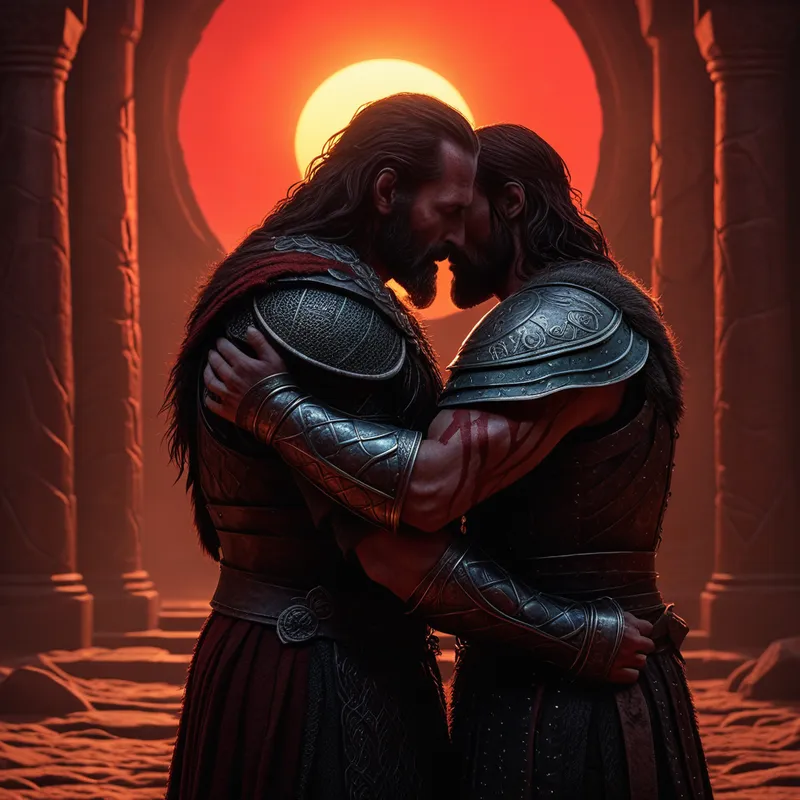
Cultural Origins & Context
The [Ragnarök prophecy](/myths/ragnark-prophecy “Myth from Norse culture.”/) is preserved primarily in two 13th-century Icelandic texts: the Poetic Edda, particularly the poem Völuspá (The Prophecy of the Seeress), and the Prose Edda of Snorri Sturluson. These Christian-era writings systematized older, fragmented oral traditions that had circulated for centuries across the Germanic world.
The myth was not a distant theological concept but a lived cosmology for the Viking Age Norse. It was recited by skalds and seeresses, its imagery etched on [runestones](/myths/runestones “Myth from Norse culture.”/) and woven into the fabric of daily life. Its function was multifaceted: it was a cosmic explanation for natural cycles of destruction and regeneration (winter and spring, volcanic eruptions, and fertile ash), a moral compass emphasizing courage and loyalty in the face of certain doom, and a narrative that gave profound meaning to a life often lived on the harsh edge of survival. In a culture that valued heroic defiance above all, [Ragnarök](/myths/ragnark “Myth from Norse culture.”/) provided the ultimate stage for that defiance, even—especially—when it was foredoomed.
Symbolic Architecture
Ragnarök is not merely an apocalypse; it is the necessary [dissolution](/symbols/dissolution “Symbol: The process of breaking down, dispersing, or losing form, often representing transformation, release, or the end of a state of being.”/) that precedes reconstitution. It is the mythic [expression](/symbols/expression “Symbol: Expression represents the act of conveying thoughts, emotions, and individuality, emphasizing personal communication and creativity.”/) of [entropy](/symbols/entropy “Symbol: In arts and music, entropy represents the inevitable decay of order into chaos, often symbolizing creative destruction, impermanence, and the natural progression toward disorder.”/) and evolution locked in an eternal dance. The gods themselves are not eternal, unchanging beings; they are participants in a cycle that demands their end for a new beginning to be possible.
The old order, no matter how noble, must shatter for the new to be born. This is the terrifying, fertile law of all deep transformation.
Symbolically, the Fenrir represents the uncontrollable, chaotic [shadow](/symbols/shadow “Symbol: The ‘shadow’ embodies the unconscious, repressed aspects of the self and often represents fears or hidden emotions.”/) that eventually breaks all bonds of repression. The Jörmungandr is the [tail](/symbols/tail “Symbol: A tail in dreams can symbolize instincts, connection to one’s roots, or the hidden aspects of personality.”/)-eating [ouroboros](/symbols/ouroboros “Symbol: An ancient symbol depicting a serpent or dragon eating its own tail, representing cyclicality, eternity, self-sufficiency, and the unity of opposites.”/), the cycle of existence that must be confronted and transcended. Surtr is the purifying, all-consuming fire of radical change. Crucially, the survivors—gods and humans—are not new creations, but inheritors. They carry the [memory](/symbols/memory “Symbol: Memory symbolizes the past, lessons learned, and the narratives we construct about our identities.”/) (the golden tafl pieces) and the tools (Mjölnir) of the past into the new world, suggesting that wisdom, not just [life](/symbols/life “Symbol: The symbol of ‘Life’ represents a journey of growth, interconnectedness, and existential meaning, encompassing both the joys and challenges that define human experience.”/), is what survives the conflagration.
The Dreamer’s Resonance
When the imagery of Ragnarök erupts in the modern [psyche](/myths/psyche “Myth from Greek culture.”/)—through dreams of world-ending floods, collapsing structures, or titanic, futile battles—it rarely signals literal fear of annihilation. Instead, it marks a profound psychic Ragnarök. The dreamer is undergoing the dissolution of a long-standing inner “world”: a rigid identity, a foundational belief system, a career, or a relationship that has structured their reality.
The somatic experience can be one of deep exhaustion (the Fimbulwinter), feeling poisoned by old resentments (Thor’s venom), or the terrifying sense of being consumed by a previously managed anxiety or rage (the wolf Fenrir). The dream is the psyche’s dramatic enactment of a necessary death. It feels apocalyptic because, to the conscious ego, it is. The dreamer is in the space between stories, where the old map has burned and the new land has not yet risen from the sea.
Alchemical Translation
For the individual on the path of individuation, the Ragnarök cycle models the most profound alchemical operation: [solve et coagula](/myths/solve-et-coagula “Myth from Alchemical culture.”/) (dissolve and coagulate). The conscious personality, the “kingdom of [the ego](/myths/the-ego “Myth from Jungian culture.”/)” with its ruling gods (complexes and personas), must face its destined confrontation with the repressed contents of the unconscious—the monsters bred in [the shadow](/myths/the-shadow “Myth from Jungian culture.”/).
The hero’s journey culminates not in eternal victory, but in the willingness to participate in one’s own meaningful end.
The battle on Vígríðr is the inner confrontation where outdated aspects of [the self](/myths/the-self “Myth from Jungian culture.”/) are sacrificed. The “Odin” within—the ruling principle of wilful knowledge—must be devoured by the instinctual “wolf” it once tried to chain. The “Thor” within—the defensive, protecting will—must exhaust itself battling the cyclical, all-encompassing problem (the serpent) it can defeat but not survive unchanged. This is not failure, but fulfillment.
The green earth that rises is the new psychic synthesis, the [unus mundus](/myths/unus-mundus “Myth from Alchemical culture.”/) or unified self, born from the ashes of that conflict. Líf and Lífþrasir are the nascent, vulnerable, but resilient core of the individual that emerges when the drama of the complexes has burned itself out. They do not rule, but they live, carrying the potential of a world no longer at war with itself. Thus, Ragnarök translates from a myth of cosmic fate to a map of psychic rebirth, where the end of one’s world is the precondition for becoming whole.
Associated Symbols
Explore related symbols from the CaleaDream lexicon: