Ragnarök Myth Meaning & Symbolism
The prophesied end of the Norse cosmos, a cataclysmic battle where gods and monsters fall, and a new, green world rises from the sea.
The Tale of Ragnarök
Listen. The wind that whispers through the roots of the Yggdrasil carries a chill that was not there before. The sun, once golden, now casts a sickly, pallid light. The moon is chased by a hungry shadow. This is the Ragnarök, the doom of the powers, and its harbingers are everywhere.
First comes the Fimbulwinter. Three winters roll into one, without a summer’s breath between. Snow drives horizontally, burying homes and hope. Brothers turn on brothers for a crust of bread, and all oaths are shattered. In this endless cold, the bonds of the world begin to fray.
Then, the prisoners of the gods stir. In the eastern woods, the aging giantess gives birth to wolf-cubs fathered by Loki, and one, Fenrir, breaks his magical fetters, his jaws stretching from earth to sky. From the deep, the Jörmungandr writhes, churning the oceans into poison as he hauls his mountainous coils onto the land. The ship Naglfar, built from the untrimmed nails of the dead, is loosed, steered by Surtr and laden with jötnar. From the south, Surtr marches, a being of living flame, his sword brighter than the sun, setting the very air aflame. Heimdallr sees all, and with a breath that has been held for ages, he raises the Gjallarhorn and sounds the final note.
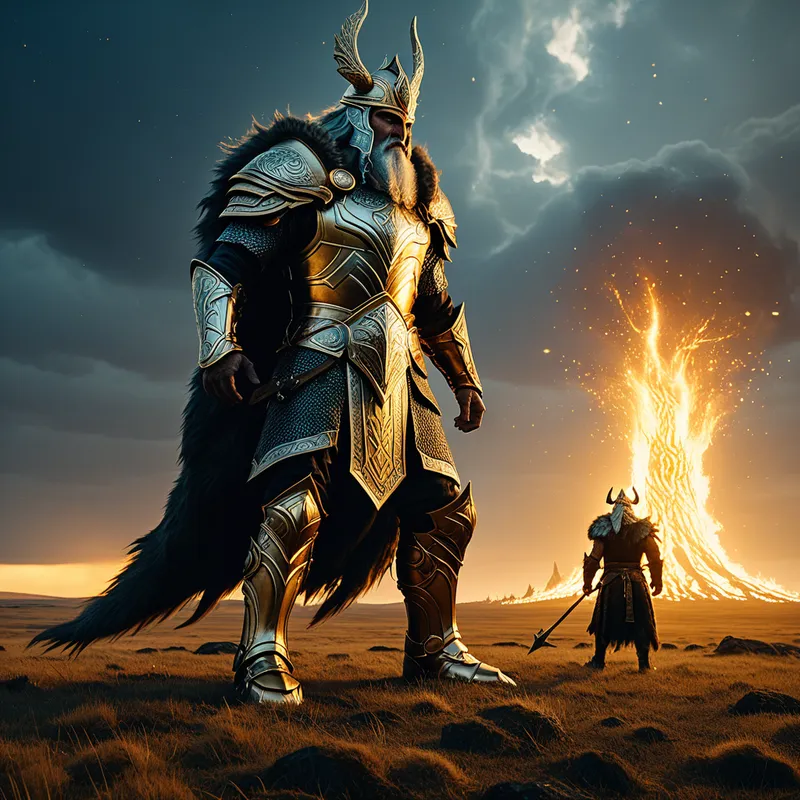
The Vígríðr plain becomes the stage. Óðinn, in his golden helm, rides to meet Fenrir. The wolf’s maw closes. The All-Father falls. In revenge, Þórr, mightiest of the gods, strides forth to face the Midgard Serpent. He raises Mjölnir, lands a blow that cracks the world, and takes nine steps back before succumbing to the serpent’s venom. Týr, who once bound the wolf, fights the hound Garmr, and they slay each other. Loki and Heimdallr, eternal adversaries, meet and exchange fatal blows. Surtr swings his sword, and the nine worlds become a roaring furnace. Stars gutter out. The earth sinks beneath the boiling sea. Yggdrasil groans, its trunk ablaze, and the great tree trembles.
Silence. Ash falls like grey snow on a steaming, empty sea.
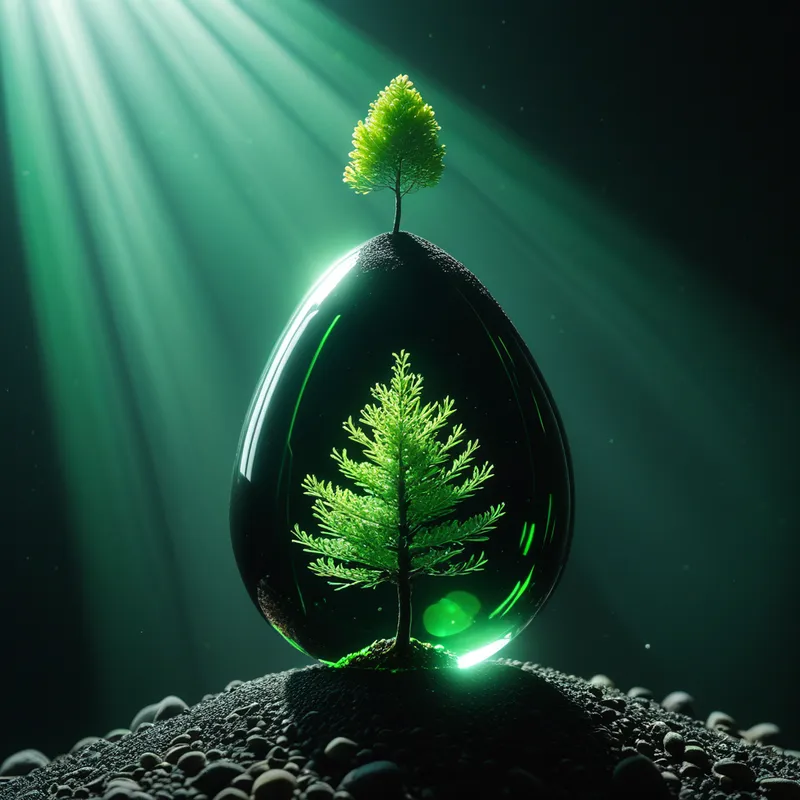
Then, a miracle of green. From the waters, land rises again, fresh and fertile. A new sun, daughter of the old, rides across a cleansed sky. In a hidden grove, two human survivors, Líf and Lífþrasir, emerge, having hidden in the wood of the world tree. And in the high grass of Valhalla, the gods Baldr and Höðr, reconciled, return from the land of the dead. They find, lying in the grass, the golden chess pieces the gods played with in the dawn of time. The game begins anew.
Cultural Origins & Context
The myth of Ragnarök was not a distant theological concept for the Norse peoples; it was a living, breathing framework etched into the very fabric of their reality. Preserved primarily in the Völuspá (“The Prophecy of the Seeress”) and the Prose Edda, these stories were the province of skalds and storytellers, recited in smoky longhouses and around flickering hearths. This was an oral tradition, where the rhythm of the verse and the power of the performance kept the knowledge alive across generations.
Its societal function was multifaceted. In a world perceived as inherently hostile and finite, where winter could mean death and conflict was a constant, Ragnarök provided a cosmic validation of that struggle. It taught that even the gods were subject to ørlög, a fate woven from the beginning. This was not a myth that promised salvation or an easy afterlife for all, but one that prized courage in the face of inevitable doom. The glory was in the fight itself, in meeting one’s destiny with a sword in hand and a laugh on one’s lips, just as the gods did on Vígríðr. It was a narrative that forged resilience, binding community through a shared understanding of a cosmos that was cyclical, brutal, beautiful, and ultimately renewable.
Symbolic Architecture
Ragnarök is not merely an apocalyptic tale; it is a profound symbolic map of necessary dissolution. Every element is an archetypal force in the drama of existence.
The Fimbulwinter represents the psychic freeze, the period of stagnation, depression, or spiritual death that must precede any great transformation. It is the hardening of old patterns, the coldness that makes the current way of life untenable. The breaking of the monsters—Fenrir, Jörmungandr, Naglfar—symbolizes the eruption of all that has been repressed, bound, and denied. These are the chaotic, destructive, yet potent energies of the unconscious that can no longer be contained by the ruling order of the conscious psyche (the gods).
The death of the gods is not a failure, but the ultimate sacrifice of a ruling consciousness that has become too rigid to contain the totality of life.
Óðinn’s fall to the wolf signifies the devouring of intellectual knowledge and control by raw, instinctual fury. Þórr’s mutual destruction with the serpent is the exhaustion of brute force in battling the endless, coiling complexities of one’s own shadow. The fire of Surtr is the alchemical ignis, the purifying flame that reduces all forms to their essential ashes, making space for the new. Crucially, the world tree, Yggdrasil, trembles but is not destroyed; it is the enduring structure of the Self that survives the ego’s cataclysm.
The Dreamer’s Resonance
When the pattern of Ragnarök stirs in the modern dreamscape, the dreamer is in the throes of a profound psychic death-rebirth sequence. This is not about small anxieties, but about the collapse of a foundational life-structure: the end of a career, the dissolution of a long-held identity, the shattering of a core belief system, or the overwhelming influx of repressed trauma or rage.
Dreams may be filled with imagery of natural disasters—world-ending floods, consuming fires, or endless, desolate winters. Monstrous figures may pursue the dreamer, representing “bound” aspects of the self now running rampant. There is often a somatic component: a feeling of crushing pressure, of being devoured, or of freezing cold. The dream ego, like the gods, often fights a desperate, losing battle.
This is the psyche’s way of orchestrating its own Ragnarök. The conscious attitude (the pantheon of gods) that has ruled the inner kingdom has become unsustainable. It is being overthrown by the neglected and powerful forces of the unconscious (the monsters and giants). The intense fear and chaos in such dreams are the birth pangs of a new psychological order. The dreamer is not going mad; they are undergoing a necessary, if terrifying, initiation into a larger state of being.
Alchemical Translation
For the individual on the path of individuation, Ragnarök is the ultimate model of psychic transmutation. The alchemical process of solve et coagula—dissolve and coagulate—is writ large across the myth. One must have the courage to let the old “god”—the outmoded self-image, the inflated persona, the complex that has ruled one’s life—be slain.
This is the heroism of the rebel archetype, not rebelling against an external authority, but against the internal, tyrannical status quo. It requires facing one’s personal Fenrir (unbridled anger or hunger), one’s Jörmungandr (the encircling anxiety or guilt that poisons one’s world), and one’s Surtr (the purifying, destructive passion that burns away the inauthentic).
The green land that rises is the new consciousness, tempered by fire and flood, capable of holding both light (Baldr) and darkness (Höðr) in reconciliation.
The survivors, Líf and Lífþrasir, represent the nascent, resilient core of the personality that hides within the world tree of the Self during the cataclysm. They are the seed of the future. To undergo one’s Ragnarök is to stop fighting the inevitable death of an old phase and to instead submit to the transformative fire, trusting—not knowing, but trusting—in the regenerative principle of the psyche itself. It is to find, amidst the ashes, the golden game pieces, and to begin playing again, not as a doomed god, but as a human, reborn and whole.
Associated Symbols
Explore related symbols from the CaleaDream lexicon:
- Battle
- Explosion
- Sunset
- Disaster
- Commotion
- Crash
- Time Loop
- Eclipse of Understanding
- Eclipsed Light
- Avalanche
- Blazing Sunset
- Supernova
- Hypernova Explosion
- Francium Burst
- Severe Weather Warning
- Nightmare Mode
- Dominoes
- Mythical Legends
- Celestial Eraser
- Dramatic Sunset
- Screeching Tires
- Ashen Skies
- Shattered Hourglass
- Ruins Smoldering
- Heat of Battle
- Wildfire Resilience
- Flame-Kissed Wilderness
- Ashen Sky
- Tornado Warnings
- Wildfire Remains
- Angel Number 999
- Harsh Noise
- Discordant Clash
- Notification Flood
- System Crash
- Data Corruption
- Atmospheric Inversion
- Entropy
- Turbulence
- Sound Scattering
- Singularity Point
- Entropy Arrow
- Entropy Gradient
- Permadeath
- Countdown
- Cliffhanger
- Resolution
- Foreclosure
- Degeneration
- Finite
- Destroyer
- Redshift
- Asteroid
- Tephra
- Erase
- Resetting