Rabbi Akiva's Vision Myth Meaning & Symbolism
A sage sees the Temple in ruins and laughs, then sees it rebuilt and weeps, revealing a paradoxical vision of divine providence within catastrophe.
The Tale of Rabbi Akiva’s Vision
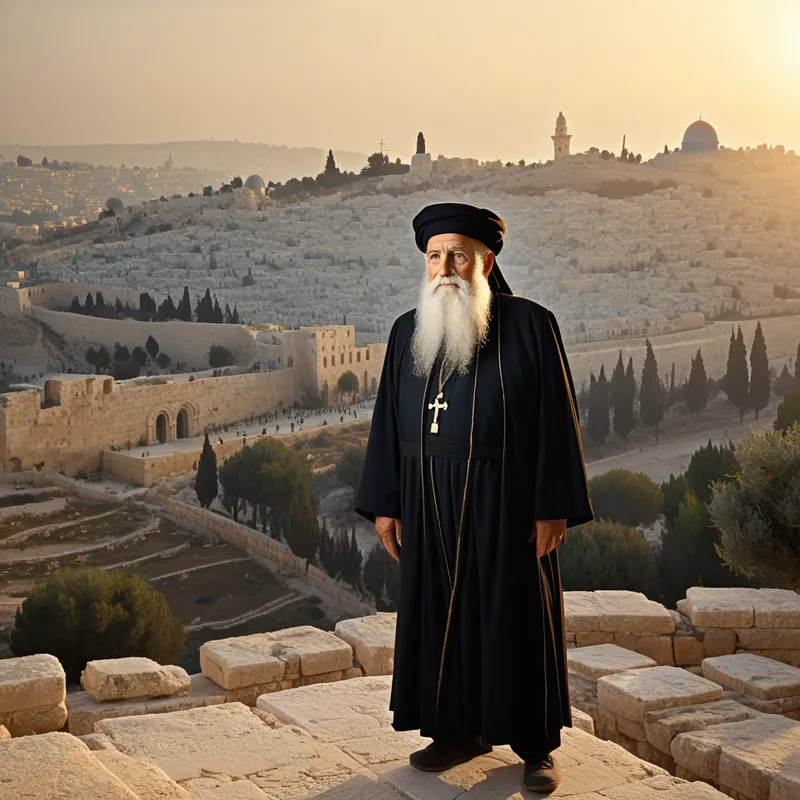
The world was ash. The scent of charred cedar and sanctified stone hung thick over Jerusalem, a bitter perfume of defeat. Upon the Mount of Olives, the earth itself seemed to weep, its slopes littered with the grief of a nation. Here walked Rabbi Akiva, not as a conqueror but as a witness. His robes were simple, his face a map of lines drawn by study and sorrow. With him walked the great sages—Rabbi Gamaliel, Rabbi Eleazar ben Azariah, and Rabbi Joshua—their silence a heavier burden than any lament.
They crested the ridge. And there it lay: the Holy Temple. Not the gleaming house of gold and song from the psalms, but a carcass of shattered marble. The great walls were broken teeth against the sky. Where the Holy of Holies had stood, now only a smoldering foundation remained, open to the indifferent heavens. It was the unmaking of the world’s center.
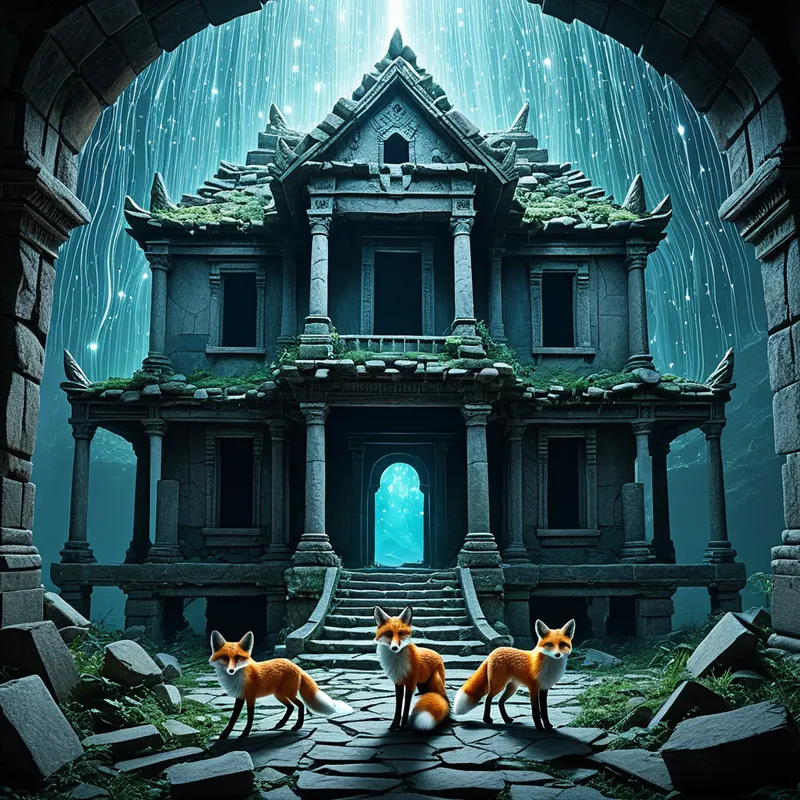
Then, a movement in the ruins. A fox. Its red brush flickered as it picked its way daintily over the foundation stones of the Holy of Holies, the place where only the High Priest, once a year, in fear and trembling, dared to tread. The other sages tore their garments anew and wept, their cries echoing the broken stones. This was the ultimate desecration, the final proof of abandonment.
But Rabbi Akiva did not weep. His eyes, old and deep as wells, watched the fox. And then, a sound tore from his throat—a sound so foreign to that place of mourning it seemed to split reality. He laughed. A rich, full laugh that rolled down the hill toward the ruins.
His companions stared, aghast. “Akiva! You console us? Here, where even the foxes trample our holiness, you laugh?”
He turned to them, the ghost of his laughter still in his eyes. “That is precisely why I laugh,” he said, his voice quiet yet carrying. “For it was prophesied: ‘Zion shall be plowed as a field; Jerusalem shall become a heap of ruins, and the mountain of the house a wooded height.’ The prophecy of desolation, see, it is fulfilled before our eyes in terrifying detail. But the prophets also spoke of rebuilding: ‘Yet again shall there be heard in this place… the voice of joy and the voice of gladness.’ If the prophecy of ruin is so meticulously true, then how much more certain, how utterly inevitable, is the prophecy of restoration? The fox proves the promise.”
The sages fell silent, the logic of his vision settling upon them like a mantle. Then Rabbi Akiva spoke again, his voice now thick. “Therefore, I laughed. For I saw the ruin and knew the rebuilding.” He paused, and a single tear, brighter than any jewel the Temple had held, traced a path through the dust on his cheek. “But now… now I weep. For I who have seen the promise, I who am certain of the joy to come… I weep that I may not live to see it with my own eyes.”
Cultural Origins & Context
This narrative is preserved in the Talmud (Makkot 24b), a text codified centuries after the catastrophic Roman destruction of the Second Temple in 70 CE. The story is not a historical report but a profound theological and psychological artifact forged in the crucible of national trauma. Rabbi Akiva, a historical figure martyred by the Romans, is elevated here to the archetypal seer.
The tale functioned as a vital survival mechanism for a people whose entire cosmic and social order—centered on the Temple—had been obliterated. It was told in study halls and whispered in exile, a narrative antidote to despair. It transferred the locus of holiness from a physical, destructible building to the indestructible, interpretive mind of the sage. The story asserts that meaning is not derived from circumstance, but imposed upon circumstance through a visionary act of faith and intellect. It taught that true sight—prophetic vision—could perceive the future template within the present wreckage.
Symbolic Architecture
At its core, the myth is a masterclass in paradoxical [perception](/symbols/perception “Symbol: The process of becoming aware of something through the senses. In dreams, it often represents how one interprets reality or internal states.”/). The [Temple](/symbols/temple “Symbol: A temple often symbolizes spirituality, sanctuary, and a deep connection to the sacred aspects of life.”/) represents the psychic center, the Self, or any foundational [structure](/symbols/structure “Symbol: Structure in dreams often symbolizes stability, organization, and the framework of one’s life, reflecting how one perceives their environment and personal life.”/) of [identity](/symbols/identity “Symbol: Identity represents the sense of self, encompassing personal beliefs, cultural background, and social roles.”/), [faith](/symbols/faith “Symbol: A profound trust or belief in something beyond empirical proof, often tied to spiritual conviction or deep-seated confidence in people, ideas, or outcomes.”/), or order. Its ruin is the experience of profound personal or collective catastrophe—the [death](/symbols/death “Symbol: Symbolizes transformation, endings, and new beginnings; often associated with fear of the unknown.”/) of a dream, the collapse of a worldview, a shattering depression.
The fox in the Holy of Holies is not a symbol of desecration, but of the liberated, cunning, and adaptive spirit of life that persists when rigid structures fall.
The fox, often a [trickster](/symbols/trickster “Symbol: A boundary-crossing archetype representing chaos, transformation, and the subversion of norms through cunning and humor.”/) figure, embodies the unexpected, even profane, [energy](/symbols/energy “Symbol: Energy symbolizes vitality, motivation, and the drive that fuels actions and ambitions.”/) that emerges in the void. It is the raw, instinctual [life](/symbols/life “Symbol: The symbol of ‘Life’ represents a journey of growth, interconnectedness, and existential meaning, encompassing both the joys and challenges that define human experience.”/)-force that scrambles over the ruins of our most sacred assumptions. Akiva’s genius is to not reject this [image](/symbols/image “Symbol: An image represents perception, memories, and the visual narratives we create in our minds.”/) as blasphemous, but to recognize it as the necessary proof-text for a greater narrative. His laugh is the [eruption](/symbols/eruption “Symbol: A sudden, violent release of pent-up energy or emotion from beneath the surface, often representing transformation or crisis.”/) of [gnosis](/symbols/gnosis “Symbol: Direct, intuitive spiritual knowledge or enlightenment that transcends ordinary understanding, often associated with mystical experiences and esoteric traditions.”/)—the [moment](/symbols/moment “Symbol: The symbol of a ‘moment’ embodies the significance of transient experiences that encapsulate emotional depth or pivotal transformations in life.”/) the psyche grasps the hidden, redemptive [pattern](/symbols/pattern “Symbol: A ‘Pattern’ in dreams often signifies the underlying structure of experiences and thoughts, representing both order and the repetitiveness of life’s situations.”/) within the [chaos](/symbols/chaos “Symbol: In Arts & Music, chaos represents raw creative potential, uncontrolled expression, and the breakdown of order to forge new artistic forms.”/).
His subsequent tears represent the poignant [human](/symbols/human “Symbol: The symbol of a human represents individuality, complexity of emotions, and social relationships.”/) cost of this transcendent understanding. The visionary sees the promised wholeness but must still inhabit the broken present. This [tension](/symbols/tension “Symbol: A state of mental or emotional strain, often manifesting physically as tightness, pressure, or unease, signaling unresolved conflict or anticipation.”/) between the eternal pattern and the temporal suffering is the essence of the [human](/symbols/human “Symbol: The symbol of a human represents individuality, complexity of emotions, and social relationships.”/) [condition](/symbols/condition “Symbol: Condition reflects the state of being, often focusing on physical, emotional, or situational aspects of life.”/).
The Dreamer’s Resonance
When this mythic pattern stirs in the modern dream, it often manifests as dreams of ruined familiar places—childhood homes collapsed, universities as empty shells, one’s own body as a derelict temple. The emotional tone is one of profound grief and disorientation. Yet, within the dream, there is often an incongruous, even irritating, element of vitality: animals playing in the rubble, weeds flowering through cracks, or a strange, calm figure (perhaps the dreamer themselves) who seems oddly at peace or amused.
This dream signals that the psyche is in the throes of a necessary deconstruction. The old inner Temple—a career identity, a long-held belief, a relational paradigm—has fallen. The dream is not merely reporting the catastrophe but initiating the alchemical process. The laughing figure or playful animal is the first hint of the Self’s reassurance, the emerging blueprint for a new, more authentic structure that can only be built upon these cleared foundations. The somatic experience may be a tight chest of grief simultaneously coupled with a strange, deep-seated relief or calm.
Alchemical Translation
The myth models the complete cycle of psychic transmutation, or individuation. The first stage is Nigredo—the blackening, the ruin on the mountaintop, the confrontation with the shadow of loss and failure. This is not a mistake but the prerequisite.
The alchemical work begins not with building, but with the courageous witnessing of the destruction, and the paradoxical finding of validation within it.
Akiva’s laugh is the Albedo—the whitening, the illuminating insight. It is the moment the ego’s perspective is overthrown by the wider, timeless perspective of the Self. He decodes the ruin, not as a random tragedy, but as a verse in a sacred text written by fate itself. This reframing is an act of supreme psychic authority, where one becomes the interpreter of one’s own suffering.
The weeping is the final, humanizing stage. It is the reintegration of the transcendent insight back into the heart of mortal experience. The visionary knows the gold (Citrinitas and Rubedo) is coming, but must feel the weight of the lead. This full-hearted embrace of both the certainty of renewal and the pain of the present moment is the birth of authentic, grounded wisdom. The new Temple is not a return to the old form, but a more conscious, resilient, and interiorized structure, built precisely because—and not in spite of—the foxes that once played in its sacred dust.
Associated Symbols
Explore related symbols from the CaleaDream lexicon:
- Vision — The central faculty of the myth, representing the ability to perceive the latent future pattern within the apparent present reality, a form of prophetic or depth-psychological sight.
- Temple — The symbol of the psychic center, the integrated Self, or any sacred internal or external structure that can be destroyed and must be rebuilt on a new level of consciousness.
- Ruins — The necessary state of deconstruction and nigredo that precedes any authentic rebirth, representing shattered paradigms and the fertile ground for new growth.
- Fox — The trickster spirit and adaptive life force that inhabits ruins, proving that life and cunning persist even in the heart of devastation, challenging rigid sanctity.
- Mountain — The place of revelation and perspective, the elevated vantage point (the Mount of Olives) from which the full, painful panorama of destruction can be surveyed and transmuted into vision.
- Stone — The foundational material of the Temple and its ruins, representing the hard, enduring facts of reality and loss, which become the literal building blocks for the future structure.
- Rebirth — The inevitable promise hidden within the ruin, the core theme of the myth which asserts that destruction is always the first phase of a cyclical process of renewal.
- Light — The illuminating insight of Akiva’s laugh, the sudden gnosis that reveals the hidden order and future restoration within the present darkness.
- Grief — The authentic human response to loss, represented by the tears of the sages and Akiva’s own weeping, which is not negated by the vision but given deeper meaning within it.
- Prophet — The archetypal role embodied by Akiva, the one who speaks the future into the present, who interprets the signs of the times through the lens of a deeper, divine narrative.
- Desert — The symbolic landscape of testing and revelation that often follows the ruin, the barren period of wandering and waiting where the new vision must be nurtured.
- Circle — The myth’s underlying structure of ruin and rebuilding, death and rebirth, representing the cyclical,而非 linear, nature of psychological and spiritual transformation.