Qoricancha Temple of the Sun Myth Meaning & Symbolism
The myth of the sacred temple where the Sun God Inti anchored divine order, binding heaven to earth through gold, light, and perfect geometry.
The Tale of Qoricancha Temple of the Sun
Listen. Before the world knew time as we count it, when the mountains were young and the sky was a breath away, the Sun God Inti wept tears of molten gold. His children, the first Incas, Manco Cápac and Mama Ocllo, emerged from the depths of Lake Titicaca, sent to bring order to the chaos of the earth. They carried a slender rod of gold, a divine mandate. Where this rod would sink effortlessly into the soil, there they would found their kingdom.
They journeyed through valleys and over peaks, the rod testing the earth. For years, it struck stone. Then, they came to a high valley cradled by sleeping giants of rock. Here, the air was thin and sharp, the light so clear it seemed to cut. Manco Cápac plunged the golden rod. It did not clang. It did not resist. It sank into the rich, dark earth as into water, vanishing up to his fist. At that moment, Inti spoke not with sound, but with a searing beam of light that struck the very spot, warming the stone, promising life.
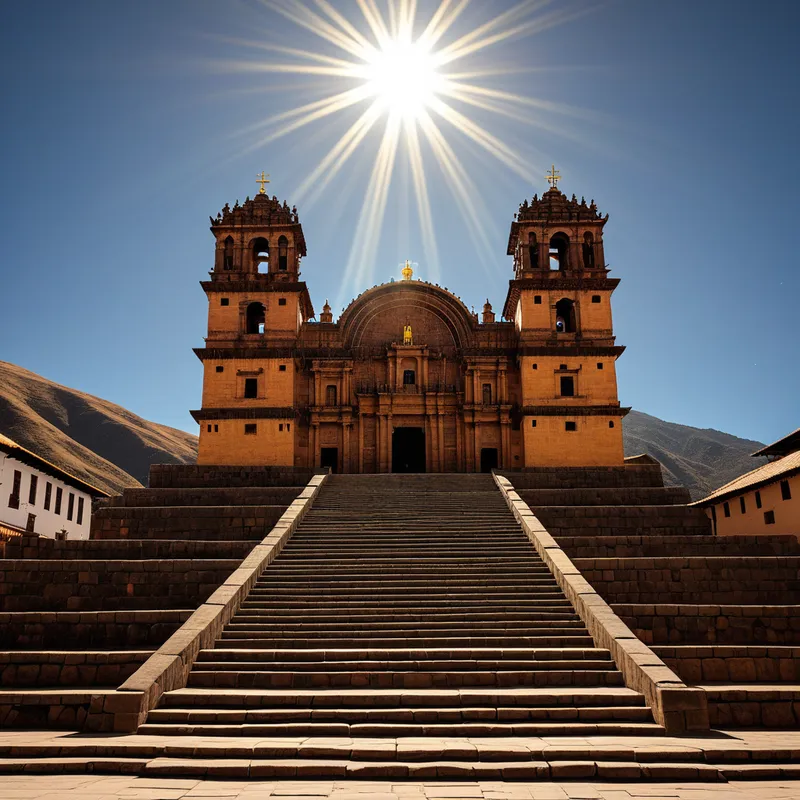
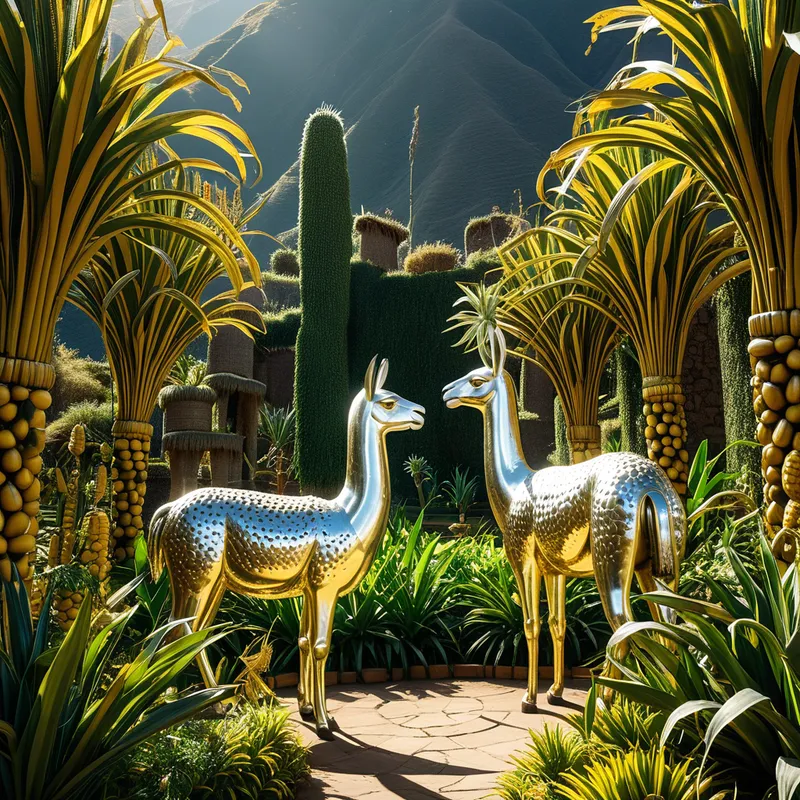
This was the Cusco, the navel. And at its heart, they built the Qoricancha. Not with crude effort, but with a whispered song to the stones, which softened and flowed into place, joints so tight a blade of light could not pass. They sheathed its walls in plates of beaten gold, so that when the sun rose, the temple did not merely reflect light—it became light, a second sun resting upon the earth. Inside, they fashioned a garden of marvels: cornstalks of silver, llamas of gold, life frozen in precious metal, a perfect, silent mirror of the world Inti sustained.
Here, the Sapa Inca would come, his shadow long in the dawn. He would stand in the central chamber, where a great golden disk, etched with the face of Inti, caught the first rays. The light would ignite the disk, fill the room with a palpable, warming presence, and travel through precisely aligned windows to touch lesser shrines to the Moon, Illapa, and the stars. In this daily ritual, the cosmic order was reaffirmed. The temple was not just a building; it was the anchor point of the universe, the knot that tied the celestial to the terrestrial, ensuring the sun would return, the rains would fall, and the empire would endure under the unwavering gaze of its father.
Cultural Origins & Context
The myth of Qoricancha is the foundational narrative of Tawantinsuyu, the Inca Empire. It is a state myth, propagated by the royal amautas and performed through monumental architecture and public ceremony. Its primary function was legitimization. By rooting the origin of the ruling dynasty and their capital in a direct divine mandate from Inti, it established the Sapa Inca as the indispensable intermediary between the people and the forces that governed their survival.
The temple itself was the physical proof of this myth. Its unparalleled opulence, its precise astronomical alignments, and its central location in the cosmologically designed city of Cusco made the story tangible. The myth was passed down not only orally but etched into the landscape. Every solstice ceremony, where the sun entered a specific niche, was a re-enactment of the original divine anchoring. It told a story of order (Tawantinsuyu itself means “the four parts together”) imposed upon potential chaos, a narrative essential for unifying a vast, ethnically diverse empire under a single, sacrosanct authority.
Symbolic Architecture
At its core, the myth of Qoricancha is about the incarnation of a cosmic principle into terrestrial form. The [temple](/symbols/temple “Symbol: A temple often symbolizes spirituality, sanctuary, and a deep connection to the sacred aspects of life.”/) is the [axis](/symbols/axis “Symbol: A central line or principle around which things revolve, representing stability, orientation, and the fundamental structure of reality or consciousness.”/) mundi, the still point around which the world turns. It symbolizes the [human](/symbols/human “Symbol: The symbol of a human represents individuality, complexity of emotions, and social relationships.”/) yearning to find—or create—a center of meaning, a place where the transcendent (the sun, divine light, cosmic order) touches the immanent (the [earth](/symbols/earth “Symbol: The symbol of Earth often represents grounding, stability, and the physical realm, embodying a connection to nature and the innate support it provides.”/), the [community](/symbols/community “Symbol: Community in dreams symbolizes connection, support, and the need for belonging.”/), the individual).
The true temple is not built of stone, but is the point where consciousness aligns with a law greater than itself, becoming a conduit for meaning.
The golden rod represents divine will or intuitive knowing sinking into the [fertile ground](/symbols/fertile-ground “Symbol: Fertile ground symbolizes potential, growth, and the promise of new beginnings, reflecting a state where life can thrive.”/) of potential. Cusco is the discovered Self. Qoricancha is the Self [archetype](/symbols/archetype “Symbol: A universal, primordial pattern or prototype in the collective unconscious that shapes human experience, behavior, and creative expression.”/) manifested—a perfectly ordered, radiant psychic [structure](/symbols/structure “Symbol: Structure in dreams often symbolizes stability, organization, and the framework of one’s life, reflecting how one perceives their environment and personal life.”/) built from the refined [material](/symbols/material “Symbol: Material signifies the tangible aspects of life, often representing physical resources, desires, and the physical world’s influence on our existence.”/) of one’s [life](/symbols/life “Symbol: The symbol of ‘Life’ represents a journey of growth, interconnectedness, and existential meaning, encompassing both the joys and challenges that define human experience.”/) (the gold). The gold sheathing is not mere [wealth](/symbols/wealth “Symbol: Wealth in dreams often represents abundance, security, or inner resources, but can also symbolize burdens, anxieties, or moral/spiritual values.”/); it is the outer manifestation of an inner alignment, where one’s [persona](/symbols/persona “Symbol: The social mask or outward identity one presents to the world, often concealing the true self.”/) reflects the luminosity of the core. The garden of golden flora and fauna symbolizes the state where the inner world is so harmoniously integrated that its contents are transformed, becoming precious and [life](/symbols/life “Symbol: The symbol of ‘Life’ represents a journey of growth, interconnectedness, and existential meaning, encompassing both the joys and challenges that define human experience.”/)-giving.
The Dreamer’s Resonance
To dream of Qoricancha is to dream of seeking or encountering one’s inner sanctum. The dream may present as discovering a hidden, perfectly geometric room within a familiar house, or finding a source of brilliant, warm light in a dark labyrinth. The somatic feeling is often one of profound relief, warmth, and awe—a dropping of the shoulders, an opening of the chest.
Psychologically, this dream pattern emerges during a process of centering and integration. The dreamer is likely consolidating a hard-won sense of identity or purpose. The chaotic or fragmented elements of the psyche (the untamed land) are being organized around a newly discovered or reaffirmed central principle (the temple). If the temple in the dream is ruined or desecrated, it may speak to a crisis of faith in one’s own inner authority or guiding principle. If it is radiant and intact, it signifies a moment of self-consecration, where the dreamer’s life feels authentically aligned with a deep, inner truth.
Alchemical Translation
The myth models the alchemical process of individuation as the construction of an inner temenos—a sacred precinct. The raw prima materia is the chaotic, undirected potential of the individual. The divine mandate (Inti’s will) is the call from the Self, often felt as a compelling intuition or life purpose.
The journey with the rod is the stage of nigredo and albedo—the difficult search and the clarifying insight, testing various life paths (soils) until one finds the place where effort ceases and things flow naturally (“the rod sinks in”). This is the discovery of one’s vocation or true center.
The alchemical gold is not found in the earth, but is forged in the act of building a structure worthy of the light that seeks to inhabit it.
Building the temple is the citrinitas and rubedo—the conscious, disciplined work of personality integration. The polished stones are hard-won insights and healed wounds fitted together. The gold sheathing is the application of one’s highest values to everyday life. The final stage is the daily ritual—the opus circulatorium—where the conscious ego (the Sapa Inca) returns repeatedly to this inner center to receive illumination, ensuring the ongoing vitality and order of the entire psychic empire. The individual becomes both the temple and the priest, the vessel and the conduit for a transcendent, ordering light.
Associated Symbols
Explore related symbols from the CaleaDream lexicon:
- Temple — The archetypal symbol of the sacred center, the constructed space where the divine and human meet, representing the integrated psyche in the Qoricancha myth.
- Sun — The source of light, consciousness, divine fatherhood, and cosmic order, embodied by Inti, whose presence and mandate are the raison d’être of the temple.
- Gold — Represents the highest value, divine essence, and incorruptible truth; the material that transforms stone into light, symbolizing the alchemical goal of the psyche.
- Stone — The foundational, earthly material of the temple, representing the durable structure of the self, shaped and polished by conscious effort to receive the divine.
- Light — The active, illuminating principle of consciousness and divine grace that fills the temple, binding all elements into a coherent, meaningful whole.
- Order — The central theme of the myth, manifest as the perfect geometry of the temple and the harmonious empire it anchors, opposing chaos.
- Circle — Symbolic of the sun disk, the navel of the world (Cusco), and the wholeness achieved when all parts are organized around a sacred center.
- Mountain — Represents the lofty, stable foundation upon which divine order is established, connecting earth to sky, mirroring the temple’s role.
- Altar — The focal point within the temple where the divine light is received and ritual exchange occurs, symbolizing the heart of the individual’s commitment to their inner truth.
- Ruler — Embodied by the Sapa Inca, this archetype represents the necessary inner authority that mediates between the divine order and the governance of one’s personal world.
- Dream — The modern echo of the mythic narrative, where the search for the inner temple continues in the unconscious, guiding toward wholeness.
- Mystical Temple — The transcendent aspect of Qoricancha, representing not just a historical site but the eternal archetype of the soul’s perfect, luminous sanctuary.