Python Myth Meaning & Symbolism
The story of Apollo's battle with the primordial serpent Python, a myth of order conquering chaos, light piercing the dark, and the birth of consciousness.
The Tale of Python
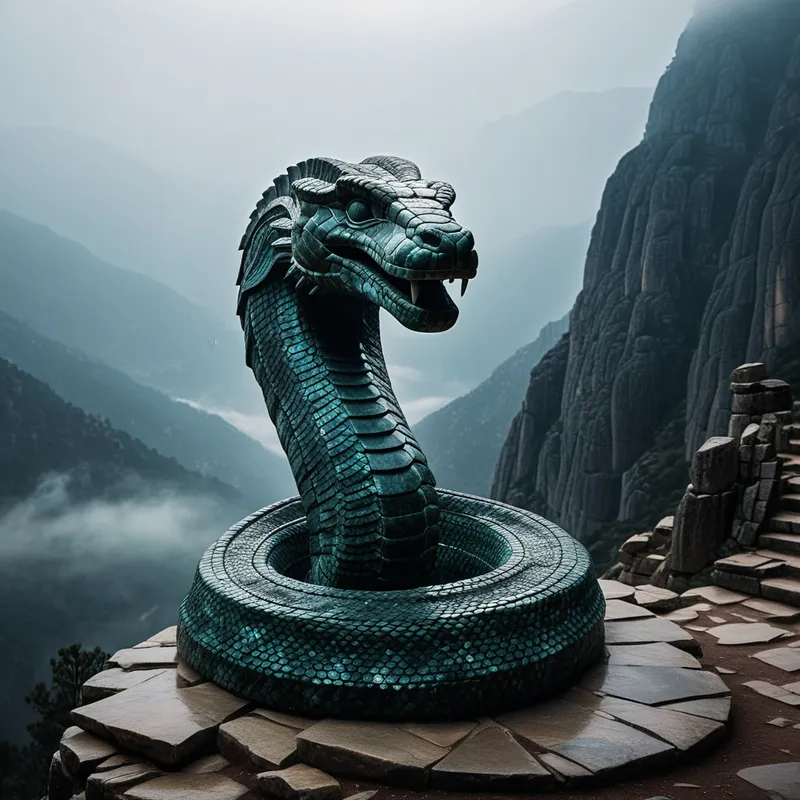
Before the first lyre’s note, before the first prophecy was breathed into [the world](/myths/the-world “Myth from Tarot culture.”/), [the earth](/myths/the-earth “Myth from Hindu culture.”/) was a place of deep, murmuring darkness. In [the womb](/myths/the-womb “Myth from Various culture.”/) of [the world](/myths/the-world “Myth from Tarot culture.”/), where the hot breath of Gaia met the chill of the deep abyss, something stirred. It was not born but coalesced—from the damp rot of the primal mud, from the venom of the first springs, from the lingering miasma of [the great flood](/myths/the-great-flood “Myth from Biblical culture.”/) sent by Zeus. This was Python, the great serpent-dragon, a creature of the Before-Time.
Its body was the mountain’s root, scaled in stone and slick with [the dew](/myths/the-dew “Myth from Alchemical culture.”/) of creation. Its coils encircled the very navel of the world, a place that would one day be called Delphi. There, in [the shadow](/myths/the-shadow “Myth from Jungian culture.”/) of [Mount Parnassus](/myths/mount-parnassus “Myth from Greek culture.”/), Python made its lair in the chasm of the earth, a crack from which issued not light, but whispers of a truth too terrible for mortals. It did not hunt; it was. It was the guardian of the chthonic oracle, the voice of the Mother Earth herself, a power ancient, raw, and untamed.
The air around its den was thick and silent, heavy with the scent of wet stone and decay. No bird sang. No creature dared approach. Python was the sovereign of that twilight realm, a living embodiment of the world’s primal, undifferentiated state—powerful, prophetic, but formless and fearsome.
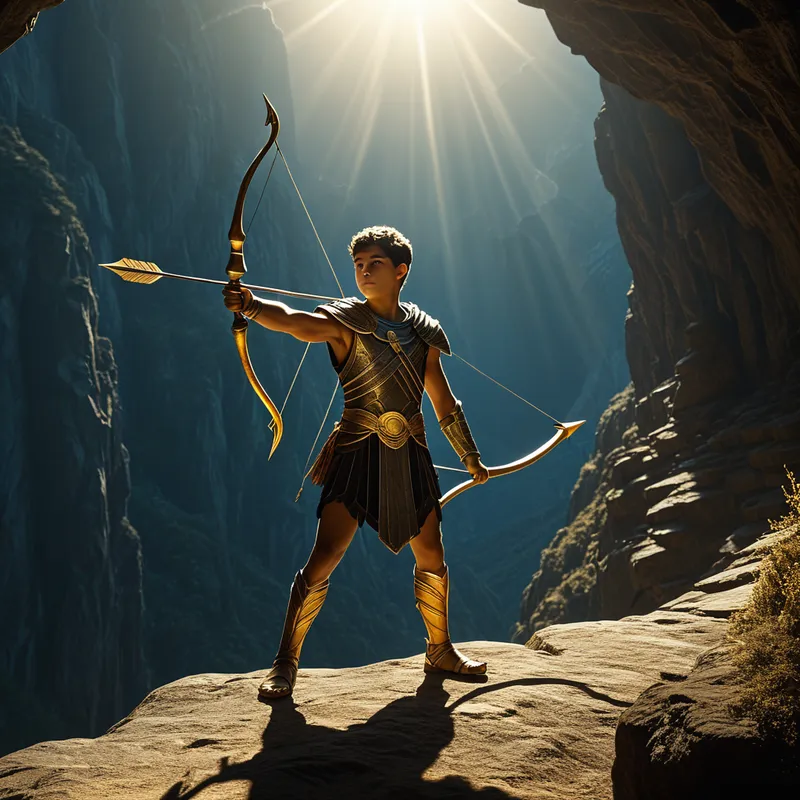
Then came the light. It was the light of Apollo, the golden son of Leto, still young but blazing with the purpose of the new Olympian order. He descended from the bright heights, a silver bow in his hand and a quiver of arrows that shone like captured sunbeams. He sought a place for his own oracle, a voice not of the murmuring earth, but of the clear, piercing sky.
He found Python coiled around [the omphalos](/myths/the-omphalos “Myth from Greek culture.”/), the world’s navel. The serpent reared its head, its eyes like pools of stagnant [water](/myths/water “Myth from Chinese culture.”/) reflecting no light, only depth. It did not roar; it issued a hiss that was the sound of the earth itself resisting definition. The conflict was not merely physical; it was cosmological. The old, chthonic power against the new, celestial clarity.
Apollo drew his bow. The air, once heavy, grew taut and electric. He let fly not one arrow, but a storm of them—each a shaft of pure, destructive reason. They pierced the primordial hide, not with mere force, but with the searing heat of meaning. Python thrashed, its coils loosening from the sacred stone, its dark blood—the [ichor](/myths/ichor “Myth from Greek culture.”/) of the old world—soaking into the ground. The great serpent sank back into the chasm from which it came, its form dissolving, its power broken.
Where its blood fell, the earth was sanctified. Apollo claimed the oracle for his own, and from the very tripod above the chasm, through the priestess known as the [Pythia](/myths/pythia “Myth from Greek culture.”/), he would now speak. The wild, earth-bound prophecy was purified by the god of light. The place was named Pytho, and the priestess the Pythian, in memory of the vanquished guardian. Order was established from chaos, and a new voice, both divine and intelligible, was given to humanity.
Cultural Origins & Context
The myth of Python is not a simple monster-slaying tale; it is a foundational charter myth for the most important religious site in the ancient Greek world: the Sanctuary of Apollo at Delphi. Its origins are deeply prehistoric, likely reflecting a real historical and religious transition. Scholars suggest Delphi was originally a site of worship for a pre-Hellenic earth goddess (possibly an aspect of Gaia or [Themis](/myths/themis “Myth from Global/Universal culture.”/)), whose oracle spoke through the fissures in the earth. The serpent Python was the mythic personification of that chthonic, feminine, and chaotic prophetic power.
The Homeric Hymn to Apollo (circa 7th century BCE) provides our most complete early account, framing Apollo’s conquest as the necessary act of a young Olympian god establishing his domain. The myth was performed by rhapsodes and embedded in the cultural consciousness, serving a critical societal function: it legitimized the Apollo cult’s takeover of the site, transforming a place of terrifying, amorphous power into one of Olympian order and sanctioned divine communication. The myth explained the name of the place (Pytho), the title of its priestess (the Pythia), and even the Pythian Games held there. It was a story of cultural and religious succession, marking the victory of the patriarchal, sky-oriented Olympian [pantheon](/myths/pantheon “Myth from Roman culture.”/) over the older, earth-bound forces.
Symbolic Architecture
At its core, the [Python](/symbols/python “Symbol: The python represents both fear and fascination, as well as transformation through confronting one’s deeper issues.”/) myth is a profound [allegory](/symbols/allegory “Symbol: A narrative device where characters, events, or settings represent abstract ideas or moral qualities, conveying deeper meanings through symbolic storytelling.”/) for the [emergence](/symbols/emergence “Symbol: A process of coming into being, rising from obscurity, or breaking through a barrier, often representing birth, transformation, or revelation.”/) of [consciousness](/symbols/consciousness “Symbol: Consciousness represents the state of awareness and perception, encompassing thoughts, feelings, and experiences.”/) from the unconscious, and of order from [chaos](/symbols/chaos “Symbol: In Arts & Music, chaos represents raw creative potential, uncontrolled expression, and the breakdown of order to forge new artistic forms.”/). [Python](/symbols/python “Symbol: The python represents both fear and fascination, as well as transformation through confronting one’s deeper issues.”/) represents the undifferentiated, primal state of the [psyche](/myths/psyche “Myth from Greek culture.”/)—the [pleroma](/symbols/pleroma “Symbol: In Gnostic cosmology, the Pleroma is the divine fullness or totality of spiritual powers, representing the realm of perfection beyond the material world.”/) where all potentials and terrors swim together. It is the autonomous, overwhelming power of the instinctual and archetypal world before the light of [the ego](/myths/the-ego “Myth from Jungian culture.”/), or the differentiating principle, arrives.
The serpent guards the oracle because the raw, unmediated truth of the unconscious is both priceless and perilous; it must be confronted and integrated, not merely obeyed.
Apollo represents the archetypal force of [logos](/myths/logos “Myth from Christian culture.”/)—[the principle](/symbols/the-principle “Symbol: A fundamental truth, law, or doctrine that serves as a foundation for a system of belief, behavior, or reasoning, often representing moral or ethical standards.”/) of distinction, [clarity](/symbols/clarity “Symbol: A state of mental transparency and sharp focus, often representing resolution of confusion or attainment of insight.”/), light, and conscious understanding. His arrows are not weapons of brute force, but of piercing [insight](/symbols/insight “Symbol: A sudden, deep understanding of a complex situation or truth, often arriving unexpectedly and illuminating hidden connections.”/) and focused will. The battle, therefore, symbolizes the necessary and often violent struggle of the conscious mind to separate itself from, and gain sovereignty over, the engulfing waters of the unconscious. The [oracle](/symbols/oracle “Symbol: An oracle represents wisdom, foresight, and divine communication, often serving as a mediator between the spiritual and physical worlds.”/) that results is not destroyed but transformed; it becomes a mediated channel where the deep, chthonic wisdom (Python) is filtered through the clarifying [structure](/symbols/structure “Symbol: Structure in dreams often symbolizes stability, organization, and the framework of one’s life, reflecting how one perceives their environment and personal life.”/) of divine order (Apollo). This is the [birth](/symbols/birth “Symbol: Birth symbolizes new beginnings, transformation, and the potential for growth and development.”/) of true symbolic understanding.
The Dreamer’s Resonance
When this mythic pattern stirs in the modern dreamer, it often manifests as an encounter with a monstrous, serpentine, or formless entity that seems to guard a vital but frightening truth. The dreamer may find themselves at the mouth of a cave, before a deep pit, or in a swamp, facing a creature that embodies a pervasive anxiety, a repressed memory, or a chaotic life situation that feels overwhelming and “primordial.”
Somatically, this can feel like a tightening in the gut, a sense of suffocation, or a paralyzing dread. Psychologically, this is the moment when content from the personal or collective shadow is rising to [the threshold](/myths/the-threshold “Myth from Folklore culture.”/) of awareness. The Python in the dream is the autonomous complex that claims territory in the psyche—be it unprocessed grief, a stifled creative impulse, or a deep-seated fear of chaos. The dream is presenting the guardian that must be faced for the dreamer to access their own inner “oracle,” their own deeper truth or potential. The conflict has begun, and the ego is being called to its Apollo-task: to engage, not flee.
Alchemical Translation
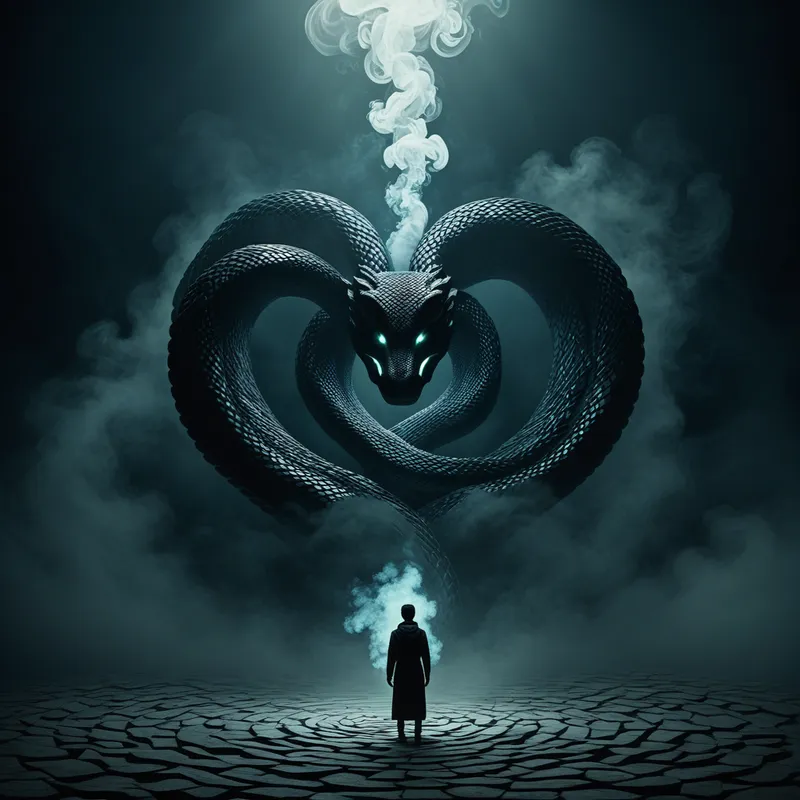
The alchemical journey mirrored in the Python myth is the [nigredo](/myths/nigredo “Myth from Alchemical culture.”/) giving way to the albedo—the blackening of chaos confronted by the whitening of clarifying consciousness. For the individual on the path of individuation, Python is [the prima materia](/myths/the-prima-materia “Myth from Alchemical culture.”/), the confusing, dark, and rejected mass of one’s unlived life and unconscious drives.
The heroic act of Apollo is not about annihilation, but about differentiation. The modern individual’s task is not to kill their inner chaos (which is impossible and destructive), but to confront it with the “arrows” of conscious attention, honest self-reflection, and courageous naming. This is the act of “slaying” the power of the complex to hold one autonomously captive.
The victory is not in the corpse of the serpent, but in the establishment of a sacred precinct—a stable center of consciousness (the ego) from which one can safely consult the depths.
The transformed oracle—the new voice that speaks from the tripod—is the integrated Self. It is the ability to receive intuitive wisdom, creativity, and guidance from the unconscious no longer as a terrifying possession, but as a stream of information that can be interpreted and applied by the conscious mind. The myth thus models the ultimate alchemical goal: to create a conscious vessel strong enough to contain and translate the divine, chaotic fire of the psyche into a guiding, healing light for one’s life. The [omphalos](/myths/omphalos “Myth from Greek culture.”/), the world navel, becomes the symbol of the individuated Self, the stable center around which both order and mystery can harmoniously coil.
Associated Symbols
Explore related symbols from the CaleaDream lexicon: