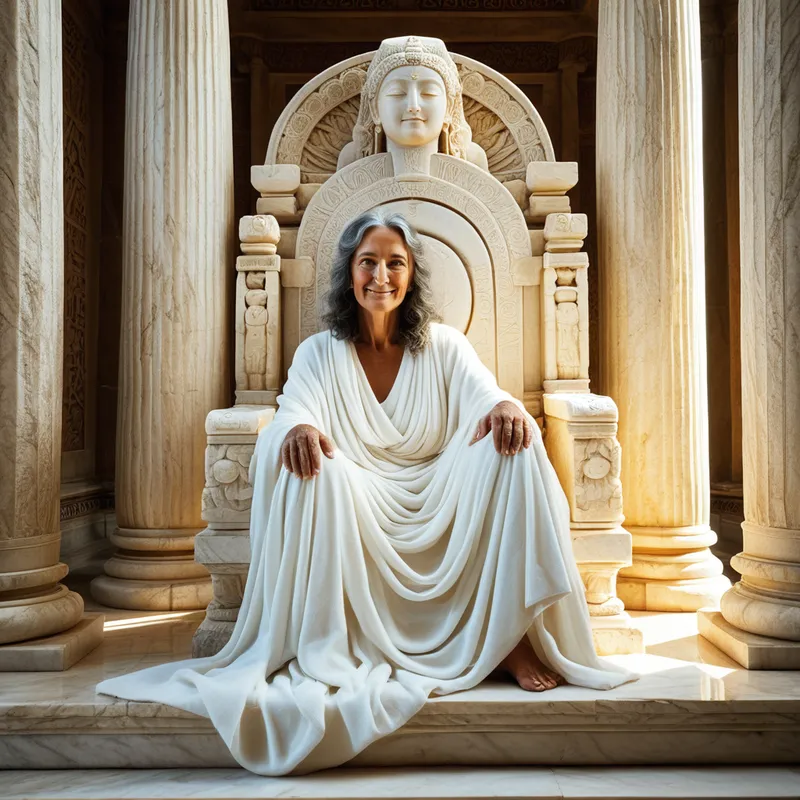
Pythia of Delphi Myth Meaning & Symbolism
The priestess of Apollo who, breathing sacred vapors from a chasm, became a vessel for divine prophecy, guiding heroes and kings from her tripod throne.
The Tale of Pythia of Delphi
Before the first stone of the temple was laid, the earth herself dreamed here. In the shadow of Mount Parnassus, where eagles circled the high crags, there was a place of primal power. A deep chasm split the living rock, and from it breathed a strange, sweet vapor, like the scent of crushed laurel and damp stone after lightning. It was the breath of Gaia. Here, her ancient serpent-daughter, Python, coiled, guardian of the mantic cleft, her scales whispering secrets of the deep earth to those who dared listen.
Then came the one who would claim it. Apollo, the Far-Darter, golden and terrible. He descended from the bright heights, a new god seeking an anchor in the world. He found Python draped over the sacred chasm, a creature of the old, chthonic order. A great battle shook the mountainside, not of brute strength, but of essence against essence—the clarifying, piercing light of the sun against the coiled, earthy wisdom of the abyss. With a single, shining arrow, Apollo slew the serpent. Python fell, her body melting back into the rock from which she was born, and her name was given to the place: Pytho.
But the victory was not a conquest; it was a marriage. Apollo did not seal the chasm. He took its power, its intoxicating breath, and made it his own. To give this wild, earth-born prophecy a voice, he instituted his oracle. From the nearby village, a woman of good character, often past the age of childbearing, was chosen. She was bathed in the sacred Castalian Spring, crowned with laurel, and led into the temple’s inner sanctum, the adyton.
There, above the still-gaping chasm, stood a tall, three-legged stool—the tripod. She would seat herself upon it, a vessel awaiting filling. As the sweet, numbing pneuma—the sacred breath of the earth—rose to envelop her, she would chew leaves from the sacred laurel tree. The world would dissolve. Her body would tremble, her limbs twitch, her eyes lose focus, seeing not the dim chamber but the vast, shimmering tapestry of what was, what is, and what may be. Her voice, when it came, was not her own. It was raw, guttural, a torrent of sound shaped by the god. It was the voice of Apollo speaking through a human throat, a fusion of Olympian light and chthonic vapor. Priests, the Hosioi, stood by, translating her ravings into the cryptic, often ambiguous hexameter verses that would decide the fates of kings, launch voyages, and haunt the dreams of heroes. She was the Pythia, the pivot upon which the known world turned, a mortal woman who became the crossroads where humanity met the divine.
Cultural Origins & Context
The Oracle at Delphi was not merely a religious institution; it was the geopolitical and psychological nerve center of the ancient Greek world for nearly a millennium. Known as the Omphalos, Delphi was considered the literal center of the earth. Its origins are pre-Greek, rooted in the Minoan and Mycenaean worship of an Earth Mother goddess at the site. The myth of Apollo’s takeover reflects a historical shift in religious dominance, where the older, matriarchal, earth-based cults were assimilated—but not erased—by the newer, patriarchal, Olympian order.
The Pythia’s prophecies were sought for matters of state—whether to go to war, found a colony, or enact a law—and for deeply personal crises. The process was highly ritualized and costly, reinforcing its authority. The myth of her origin served to sanctify this authority, grounding it in a divine drama of succession and synthesis. It explained why the voice of a god came from a mortal woman in a specific, terrifying, and transformative state. The story was passed down through poets like Homer and Hesiod, dramatized in plays, and recounted by historians like Herodotus and Plutarch, ensuring the Pythia remained a potent symbol of accessed, albeit perilous, truth.
Symbolic Architecture
The myth of the Pythia is a profound map of the psyche’s structure and the perilous process of accessing deep truth. She is not a goddess but a human vessel, representing the ego that must be made vacant for a greater, transpersonal content to emerge.
The oracle does not speak to you; it speaks through you. True wisdom requires the temporary dissolution of the self.
The Python symbolizes the instinctual, unconscious, and potentially overwhelming psychic energy of the deep Self—the chthonic, unformed wisdom of the body and the earth. Apollo’s slaying of Python represents the necessary, often violent, act of consciousness (the light) confronting and differentiating itself from the undifferentiated unconscious (the dark). The tripod is a symbol of unstable equilibrium; it only stands firm on three points, representing the precarious balance between the conscious, the unconscious, and the mediating ego-vessel. The intoxicating vapors are the numinosum, the overwhelming psychic energy that breaks down rational ego-boundaries to allow for a state of inspired possession. The resulting prophecy is never clear, always requiring interpretation (Hosioi), symbolizing that messages from the deep unconscious are not literal instructions but symbolic narratives to be decoded by the conscious mind.
The Dreamer’s Resonance
When the archetype of the Pythia stirs in the modern dreamer, it signals a powerful encounter with the unconscious that demands to be voiced. This is not a gentle intuition but a possession.
One might dream of being in a cavern or basement (the adyton) where a strange mist or gas fills the air, inducing panic or ecstasy. The dreamer may find themselves forced to speak, hearing words come from their mouth in a language they do not understand, or with a voice that is not their own. There is often a somatic component: a feeling of choking, of breath being taken away, or conversely, of a powerful wind moving through the chest. The dreamer may be seated on a strange, unstable chair or throne. These dreams point to a psychological process where a content from the collective or personal unconscious is so charged it is breaking through the ego’s defenses. The dreamer is, for a moment, the Pythia—the vessel through which a buried truth, a forgotten trauma, or a nascent creative vision is violently seeking expression, often at the cost of their sense of coherent self.

Alchemical Translation
The Pythia’s ritual models the alchemical process of solve et coagula—dissolve and coagulate—applied to the psyche. This is the heart of individuation.
First, the Dissolution (Solve). The Pythia leaves her ordinary life, is purified, and enters the sacred space. This is the ego’s voluntary descent, the setting aside of personal identity, social role, and rational control. The inhalation of the vapors is the surrender to the unconscious, allowing the ego-complex to be broken down. This stage is fraught with danger—the “madness” of the Pythia is the terror of ego-loss, of being swallowed by the Python of the undifferentiated psyche.
The tripod stands in the liminal space where the individual ‘I’ is shattered so the transpersonal ‘Thou’ can be heard.
Then, the Coagulation (Coagula). From the chaotic torrent of divine speech comes a formed utterance. The priests interpret the raw sounds into structured verse. Psychologically, this is the critical, integrative work that must follow an unconscious eruption. The ego, having survived the dissolution, must now re-form around this new content. It must “interpret” the raw emotion, the bizarre dream image, the compulsive thought, and translate it into something that can be understood and lived in the world of consciousness. The Pythia does not remember her prophecies; the integrated individual must. The goal is not permanent possession, but a renewed self that has incorporated the voice of the deeper Self. One becomes not a permanent oracle, but a person in whom the channel between the depths and the surface has been opened, cleansed, and respected. The myth teaches that ultimate truth is not possessed, but participated in, through a cycle of courageous surrender and discerning reconstruction.
Associated Symbols
Explore related symbols from the CaleaDream lexicon: