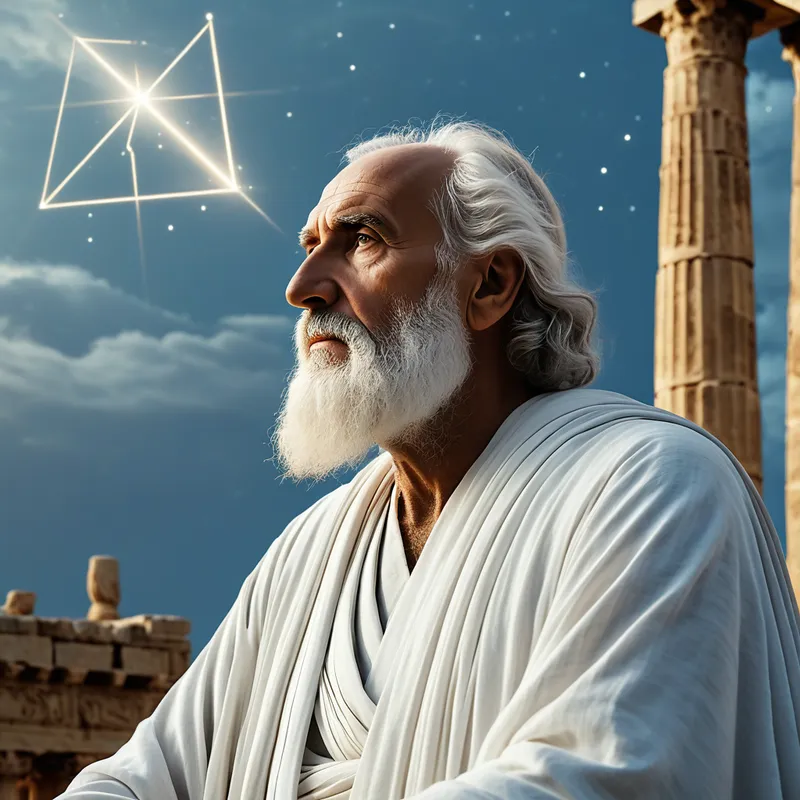
Pythagoras Myth Meaning & Symbolism
The story of a man who sought the divine pattern behind all things, founding a mystical brotherhood on the principle that number is the soul of the world.
The Tale of Pythagoras
In the golden, wine-dark age of the Mediterranean, when gods still whispered in the rustling of oak leaves and the crash of waves, there walked a man who listened not for voices, but for the silence between them. His name was Pythagoras. He was born under a strange star on the island of Samos, a child who, they say, did not cry at birth but gazed with ancient, knowing eyes.
His soul was restless, thirsty for a [water](/myths/water “Myth from Chinese culture.”/) not found in earthly wells. He traveled, a ghost in the markets of men, his sandals wearing thin on the stone roads of Egypt. There, in [the shadow](/myths/the-shadow “Myth from Jungian culture.”/) of the silent, geometric mountains men called pyramids, he was initiated into mysteries older than kings. He learned the language of stars and the secret measures of [the earth](/myths/the-earth “Myth from Hindu culture.”/). He journeyed east, to Babylon, where he deciphered the music of the moving lights in [the sky](/myths/the-sky “Myth from Persian culture.”/)—the planets—their dance governed by laws unseen.
But the true call came not from without, but from within—a silent, persistent hum in the marrow of his being. It was the hum of the string, the note, the interval. In the clang of a blacksmith’s hammer, he heard it: the perfect consonance of the fourth, the fifth, the octave. He saw that weight and measure, length and tension, gave birth to harmony. And in that moment, a lightning-flash of understanding: if the forge of [Hephaestus](/myths/hephaestus “Myth from Global/Universal culture.”/) could sing a mathematical truth, then the whole cosmos must be a symphony.
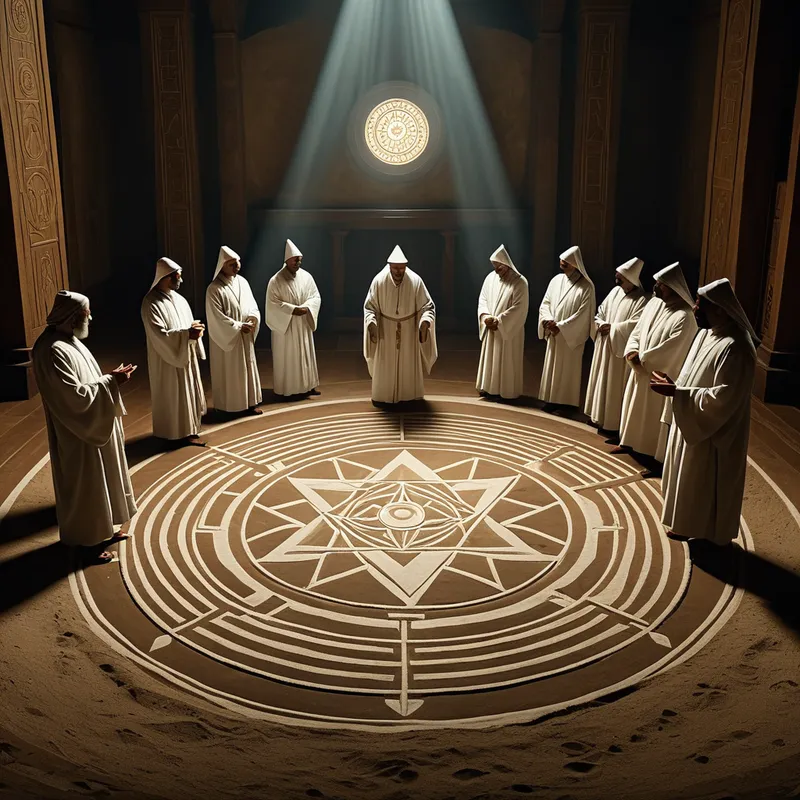
He sailed to the shores of Croton, in the land the Greeks called Magna Graecia. He spoke not of politics or war, but of the soul. He gathered around him not soldiers, but seekers—men and women who would become his mathematikoi. They formed a sacred brotherhood, a living temple of the mind. Their rule was silence, their ritual was contemplation, their sacrament was number.
They discovered that [the world](/myths/the-world “Myth from Tarot culture.”/) is built not of earth and fire, but of ratio and proportion. [The harmony of the spheres](/myths/the-harmony-of-the-spheres “Myth from Greek culture.”/) was not a metaphor but a deafening, divine reality, inaudible only because it had always been there, the very ground of being. They drew the Tetractys and worshipped it, for in its ten points they saw the blueprint of creation: one point (the divine [monad](/myths/monad “Myth from Greek culture.”/)), becoming two (the dyad, the first division), becoming three (the surface), becoming four (the solid world). Ten, the perfect number, containing all.
But the world of men fears a perfect order it cannot possess. The citizens of Croton grew suspicious of this silent society that held all things in common, even their discoveries, which they attributed only to the Master. Envy, that green-eyed demon, stirred. A powerful man, denied entry to the inner circle, whipped the mob into a frenzy. They came with torches and hatred, seeking to shatter the harmony with the discord of violence.
The meeting house was set ablaze. The sacred diagrams in the sand were scattered. Pythagoras, they say, fled to the edge of a field of beans. To his followers, the bean was a symbol of the soul’s potential, a sacred life. To the pursuers, it was just a crop. Trapped between a sacred oath not to tread upon them and the murderous mob at his back, the sage who heard the music of the universe chose to stand his ground. There, at the boundary of his own deepest symbol, the great listener was silenced.
Cultural Origins & Context
The figure of Pythagoras exists in a liminal space between history and myth, a testament to the profound impact his teachings had on the Greek world. He left no writings; his voice comes to us through a haze of reverence and legend, filtered through the accounts of later philosophers like Plato and Plutarch. He was not merely a philosopher in the later Athenian sense, but a mystagogue, the founder of a way of life.
His school in Croton functioned as a religious and scientific community, a radical departure from the individualistic, agonistic culture of the Greek city-state. It was an ascetic, contemplative order that believed in the transmigration of souls (metempsychosis), dietary restrictions (most famously abstaining from beans), and a strict code of secrecy. The myth was passed down not as a single epic poem, but as a collection of akousmata (“things heard”) and biographical fragments, often told to illustrate a philosophical or ethical point. Its societal function was to provide an origin story for a revolutionary idea: that the chaotic, warring, beautiful world of appearances is underpinned by an eternal, rational, and harmonious order accessible to the disciplined mind.
Symbolic Architecture
At its core, the myth of Pythagoras is not about calculation, but about recognition. It symbolizes the [human](/symbols/human “Symbol: The symbol of a human represents individuality, complexity of emotions, and social relationships.”/) [psyche](/myths/psyche “Myth from Greek culture.”/)‘s drive to discover the underlying [pattern](/symbols/pattern “Symbol: A ‘Pattern’ in dreams often signifies the underlying structure of experiences and thoughts, representing both order and the repetitiveness of life’s situations.”/), the archetypal [blueprint](/symbols/blueprint “Symbol: A blueprint represents the foundational plan or design for something, often symbolizing potential, structure, and the mapping of one’s inner self or future.”/), behind the bewildering [flux](/symbols/flux “Symbol: A state of continuous change, instability, or flow, often representing the impermanent nature of existence and experience.”/) of experience.
The cosmos is not a chaos of events, but a logos of relationships. To know the number is to touch the garment of the divine.
Pythagoras himself represents the [archetype](/symbols/archetype “Symbol: A universal, primordial pattern or prototype in the collective unconscious that shapes human experience, behavior, and creative expression.”/) of the [Senex](/symbols/senex “Symbol: The wise old man archetype representing spiritual authority, ancestral wisdom, and the integration of life experience into transcendent knowledge.”/) or Sage, but one who acquires his wisdom not through mere age, but through a perilous [journey](/symbols/journey “Symbol: A journey in dreams typically signifies adventure, growth, or a significant life transition.”/) into the foreign—Egypt (the land of the ancestral, buried wisdom) and Babylon (the land of celestial order). His “listening” is the [symbol](/symbols/symbol “Symbol: A symbol can represent an idea, concept, or belief, serving as a powerful tool for communication and understanding.”/) of a receptive [consciousness](/symbols/consciousness “Symbol: Consciousness represents the state of awareness and perception, encompassing thoughts, feelings, and experiences.”/), one that turns away from the noisy ego to attend to the objective psyche, the [collective unconscious](/symbols/collective-unconscious “Symbol: The Collective Unconscious refers to the part of the unconscious mind shared among beings of the same species, embodying universal experiences and archetypes.”/), which speaks in patterns, images, and primordial numbers.
The Brotherhood symbolizes the necessary [vessel](/symbols/vessel “Symbol: A container or structure that holds, transports, or protects something essential, representing the self, emotions, or life journey.”/) for transformative [knowledge](/symbols/knowledge “Symbol: Knowledge symbolizes learning, understanding, and wisdom, embodying the acquisition of information and enlightenment.”/). Individuation is not a solitary act; it requires a [temenos](/myths/temenos “Myth from Greek culture.”/), a sacred [space](/symbols/space “Symbol: Dreaming of ‘Space’ often symbolizes the vastness of potential, personal freedom, or feelings of isolation and exploration in one’s life.”/) and a [community](/symbols/community “Symbol: Community in dreams symbolizes connection, support, and the need for belonging.”/) of shared intent to hold and incubate the emerging consciousness. The violent end of the community represents the eternal [tension](/symbols/tension “Symbol: A state of mental or emotional strain, often manifesting physically as tightness, pressure, or unease, signaling unresolved conflict or anticipation.”/) between the ordering principle (the archetype of meaning) and the chaotic, undifferentiated [mass](/symbols/mass “Symbol: Mass often symbolizes a gathering or collective experience, representing shared beliefs, burdens, or the weight of emotions within a community.”/) of unconsciousness (the mob), which invariably seeks to destroy what it cannot understand.
The Dreamer’s Resonance
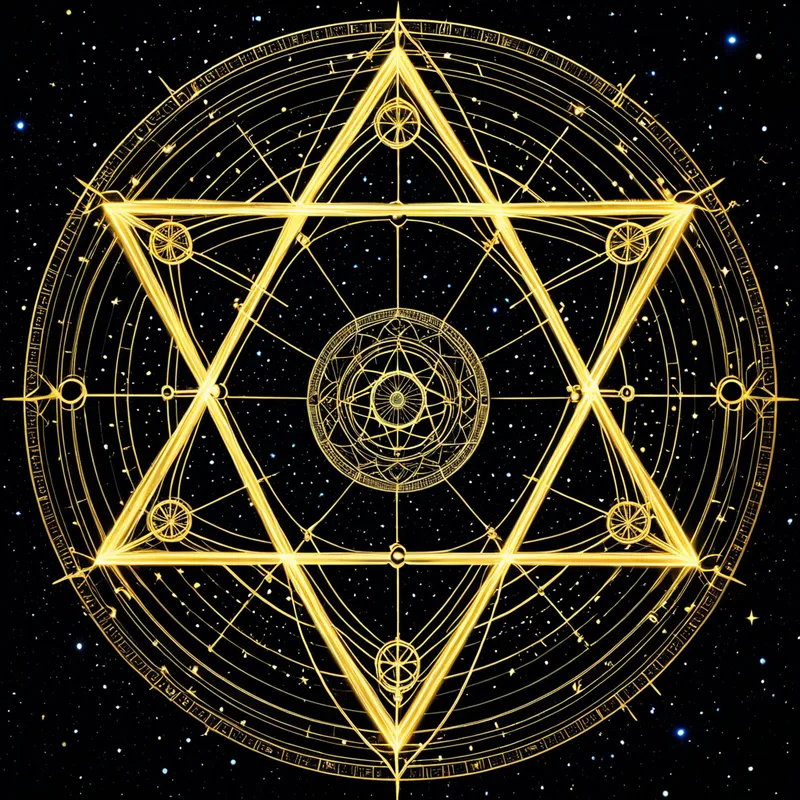
When the Pythagorean pattern stirs in the modern dreamer, it often manifests as a profound encounter with intrinsic order. One might dream of hearing a perfect, overwhelming chord of music that seems to structure reality itself, or of discovering a hidden, geometric room within one’s own house. The dreamer may be drawing or studying a complex, luminous diagram that makes perfect, wordless sense.
Somatically, this can feel like a deep, resonant alignment—a clicking into place. Psychologically, it signals a process of integration. The conscious mind (the seeker) is coming into contact with [the Self](/myths/the-self “Myth from Jungian culture.”/)‘s innate, ordering principle. The chaos of one’s personal history, the disparate fragments of identity and trauma, are suddenly perceived as part of a larger, meaningful configuration. This is often preceded by a period of intense study, introspection, or “wandering” (the dreamer’s own Egypt and Babylon). The dream is the psyche’s confirmation: you are on the path to seeing the pattern of your own soul.

Alchemical Translation
The alchemical work modeled by Pythagoras is the transmutation of perception. The [prima materia](/myths/prima-materia “Myth from Alchemical culture.”/), the leaden, chaotic stuff of ordinary, sense-bound life, is subjected to the fire of intense inquiry and the water of silent contemplation. The goal is not to acquire facts, but to undergo a metanoia—a fundamental change of mind.
The opus is not to build a better theory of the world, but to have one’s ears unstopped to the symphony that was always playing.
First, the [separatio](/myths/separatio “Myth from Alchemical culture.”/): one must leave the familiar (Samos) and journey into the foreign, gathering the scattered fragments of knowledge (the teachings of other cultures). Then, the coniunctio: these fragments are brought together in [the vessel](/myths/the-vessel “Myth from Alchemical culture.”/) of the community (Croton), where they are related not as isolated facts, but as expressions of a single, unifying principle—Number. This is the creation of [the Philosopher’s Stone](/myths/the-philosophers-stone “Myth from Alchemical culture.”/): the realization that the soul (psyche) and the cosmos (kosmos) are isomorphic, built from the same harmonic ratios.
The final stage, symbolized by his death at the bean field, is the ultimate sacrifice: the complete identification with the discovered law. [The ego](/myths/the-ego “Myth from Jungian culture.”/), which wants to own and control the knowledge, must be sacrificed at [the threshold](/myths/the-threshold “Myth from Folklore culture.”/) of the symbol itself. One does not possess the truth; one submits to its architecture. The individuated Self that emerges is no longer a lonely “I” but a conscious node within the great, living Tetractys of being—a knower who is, finally, a part of the known.
Associated Symbols
Explore related symbols from the CaleaDream lexicon: