Pyramid Texts Myth Meaning & Symbolism
The first sacred spells inscribed in stone, guiding the soul of the departed king through the perilous Duat to merge with the eternal sun.
The Tale of the Pyramid Texts
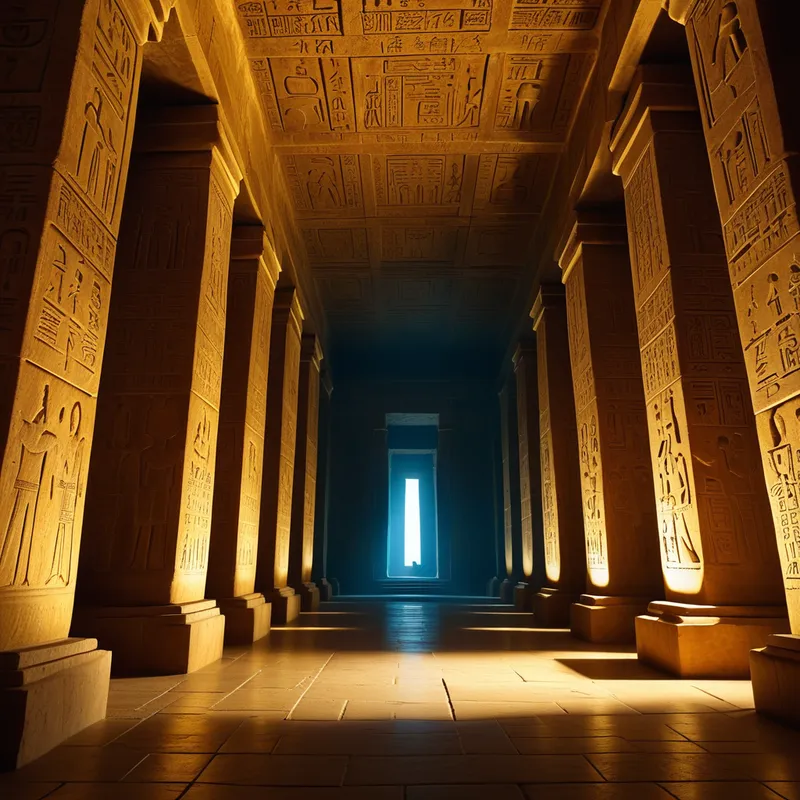
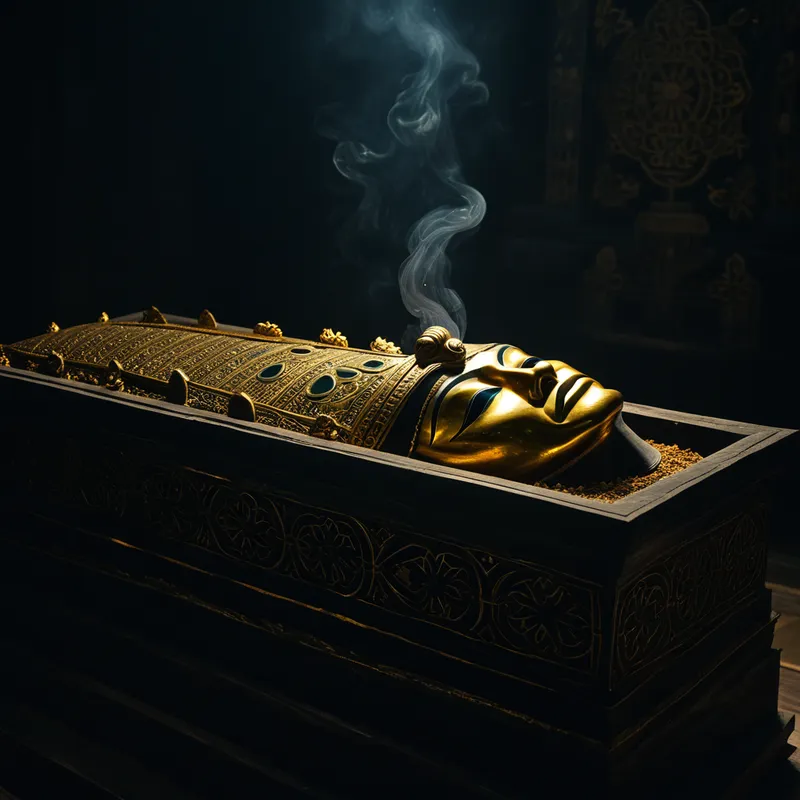
Hear now the words that are spoken in the silence of the tomb, in the deep heart of the mountain of stone. The air is still, heavy with the scent of cedar resin and myrrh, a perfume of eternity. The final seal is set. The world of the living, of the Nile’s green flood and the sun’s daily climb, is now a memory sealed behind a mountain of worked stone.
But within the sealed, starless dark, a journey begins. Not an ending, but a fierce and perilous beginning.
The Ren of the king is awake. He is a luminous seed in the heart of the earth. And the walls around him speak. They are no longer mere stone, but a skin of light, etched with the sacred utterances—the Heka—that will be his map, his boat, and his weapon. The pyramid is not a prison of death, but a launch chamber for a celestial voyage.
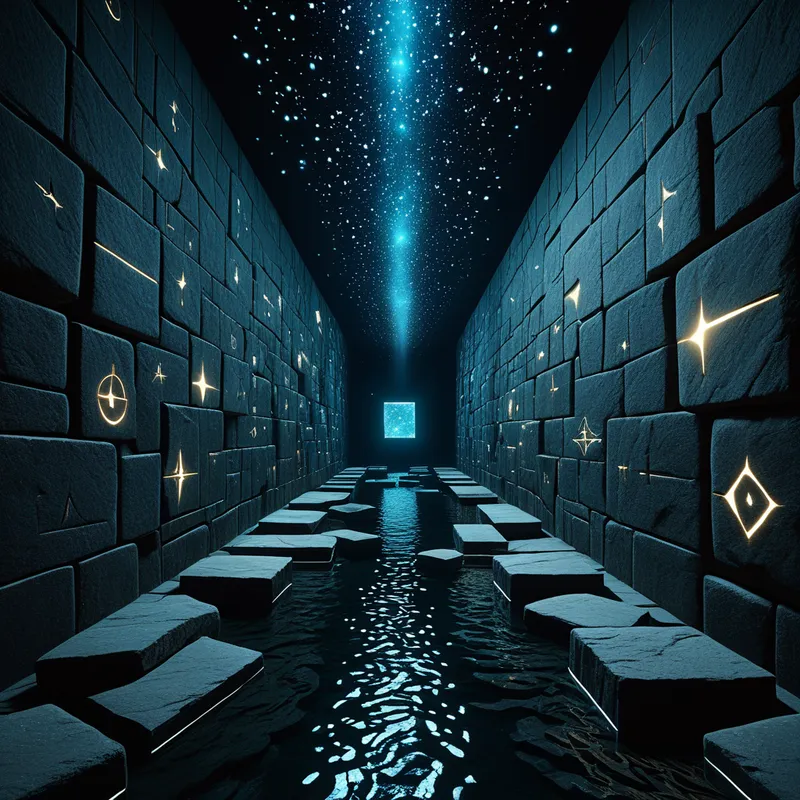
The voices of the priests, though long silent, resonate in the carved signs. They call out to the gatekeepers of the Duat, naming them, commanding them: “O you whose face is behind him, whose spine is curved, open your door to me!” They whisper to the ferocious guardians, the coiled serpents and the silent watchers, disarming them with perfect knowledge of their true names. The king must navigate a landscape of fire-lakes and inverted rivers, of caverns where stars are born and the sun is swallowed each night.
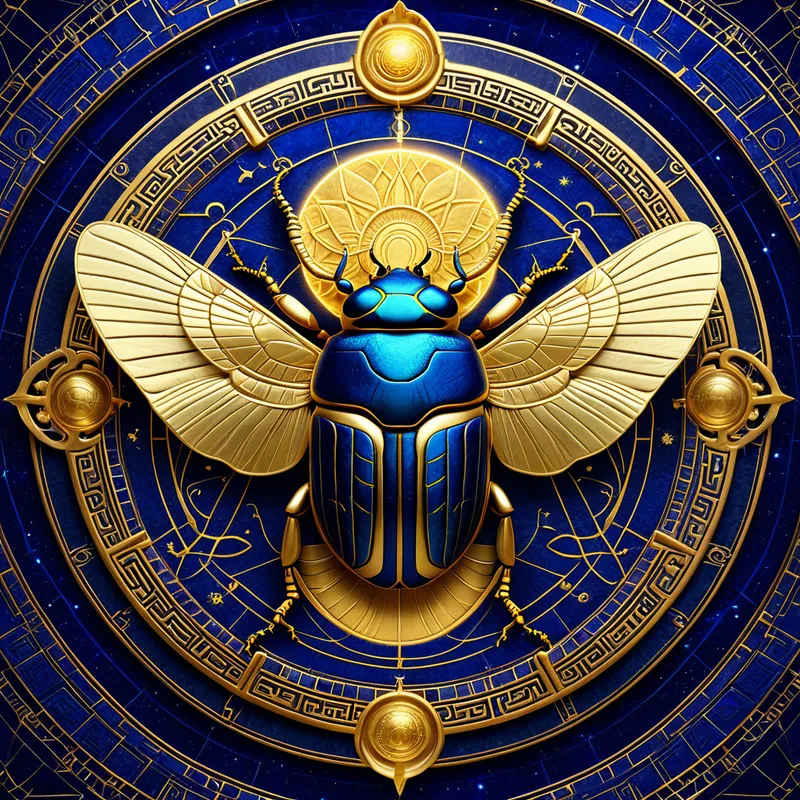
His goal is the eastern horizon. To do this, he must become many things. The spells transform him. He is the Khepri, the dawn sun, rolling the solar disk ahead of him. He is an akhu, a shining, effective spirit, soaring on the winds of the north. He is the Osiris himself, the lord of the green shoot that breaks through the dark soil.
The great conflict is the dissolution of the self. The king must shed his mortal form, his earthly identity, piece by piece. He declares: “The sky is clear, Sah (Orion) lives, because I know him!” He does not beg for passage; he asserts his divine kinship, his co-essential nature with the stars and the gods. He climbs a ladder of light—the Nut’s own limbs—to reach her starry belly.
And then, the resolution, the triumphant cry that echoes through the millennia of stone: “O King, you have not departed dead, you have departed alive!” He bursts forth from the Duat. He ascends. He takes his seat in the Mandjet, the barque of millions of years. He is now one with the Aten, an undying star in the body of the sky goddess. The journey through the perilous night is complete. The king is not gone. He is translated. He has become the light that never sets.
Cultural Origins & Context
The Pyramid Texts are the oldest extant corpus of religious literature in the world, first inscribed within the pyramid of King Unas at Saqqara circa 2400 BCE. They are not a single, cohesive “book” but a collection of over 700 individual spells, utterances, and incantations, compiled from an even older oral tradition. Their primary societal function was utterly pragmatic in the Egyptian worldview: to ensure the safe passage and celestial resurrection of the divine king, thereby maintaining the cosmic order, or Ma’at.
These texts were the exclusive property of royalty, literally carved into the very substance of the tomb—the walls, sarcophagi, and ceilings of the burial chamber. They were a permanent, magical machine, activated not by a living priest but by the mere existence of the words themselves. The act of inscribing them in stone made them eternally efficacious. This was a technology of the soul, created by a civilization that saw no firm boundary between the material and the spiritual, the word and the reality it could conjure.
Symbolic Architecture
At its core, the myth encoded in the Pyramid Texts is a master blueprint for the transformation of consciousness through the ultimate threshold: death. It is a map of the psyche’s journey through its own darkest, most chaotic layers—the personal and collective Duat—toward a state of integrated wholeness and luminous awareness.
The tomb is not an end, but a womb of stone; the spells are not mere words, but the chromosomes of a new, stellar body.
The king represents the individual ego-consciousness. His journey is the ego’s necessary dissolution and reconstitution at a higher level. The myriad gods and demons he encounters—Apep, the gatekeepers, the ferryman—are archetypal personifications of psychic obstacles: fear, attachment, ignorance, and the terror of annihilation. To know their true names is to understand their nature, to integrate their energy rather than be destroyed by it. The ultimate goal, union with the sun, symbolizes the assimilation of the conscious mind (the king) with the supreme source of life and consciousness (the sun god), achieving what Jung termed the Self.
The Dreamer’s Resonance
When this ancient pattern stirs in the modern dreamer, it often manifests not as Egyptian imagery, but as the core experience of a profound transition or “night journey.” One may dream of being sealed in a dark, confined space that is also strangely protective. Of navigating a labyrinthine bureaucracy (the gatekeepers), needing the correct password or document (the true name). Of confronting monstrous, formless threats that dissolve when faced with direct awareness.
Somatically, this can coincide with feelings of pressure, constriction, or a “dark night of the soul” in waking life—a depression, a major loss, or an identity crisis. The psyche is enacting its own version of the king’s descent. The dreamer is in the Duat, where old structures of the personality are being broken down. The emotional tone is not typically one of horror, but of solemn, arduous purpose. The dream ego is on a mission, guided by an innate, ancient knowing—the internalized “spell”—that this painful passage is necessary for rebirth.
Alchemical Translation
The alchemical process mirrored in the Pyramid Texts is the opus magnum itself: nigredo, albedo, rubedo—blackening, whitening, reddening. The sealed tomb and the perilous Duat represent the nigredo, the descent into the prima materia, the chaotic base matter of the psyche. Here, everything familiar is dissolved.
The ego must consent to its own ritual death, to become the Osiris-fragment, in order to be reassembled as the Horus-light.
The recitation of the spells is the albedo, the washing and illuminating work. It is the conscious application of insight (“I know your name!”), the ordering principle of Ma’at applied to inner chaos. By naming our inner demons—our fears, our shadows—we purify and integrate them. Finally, the ascension and solar union are the rubedo, the production of the Philosopher’s Stone or the golden, incorruptible Self. For the modern individual, this translates to the process of individuation: enduring the crisis that shatters the outworn persona, consciously working through the complex material of the unconscious, and ultimately achieving a renewed, more authentic, and spiritually connected mode of being. We do not escape the tomb by avoiding it, but by carrying its sacred words within us, turning our own darkest passages into corridors of ascent.
Associated Symbols
Explore related symbols from the CaleaDream lexicon: