Putrefactio Myth Meaning & Symbolism
The alchemical process of sacred decay, where dissolution is not an end but the necessary dark womb for the birth of the true self.
The Tale of Putrefactio
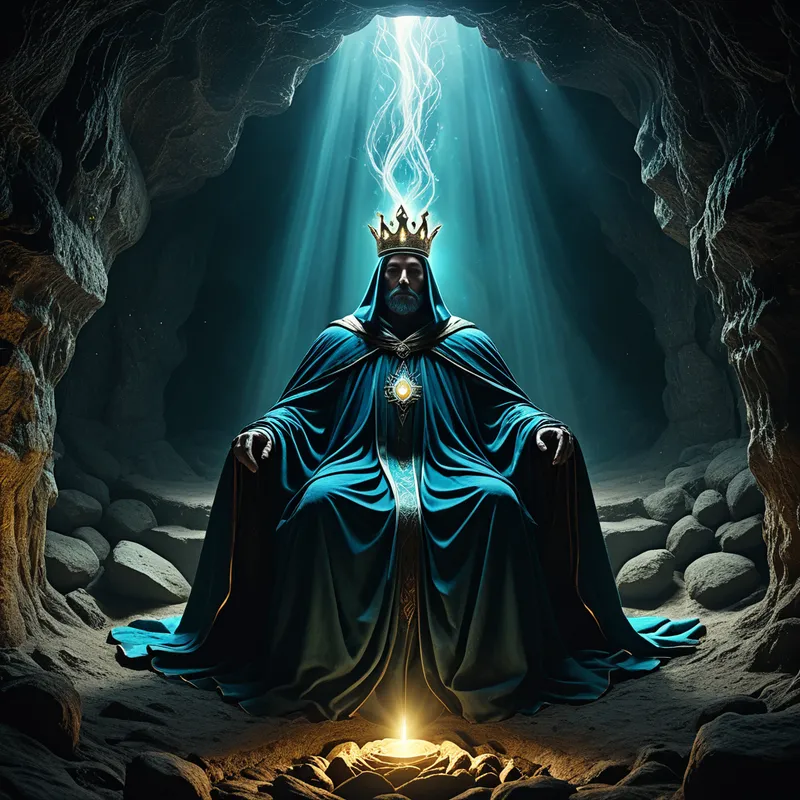
Listen, and I will tell you of the time when the King fell into the Earth.
He was not slain by blade nor felled by plague. His vigor did not wane with age. No, the King, in the fullness of his power, clad in solar gold and crowned with the light of reason, simply… stopped. The court grew silent. The machinery of state ground to a halt. A great stillness descended upon the palace, a stillness so profound it had weight and scent—the scent of turned soil and cold stone.
They carried him, this sovereign of the conscious day, not to a sepulcher of marble, but to the deepest, forgotten cellar of the castle, a place where the walls wept moisture and the air was older than dynasties. There, they laid him upon a simple bier of raw, damp earth. They extinguished the torches. They sealed the door. The world above turned, seasons passed, and the King was entered into the ledger of memory.
But below, in that absolute dark, a different sovereignty began.
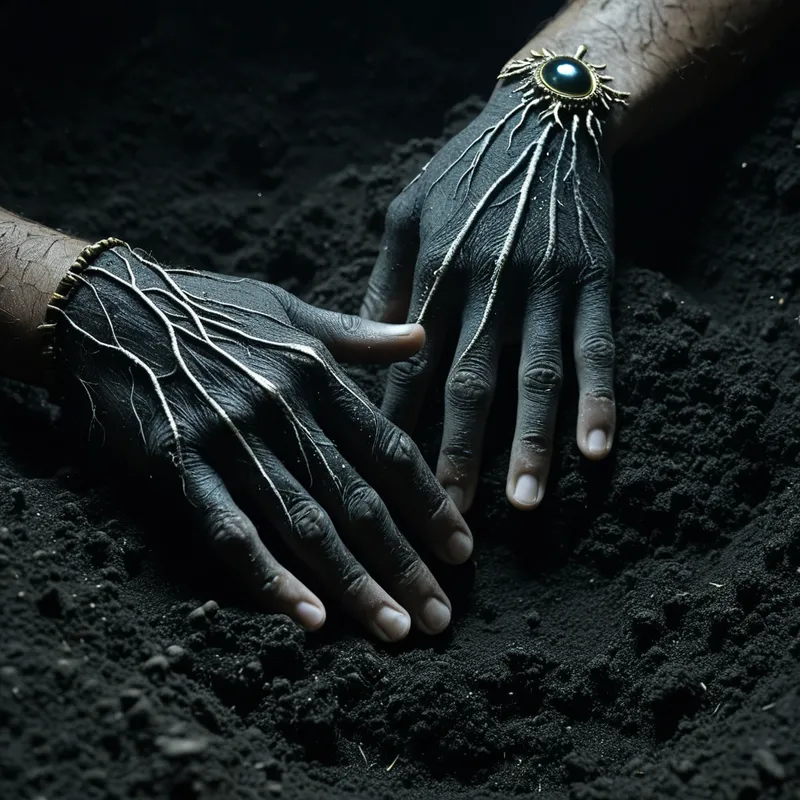
The splendid robes, woven with threads of purpose and identity, were the first to welcome the guests. Mycelia, pale and silent as ghostly fingers, crept from the living soil. They did not rend or tear; they embraced. They wove through the gold embroidery, a tender dissolution. The crown, that circle of achieved will, grew warm not with sun, but with a slow, internal heat—the heat of fermentation. It softened, its jewels clouding like eyes closing in contemplation.
Then came the Nigredo. The King’s form, the proud vessel of “I,” began to merge with the humus. Flesh and soil conversed in a language of breakdown. Colors fled, leaving only the profound, fertile black. This was not a ruin. It was a homecoming. The rigid boundaries of the monarch melted, returning to the Materia Prima, the one mother of all things.
In that long night of the soul, a great sigh seemed to echo through the foundation stones. The sigh of release. The sigh of a burden—the burden of a single, fixed form—being laid down. And in the center of that perfect, fecund blackness, where the heart of the King had beat a worldly rhythm, a new pulse began. A tiny, insistent point of light. Not the light of the sun, but a cold, clear, silver light, like the first star in a twilight sky. It was a seed. It was a pearl. It was the promise sleeping in the core of the decay.
They would find him, seasons later, not as he was, but as he was becoming. The dark earth would part, not as a grave, but as a womb. But that is a tale for another telling. This is the tale of the necessary descent, the sacred Putrefactio, where the end is the only true beginning.
Cultural Origins & Context
The mythos of Putrefactio did not originate in temples or public theaters, but in the sealed laboratories and coded manuscripts of the medieval and Renaissance alchemists. This was not a populist tale but an arcanum, passed from master to adept through symbolic imagery—the dying king, the raven, the sealed tomb, the black sun. Its societal function was profoundly subversive: in an age of rigid dogma and fixed social hierarchies, it proposed that the highest value, the Philosopher's Stone, could only be achieved through a voluntary descent into the Nigredo, a total undoing of one's current state.
The "culture" of Alchemy was a hidden stream within Western esotericism. Its practitioners were often monks, physicians, and natural philosophers who used the language of chemical processes—distillation, calcination, fermentation—as a blind for describing psychic and spiritual transformation. The myth of Putrefactio was their core narrative of initiation, a map for navigating the darkest phase of the Magnum Opus. It was told in the flickering light of the furnace, a warning and a promise to those who sought not mere gold, but the gold of the spirit.
Symbolic Architecture
Psychologically, Putrefactio represents the inevitable and terrifying stage in individuation where the conscious attitude—the "King" or ruling principle of the psyche—proves inadequate for life's deepening demands. The King is the complex of identities, achievements, and adapted personas that have successfully ruled our inner kingdom. Yet, when this complex becomes rigid or life calls for a greater wholeness, it must die.
Putrefactio is the psyche’s ruthless, loving compost. It breaks down what was structured so that what is essential can be freed from form.
The setting—the sealed, earthy cellar—is the unconscious itself, the containing vessel where this death can occur without interference from the anxious, judging daylight mind. The mycelia symbolize the latent, connecting intelligence of the unconscious, which patiently dismantles our conscious constructions to feed a greater, unseen network of being. The blackness (Nigredo) is not evil, but the fertile void, the state of maximum potential where all opposites are merged and dissolved. The seed of light is the nascent, authentic self, the Scintilla, which can only emerge after the death of the provisional self.

The Dreamer's Resonance
When this myth stirs in the modern dreamer, it announces a profound somatic and psychological process of decomposition. Dreams become landscapes of decay: teeth falling out, houses crumbling, beloved objects lost in flood or mud. There is often a visceral sense of being buried, trapped, or dissolving. One may dream of rotting food, forgotten basements, or being covered in black oil or earth.
These are not nightmares of external threat, but somatic portraits of an internal, alchemical event. The psyche is engaging in its own Putrefactio. The dreamer may feel a pervasive depression, ennui, or a sense that everything they have built feels meaningless—the "dark night of the soul." This is the somatic signature of the old King dissolving. The body itself may feel heavy, sluggish, or "stuck," mirroring the psychic inertia. The process feels like a death because it is one. The dreamer is living in the cellar, and the conscious mind, terrified, interprets it only as loss.

Alchemical Translation
For the modern individual, the myth of Putrefactio models the non-negotiable law of psychic transmutation: you cannot become who you are meant to be without ceasing to be who you have been. Our culture pathologizes this stage, calling it burnout, depression, or a crisis. Alchemy sanctifies it as the felix nigredo, the fortunate blackness.
The struggle is the ego's resistance to its own necessary death. The triumph is the surrender—allowing oneself to be sealed in the dark, to stop striving, to let the mycelial threads of the unconscious do their slow, invisible work. This is the alchemy of the orphan archetype: to willingly become bereft of former supports and identities.
The goal is not to escape the black earth, but to learn its language, to discover that in the very center of dissolution lies the indestructible, germinal point of a new consciousness.
The transmutation occurs in the waiting, in the tolerance of not-knowing, in the faith that the process itself is intelligent. The "pearl" that forms is the integrated self, born of both light and darkness, conscious and unconscious. It is a self that has metabolized its own decay and found its sovereignty not in ruling from above, but in being rooted in the deep, black earth of all being. To undergo Putrefactio is to understand that rebirth is not a sequel to death; it is death itself, seen from the other side.
Associated Symbols
Explore related symbols from the CaleaDream lexicon: