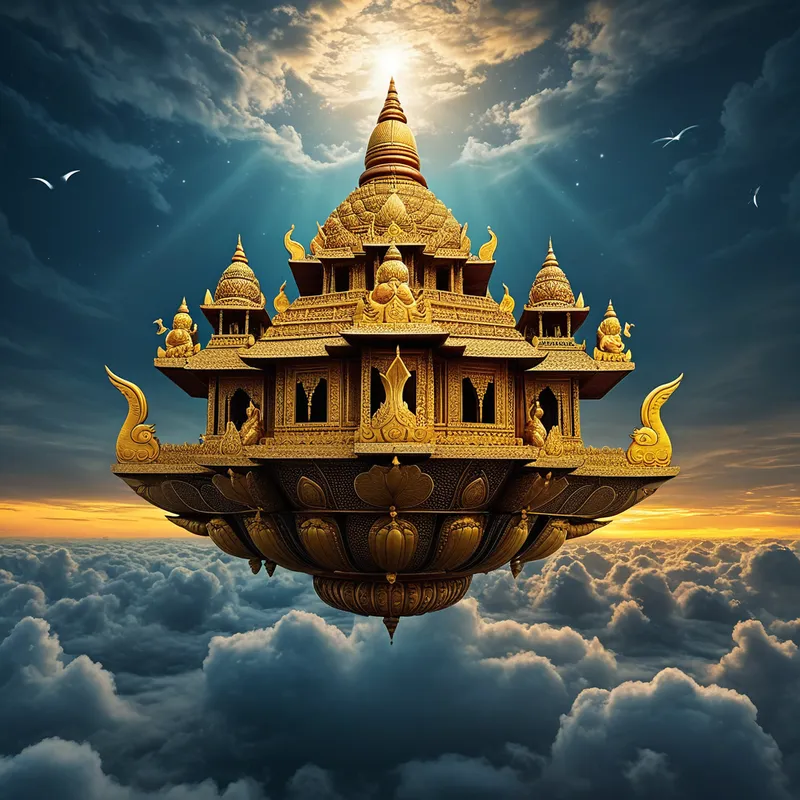
Pushpaka Vimana Myth Meaning & Symbolism
The myth of a divine, self-willed flying chariot, won and lost and won again, symbolizing the ultimate mastery over the kingdom of the self.
The Tale of Pushpaka Vimana
Listen, and let the scent of celestial flowers carry you back. Before time was measured in mortal years, in the age when gods walked with demons, there existed a wonder: the Pushpaka Vimana. It was not built by human hands, but manifested from the will of Vishwakarma himself for Kubera, the treasurer of the heavens. Crafted of gold and light, it moved at the speed of thought, its size swelling or shrinking to the desire of its master. Its name whispered its essence: Pushpaka, born of flowers, its very form an offering of beauty and fragrance to the sky.
But sovereignty is a flame that attracts moths. Kubera’s own half-brother, the ten-headed Ravana, lord of the Rakshasas, gazed upon this splendor with a covetous heart. His power, vast and terrible, was bound to the earth. He desired the sky. In a titanic clash that shook the pillars of the world, Ravana wrested the Vimana from its rightful lord. The chariot of flowers became the vehicle of a conqueror, a symbol of stolen glory and arrogant dominion over all realms.
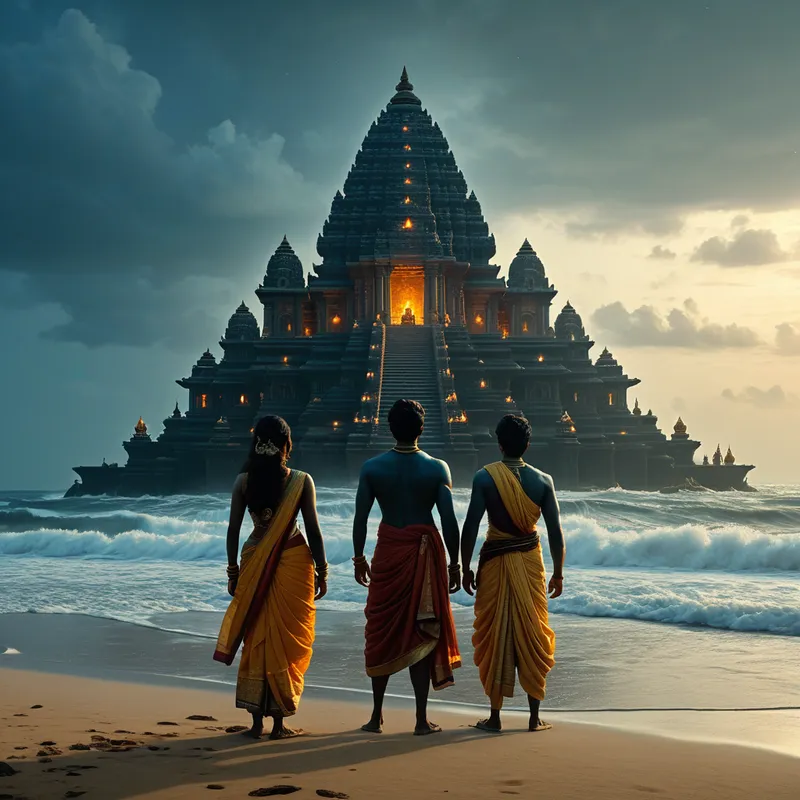
Decades passed. Ravana, in his pride, committed the gravest transgression: he abducted Sita, the queen of Rama. This act set in motion a cosmic realignment. Rama, with his brother Lakshmana and an army of devoted vanaras, crossed the ocean to the island fortress of Lanka. The war was cataclysmic, a clash of dharma against adharma. Finally, Rama’s arrow, imbued with the power of the ultimate truth, found its mark. Ravana fell, his ten heads severed, his stolen kingdom crumbling.
In the smoky silence of victory, amidst the lamentations of Lanka, the great Hanuman led Rama to the heart of the citadel. There it stood, in a vaulted chamber open to the heavens—the Pushpaka Vimana. It gleamed, untarnished by the violence it had witnessed, waiting. It recognized in Rama not just a victor, but the embodiment of rightful sovereignty. Humbly, Rama requested the Vimana to carry him, his beloved Sita, his brother, and all his allies back to the northern kingdom of Ayodhya. The vehicle, sentient and joyous, expanded to hold them all. It ascended from the ravaged isle, not with the roar of conquest, but with the gentle hum of restoration. It became a chariot of homecoming, painting the sky with the light of a dawn long awaited, carrying a king back to his throne, not to claim it, but to serve it.
Cultural Origins & Context
The tale of the Pushpaka Vimana is woven into the epic tapestry of the Ramayana, a foundational narrative of Hindu culture. For millennia, this story has been transmitted not merely as literature, but as a living oral tradition—recited by bards, enacted in village plays, sung in devotional hymns, and depicted in temple carvings. Its primary function was didactic and cosmological. It mapped the moral universe, illustrating the inevitable triumph of righteous duty (Rama’s dharma) over egoistic desire (Ravana’s kama).
The Vimana itself reflects a deep cultural fascination with transcendence of earthly limitations. In a worldview where gods traversed the heavens in various vehicles (Vahanas), the Pushpaka represented the pinnacle of this technology—a technology that was spiritual as much as it was mechanical. It was a narrative device that compressed time and space, allowing the hero’s journey to culminate in a triumphant, visible return. Its possession signaled a transfer of cosmic legitimacy, from the wealthy guardian (Kubera) to the powerful usurper (Ravana), and finally to the righteous king (Rama). The story taught that true authority over such a magnificent vessel could only be held by one who had mastered himself.
Symbolic Architecture
At its core, the Pushpaka Vimana is a profound symbol of the Self—the integrated, sovereign totality of the psyche in Jungian terms. It is the vehicle of consciousness itself.
The Vimana is the liberated psyche, capable of traversing the inner spaces of thought, memory, and spirit at will. Its theft represents the ego’s hijacking of this potential for its own aggrandizement.
Kubera, its first master, represents legitimate but perhaps static wealth—the latent potential of the Self. Ravana’s seizure is the archetypal shadow-possession; the ego, brilliant and powerful but ultimately demonic in its inflation, commandeers the soul’s vehicle for projects of conquest, building a glittering but hollow kingdom of the personality (Lanka). Rama’s reclamation is the central drama of individuation. He does not seek the Vimana; he wins it by fulfilling his destiny with integrity, by facing his shadow (Ravana) in a necessary battle. The Vimana then offers itself to him. This signifies that sovereignty over the Self is not taken, but earned through right action and psychological integration. The final journey to Ayodhya is the return of the conscious ego to its rightful place, now piloting the full Self, carrying all aspects of the psyche (allies, brothers, regained anima in Sita) home to the center of one’s being.

The Dreamer's Resonance
When the motif of the Pushpaka Vimana stirs in the modern unconscious, it often heralds a critical phase in the dreamer’s relationship with their own power and freedom. To dream of finding such a vehicle suggests an awakening to untapped potential, a discovery of an inner resource that can transport consciousness to new heights. The somatic sensation may be one of exhilarating lift, of weightlessness.
Conversely, to dream of losing control of the Vimana, or of it being stolen, points directly to a feeling of disempowerment. The ego feels that its rightful means of navigation—its will, its voice, its agency—has been hijacked by an internal “Ravana”: perhaps a compulsive complex, an addiction, a tyrannical inner critic, or an inflated sense of self that has led to a crash. The dream may involve the vehicle being damaged, grounded, or flying erratically. The psychological process here is one of confronting this usurper, of recognizing where one’s life energy has been commandeered by a power that does not serve the whole Self.
Alchemical Translation
The myth models the complete alchemical cycle of psychic transmutation. The Vimana is the lapis philosophorum, the philosopher’s stone—the ultimate prize of the inner work.
The journey from Kubera to Ravana to Rama is the soul’s progression from potential, through possession, to rightful sovereignty.
First, we identify with Kubera: we sense our potential (the nigredo, the latent material) but it is guarded, perhaps by material concerns or spiritual naivete. Then, the Ravana stage: the ego seizes this potential in a burst of inflation (inflation). We build careers, identities, empires of the personality. This phase is necessary—it is the fire that tests the metal—but it leads to isolation and a fall, as the unintegrated shadow (represented by the abduction of Sita, the soul’s connection to life and love) creates a crisis.
The battle with Ravana is the mortificatio, the necessary dissolution of the inflated ego-complex. It is a painful, dark night. Victory is not annihilation, but integration. When the ego (Rama) defeats the tyrannical complex (Ravana), it does not destroy the energy, but redeems it. The Vimana is not destroyed; it is reclaimed. This is the albedo, the whitening. The final, glorious flight home is the rubedo, the reddening—the conscious, joyful operation of the integrated Self. The individual no longer has a psyche; they are the psyche, piloting their own destiny with wisdom and grace, carrying all their parts home to the center. The Pushpaka Vimana thus ceases to be a myth of an external object and becomes the living reality of a soul in full, sovereign flight.
Associated Symbols
Explore related symbols from the CaleaDream lexicon: