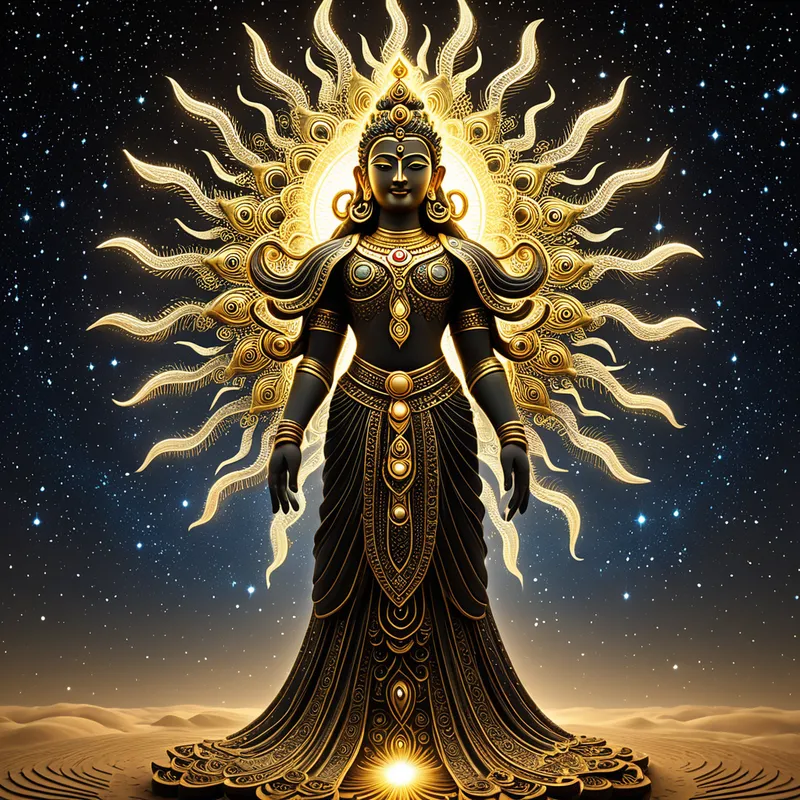
Purusha Myth Meaning & Symbolism
The primordial cosmic being whose self-offering creates the universe, establishing the sacred order of life, consciousness, and society from his own substance.
The Tale of Purusha
In the beginning, there was not a beginning. There was no then, no now. No sky arched above, no earth rested below. There was only the One, the All. A presence so vast it had no edges, a consciousness so deep it dreamed itself into being. This was Purusha.
He was a thousand heads, a thousand eyes, a thousand feet. He enveloped the earth on all sides and extended ten fingers’ breadth beyond. He was the past and all that is to come. He was the immortal who dwells in the mortal. And in the great stillness of that non-time, a stirring arose—not from outside, for there was no outside, but from within the very heart of his boundless existence. It was the desire to become.
The Devas, the shining ones, and the ancient Rishis, the seers of truth, gathered at the dawn of time. They recognized the sacrifice that must be made. With sacred intention as their blade and cosmic law as their altar, they performed the first and greatest rite. They offered up Purusha himself.
As the sacrifice commenced, a profound transformation flowed from his limitless form. From his mind was born the Moon. From his eye, the Sun. Indra and Agni sprang from his mouth. From his breath, the Wind was born. The vault of the sky emerged from his head; the earth, firm and nurturing, from his feet. The four directions were born from his ears. From the rhythm of his pulse, the sacred chants, the Vedas, took form.
The very fabric of society was woven from his body. The Brahmin was his mouth. The Kshatriya was made from his arms. His thighs became the Vaishya, and from his feet, the Shudra was produced. Animals, plants, all creatures that walk, fly, and swim—all were born from the manifold offering of the One.
The sacrifice was complete. Where there was One, there was now the Many. The universe, in all its dazzling, terrifying, beautiful diversity, was established. Purusha was both the offering and the altar, the sacrificer and the sacrificed. Through his self-dissolution, the world was made whole.
Cultural Origins & Context
This foundational narrative is enshrined in the Rigveda, in the majestic Purusha Sukta. It is not merely a creation story but a cosmological blueprint and a social charter, composed by seers who perceived the macrocosm in the microcosm. Recited in rituals for millennia, its verses were not just descriptions but were considered potent, creative acts in themselves, reinforcing the sacred order, or Dharma, of the universe.
The myth served a profound societal function, providing a divine, organic justification for the Varna system. By rooting social roles in the very body of the cosmic being, it presented them as intrinsic, interdependent parts of a single living whole, each necessary for the functioning of the cosmic organism. It was a myth of unity-in-diversity, explaining how the One becomes the Many without losing its essential connection.
Symbolic Architecture
At its heart, the Purusha myth is not about an external god creating a separate world. It is the story of consciousness objectifying itself. Purusha represents pure, undifferentiated awareness—the subjective "I AM" before it identifies with any thought, form, or name.
The ultimate sacrifice is not of something you have, but of what you are, to become what you might be.
His thousand heads, eyes, and feet symbolize omnipresence, omniscience, and omnipotence not as external powers, but as the inherent potential of consciousness itself. The sacrificial dismemberment is the primordial act of differentiation. Mind (Moon) and perception (Sun) emerge. The elements and senses are born. This is the psyche's own genesis story: from the unified field of the Self, the ego (Indra/Agni as the assertive "I"), the persona, and the complex faculties of the mind are structured.
The social body born from his physical body is a profound metaphor for the internal "society" of the psyche. The Brahmin (mouth/priest) symbolizes the inner voice of wisdom and discernment. The Kshatriya (arms/warrior) is our will, our capacity for action and defense of psychological boundaries. The Vaishya (thighs/merchant) represents the energy that "trades" and circulates—our drives, emotions, and vitality. The Shudra (feet/laborer) is the foundation, the somatic, instinctual, and unconscious ground of our being. A healthy psyche requires the conscious integration and respect of all these inner "castes."
The Dreamer's Resonance
When this myth stirs in the modern unconscious, it often manifests in dreams of profound transformation centered on the dreamer's own body. One might dream of their body expanding to fill a room, a city, or the sky, feeling simultaneously immense and peaceful—a direct encounter with the Purusha-like sense of the boundless Self.
More commonly, dreams of dismemberment or dissolution appear not as nightmares, but as strangely sacred or necessary processes. A limb turns to light; the torso opens like a map; internal organs are revealed as galaxies. These are somatic metaphors for the psyche's need to deconstruct a rigid, identified sense of self ("I am only my job, my pain, my story") to access a more fundamental wholeness. The dreamer is undergoing a psychic sacrifice—the letting go of a familiar identity so that a more authentic, complex, and connected inner "universe" can be born. There is often a deep, somatic sense of release and reorganization upon waking.

Alchemical Translation
The alchemical journey of individuation mirrors the Purusha myth precisely. It begins in the massa confusa, the undifferentiated state where one is unconsciously identified with the collective or with fragmented parts of oneself. This is the sleeping Purusha.
The first great work is the sacrificium, the sacrifice. This is the conscious, often painful, decision to offer up our most cherished identifications—our persona, our ego's certainties, our victim stories—on the inner altar. We allow ourselves to be "dismembered" by life's crises, by therapy, by introspection, not to be destroyed, but to be seen in our constituent parts.
Individuation is the conscious reassembly of the cosmic person within the vessel of the individual life.
From this sacrifice, the elements of our true being are liberated and recognized. Our inner "moon" (emotional nature) and "sun" (conscious purpose) find their rightful orbits. Our inner warrior, merchant, priest, and laborer begin to communicate and cooperate. We stop projecting these parts outwardly onto society and reclaim them as internal functions.
The goal is not to return to the undifferentiated One, but to become the living mandala—a unified, conscious individual in whom the entire cosmos of the psyche is organized, honored, and integrated. We become the Purusha who has performed his own sacrifice and now inhabits his creation knowingly. We move from being a fragment of the universe to being a universe in a fragment, embodying the ultimate alchemical truth: as above, so below; as within, so without. The myth becomes not a distant story, but the ongoing architecture of a soul coming into its full, conscious inheritance.
Associated Symbols
Explore related symbols from the CaleaDream lexicon: