Puck/Robin Goodfellow Myth Meaning & Symbolism
A shapeshifting spirit of the wild borderlands, Puck embodies the untamed, chaotic, and transformative force that disrupts order to reveal deeper truths.
The Tale of Puck/Robin Goodfellow
Listen, and let the fire grow low. In the time when [the world](/myths/the-world “Myth from Tarot culture.”/) was thicker, when the woods were deep and the fields were edged with shadow, there walked a creature of the in-between. He was not of the solemn, ancient earth of the hill-folk, nor was he of the bright, ordered realm of men and their stone hearths. He was a child of [the threshold](/myths/the-threshold “Myth from Folklore culture.”/), of [the hedge](/myths/the-hedge “Myth from Folklore culture.”/) and the stile, of the moment between the last light and the first star.
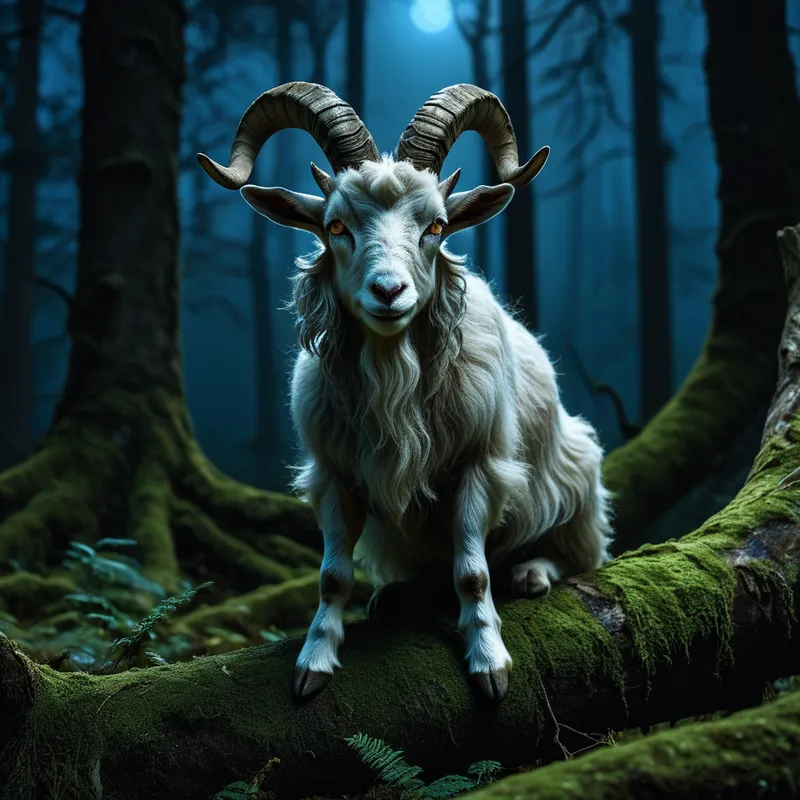
They called him Robin Goodfellow, and by older, whispered names: Puck. His hair was the colour of tangled [hawthorn](/myths/hawthorn “Myth from Celtic culture.”/), and his eyes held the glint of a [will-o’-the-wisp](/myths/will-o-the-wisp “Myth from Celtic culture.”/) over a treacherous fen. His laughter was the sound of a brook chuckling over stones, and his feet—sometimes shod, sometimes bare, sometimes ending in the delicate hoof of a goat—made no print upon [the dew](/myths/the-dew “Myth from Alchemical culture.”/).
On this night, the air was heavy with the scent of ripe barley. In a cottage at the forest’s hem, a proud and lazy dairymaid had left her churn untended, boasting she would finish at dawn. Puck, hearing her vanity from a league away, slipped through the keyhole like a draft. He found the churn, cold and idle. With a snap of his fingers, the cream within began to swirl, to froth and bubble, though no hand touched the staff. He danced a jig around it, a silent, gleeful circuit, and the butter came in a great, golden wave, overflowing the wooden tub, spilling across the floor in a rich, wasteful flood.
But his work was not done. He traveled to a village where a mean-spirited baker refused crusts to the poor. Into the man’s oven went Puck, not to warm himself, but to knead the dough with invisible, frantic hands. At dawn, the baker opened his hatch to find not loaves, but a hundred tiny, misshapen rolls, each baked into the leering likeness of his own scowling face.
His greatest sport was with travelers. To the arrogant knight, sure of his path, Puck would lead him in circles until dawn, showing him the same lightning-blasted oak again and again. To the kind-hearted plowman sharing his last crust, Puck would clear the brambles from his path and guide his feet true. He was chaos, but a chaos with a crooked sense of [justice](/myths/justice “Myth from Tarot culture.”/), a mirror held up to the hearts of men. He did not rule; he played. And in his play, the hidden truths of the village, the forest, and the human soul were stirred up from the bottom, like leaves in a sudden, capricious wind.

Cultural Origins & Context
The figure of Puck is not born of a single story, but is a condensation of breath on the cold glass of folklore. His roots are deep in the pre-Christian animism of Northern Europe, among spirits of the waste</ab title> and the elves. He is a [hobgoblin](/myths/hobgoblin “Myth from English culture.”/), a puck (from the Old English pūca, meaning a mischievous spirit), a Lob-lie-by-the-fire.
His stories were not penned by monks or sung in royal halls, but were passed in whispers by [the hearth](/myths/the-hearth “Myth from Norse culture.”/), told by nurses to children, and shared by laborers in the field. His primary function was explanatory and cautionary. Why did the butter not come? Puck. Who led the sheep astray? Robin Goodfellow. Who helped sweep the floor when you left out a bowl of cream? The same. He personified the uncanny, unpredictable aspects of the natural world just beyond the garden gate—the sudden draft, the misplaced tool, the unexpected luck. He served as a social regulator in peasant society, a supernatural enforcer of hospitality, humility, and hard work. To be “puck-led” or “pook-led” was to be morally or literally lost, a state every listener sought to avoid.
Symbolic Architecture
Puck is the archetypal [trickster](/symbols/trickster “Symbol: A boundary-crossing archetype representing chaos, transformation, and the subversion of norms through cunning and humor.”/), a psychological force of irreducible [ambiguity](/symbols/ambiguity “Symbol: A state of uncertainty or multiple possible meanings, often found in abstract art and atonal music where clear interpretation is intentionally elusive.”/). He represents the [spirit](/symbols/spirit “Symbol: Spirit symbolizes the essence of life, vitality, and the spiritual journey of the individual.”/) of the [limen](/myths/limen “Myth from Roman culture.”/)—the threshold. He exists at the [boundary](/symbols/boundary “Symbol: A conceptual or physical limit defining separation, protection, or identity between entities, spaces, or states of being.”/) between civilization and [wilderness](/symbols/wilderness “Symbol: Wilderness often symbolizes the untamed aspects of the self and the unconscious mind, representing a space for personal exploration and discovery.”/), order and [chaos](/symbols/chaos “Symbol: In Arts & Music, chaos represents raw creative potential, uncontrolled expression, and the breakdown of order to forge new artistic forms.”/), the conscious ego and the untamed unconscious.
The trickster does not destroy order; he reveals its fragility and tests its authenticity. He is the necessary grain of sand in the oyster of the psyche.
His shapeshifting signifies the fluid, unformed [nature](/symbols/nature “Symbol: Nature symbolizes growth, connectivity, and the primal forces of existence.”/) of primal psychic [energy](/symbols/energy “Symbol: Energy symbolizes vitality, motivation, and the drive that fuels actions and ambitions.”/) before it is harnessed by [the ego](/myths/the-ego “Myth from Jungian culture.”/)‘s narratives. His mischief is not mere malice; it is a disruptive, creative intelligence. The spilled [butter](/symbols/butter “Symbol: Butter symbolizes nourishment, transformation, and richness, often representing comfort, indulgence, or the churning of emotions into something valuable.”/) is wasted [effort](/symbols/effort “Symbol: Effort signifies the physical, mental, and emotional energy invested toward achieving goals and personal growth.”/) born of laziness. The ugly rolls are the baker’s own greed made manifest. Puck externalizes the internal, making the hidden [shadow](/symbols/shadow “Symbol: The ‘shadow’ embodies the unconscious, repressed aspects of the self and often represents fears or hidden emotions.”/) visible and tangible. He is the psychological function that deconstructs pretension, hypocrisy, and rigid self-importance. He is the laugh that erupts in a solemn [ceremony](/symbols/ceremony “Symbol: Ceremonies in dreams often symbolize transitions, rituals of passage, or significant life events.”/), the irrational hunch that solves a logical [problem](/symbols/problem “Symbol: Dreams featuring a ‘problem’ often symbolize internal conflicts or challenging situations that require resolution and self-reflection.”/), the creative mistake that leads to a new [discovery](/symbols/discovery “Symbol: The act of finding something previously unknown, hidden, or lost, often representing personal growth, new opportunities, or hidden aspects of the self.”/).
The Dreamer’s Resonance
To dream of a Puck-like figure is to encounter the [psyche](/myths/psyche “Myth from Greek culture.”/)‘s own trickster energy rising from the shadow. This is not a dream of terror, but of unsettling, playful chaos. The dream setting is often a familiar, ordered space—one’s home, workplace, or school—that is being subtly or overtly subverted. Files are misplaced in impossible ways, rooms change layout, gravity behaves oddly.
The somatic feeling is one of frisson—a shiver of anxiety mixed with exhilaration. The dream ego often feels frustrated, chasing after [the trickster](/myths/the-trickster “Myth from Various culture.”/) or trying to repair the disruptions. This signals a psychological process where long-held structures of identity, habit, or belief are being playfully (or ruthlessly) tested by the unconscious. The dream is an invitation to loosen control, to question the absoluteness of one’s current “order.” It asks: What part of your life has become too rigid, too vain, or too self-serious? Where is the spontaneous, wild, and authentic part of you demanding to be acknowledged, not as a monster, but as a mischievous spirit?

Alchemical Translation
The alchemical journey is one of transmutation: turning leaden, unconscious material into golden consciousness. Puck is the essential, and often dreaded, first agent in this work: the [nigredo](/myths/nigredo “Myth from Alchemical culture.”/), the blackening, the chaotic dissolution.
Individuation does not begin with building a better castle; it begins with a spirit tipping over the old, stagnant butter churn.
The ego’s carefully constructed identity—the “dairymaid’s boast,” the “baker’s mean-spiritedness”—must be disrupted. Puck performs this enantiodromia (the emergence of the unconscious opposite) by creating chaos where there was false order. For the modern individual, the “alchemical translation” of Puck’s myth is the conscious engagement with one’s own trickster nature. This means allowing oneself to be creatively “misled” from the well-worn path of [persona](/myths/persona “Myth from Greek culture.”/) and expectation. It is to welcome the thoughts, impulses, and ideas that seem nonsensical or embarrassing—the psychic “misshapen rolls”—and to see them as raw material.
The goal is not to become Puck, but to integrate his function. To develop a psychic flexibility that can dance on the threshold, that can laugh at one’s own pretensions, and that can use creative disruption to break psychic inertia. In doing so, the individual does not fall into chaos, but gains a more resilient and authentic order, one that includes, rather than excludes, the wild, untamed, and spontaneously creative forces of the deep self. The integrated trickster becomes the inner jester, the sage fool who, through play, reveals profound truth.
Associated Symbols
Explore related symbols from the CaleaDream lexicon: