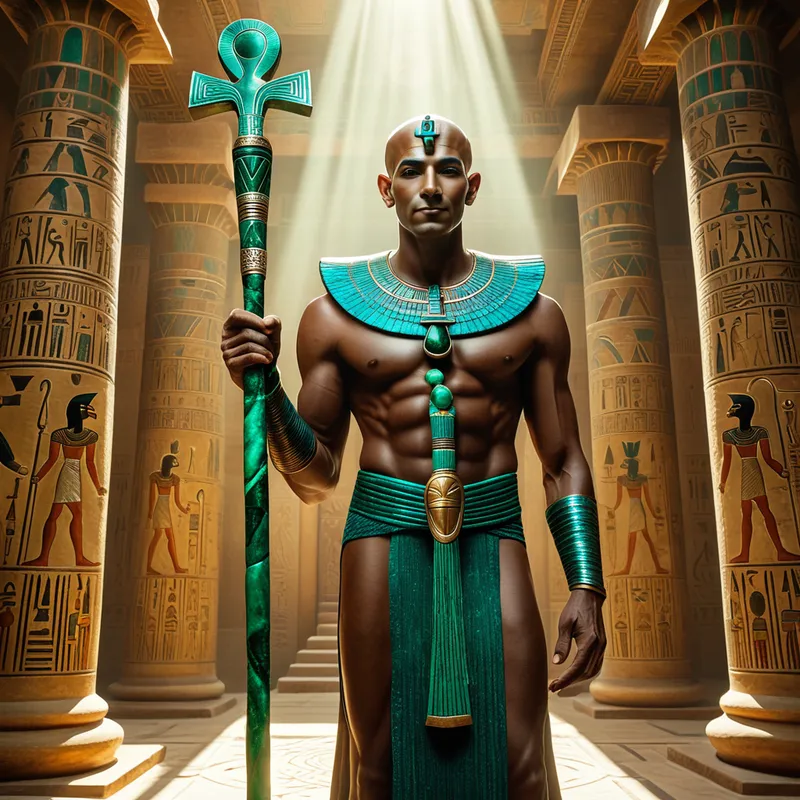
Ptah Myth Meaning & Symbolism
The story of Ptah, the divine architect who conceived the cosmos through his heart's thought and his tongue's command, birthing reality from primordial silence.
The Tale of Ptah
Before the sun first drew breath, there was only the endless, silent dark. Not a darkness of absence, but a darkness of potential—a deep, swirling, watery chaos known as Nun. In this void, there was no time, no thing, only the sleeping possibility of all things.
And within that sleeping possibility, a presence stirred. Not with movement, for there was no space to move, but with awareness. This was Ptah. He existed as a perfect, contained thought in the heart of the void. He was the architect before the foundation, the sculptor before the clay. He perceived, within his own being, the concept of a world: the soaring arc of the sky, the solid embrace of the earth, the luminous journey of the sun, and the teeming life of the river. He saw the great cycle of birth, death, and renewal, and the gods who would govern it—Ra, Geb, Nut, Osiris. He held the complete, intricate blueprint of reality within his heart.
But a blueprint in the dark is not a world. It is a dream. Ptah knew that to bring the dream into being, he must speak it. In the profound stillness, he gathered the concept from the workshop of his heart. He felt the truth of the world, its order (Maat), its structure, its beauty. This truth became a word, forming in the sacred chamber of his being.
Then, he gave it voice.
His command did not echo, for there was nothing to echo against. Instead, it became. The word “Sky” unfolded into the star-scattered vault of Nut, arching over the void. The word “Earth” solidified into the stable, fertile body of Geb, lying beneath. From his utterance, the primordial mound rose from the waters of Nun, the first solid land, and upon it, the city of Memphis was founded as his throne. The gods themselves shimmered into existence, not as his children, but as the manifest forms of his divine thoughts and pronouncements. He crafted their kas and their bodies, he established their shrines and shaped their sacred stones. He did not fight a monster or wrestle chaos into submission. He conceived, and he declared. And by declaring, he made it so. The universe was not born from conflict, but from a profound, creative utterance that set the very laws of existence into eternal motion.
Cultural Origins & Context
The myth of Ptah is the theological heart of Memphis, one of ancient Egypt’s oldest and most influential capitals. Unlike the solar creation myth of Heliopolis, which centered on a family of gods emerging from a self-created deity, the Memphite theology, recorded on the Shabaka Stone, presents a sophisticated, intellectual model of creation. It is a priestly philosophy, a doctrine developed to elevate the local god Ptah to a supreme, transcendent creator, surpassing even the popular sun god Ra.
This story was not a folktale for the masses but a foundational text for the elite—the priests, architects, scribes, and craftsmen. It was recited in temple rituals, underpinning the pharaoh’s role as the maintainer of Maat, an order first spoken by Ptah. The myth served a crucial societal function: it sanctified the arts of civilization. Building, crafting, writing, and governing were not merely human activities; they were participations in the original, divine act of creation. Every sculptor carving a statue, every architect drafting a temple plan, and every scribe writing a decree was channeling the creative power of Ptah, bringing form out of formlessness through heart and tongue.
Symbolic Architecture
Ptah represents the archetypal principle of creation through intellect and articulation. He is not a wild, generative force of nature, but the conscious, ordering mind that gives shape to potential. His mummiform body symbolizes containment, stability, and the latent power held within a defined form. The tools of his power are not weapons, but the heart and the tongue.
The heart is the silent forge where all worlds are first imagined; the tongue is the chisel that releases them from the stone of possibility.
His composite scepter—uniting the ankh (life), the djed (stability), and the was (power)—is a perfect emblem of his function: he imbues created life with enduring structure and authoritative order. Psychologically, Ptah symbolizes the transformative moment when an inner vision, a feeling, or an intuition (the heart’s thought) is consciously named, defined, and brought into the shared reality of the world (the tongue’s command). He is the bridge between the unconscious, fertile chaos of Nun and the conscious, constructed order of Maat.
The Dreamer’s Resonance
When the pattern of Ptah stirs in the modern psyche, it often manifests in dreams of profound, silent creativity. A dreamer might find themselves in a vast, empty space—a blank canvas, an empty room, a silent hall. There is no panic, only a pregnant stillness. They may discover they can shape the environment simply by thinking of an object, which then shimmers into a semi-solid form. Or they may dream of speaking a single, resonant word that alters the entire landscape of the dream.
Somatically, this can correlate with a feeling of pressure or warmth in the chest (the heart’s workshop) and a sense of constriction or activation in the throat (the tongue’s gateway). Psychologically, this dream signals a process of conscious formulation. The dreamer is moving from a state of chaotic potential, confusion, or unformed emotion into a phase of clarity, definition, and intentional manifestation. It is the psyche preparing to give birth to an idea, a project, a difficult truth, or a new identity. The conflict is not external, but internal: the struggle to find the precise, truthful word or form for what has, until now, been only a feeling.

Alchemical Translation
The alchemical journey modeled by Ptah is the transmutation of prima materia—the raw, chaotic stuff of our inner Nun (unprocessed emotions, vague yearnings, latent talents)—into the philosopher’s stone of a realized life. The process is one of precise, conscious artistry.
First, in the nigredo or blackening phase, we must dwell in the dark waters of potential, allowing the formless feeling to exist without forcing it. This is Ptah in Nun, holding the thought in his heart. The modern seeker must practice deep introspection, listening to the silent blueprint of the soul. Next comes the albedo, the whitening, where the idea is clarified and purified in the mind’s eye. Finally, the rubedo, the reddening, is the act of manifestation: speaking the truth, writing the book, building the relationship, starting the venture.
Individuation is not merely self-discovery; it is the sacred, ongoing act of self-creation, speaking the soul into existence word by deliberate word.
The modern individual often seeks transformation through dramatic upheaval or external conquest. Ptah’s myth offers a quieter, more profound path. Our greatest creative act is not to slay dragons, but to name our world into being. To look at the chaos of our experience—our grief, our joy, our ambition—and to dare to conceive its order. To find the true word for it in our heart, and then, with courage and precision, to give it voice. In doing so, we cease to be merely inhabitants of a given reality and become, like Ptah, co-creators of our own cosmos, establishing our own inner Maat upon the primordial mound of the self.
Associated Symbols
Explore related symbols from the CaleaDream lexicon: