
Psyche's Sanctuary Myth Meaning & Symbolism
A mortal woman's love for an unseen god leads her through impossible trials to achieve divine wholeness and union, forging her own sanctuary.
The Tale of Psyche’s Sanctuary
Listen, and I will tell you of a sanctuary not built of stone, but of soul. It begins with a mortal maiden, [Psyche](/myths/psyche “Myth from Greek culture.”/), whose beauty was so radiant it stole the breath from mortals and drew the cold envy of a goddess. For Aphrodite herself, seeing her altars grow cold as men worshipped this earthly vision, burned with a divine spite. She commanded her son, the winged god Eros, to pierce [Psyche](/myths/psyche “Myth from Greek culture.”/) with a golden arrow, making her fall in love with the most vile creature he could find.
But fate, that weaver of unexpected patterns, had another design. Seeing Psyche, Eros pricked himself with his own arrow. A love deeper than any command bloomed in the god’s heart. He could not doom her. Instead, he spirited her away to a hidden sanctuary—a palace of wonders that rose from the very air on a sun-kissed mountain peak. Its halls were of polished marble and gold, filled with music from unseen sources, where every desire was whispered into existence by invisible, gentle hands. Here, Psyche lived in luxury beyond imagining. Yet, her lover came only in the deep velvet of night, a presence of warmth and passion sworn to utter secrecy. “You must never seek to see my face,” his voice, like honeyed darkness, pleaded. “Trust in the love that surrounds you.”
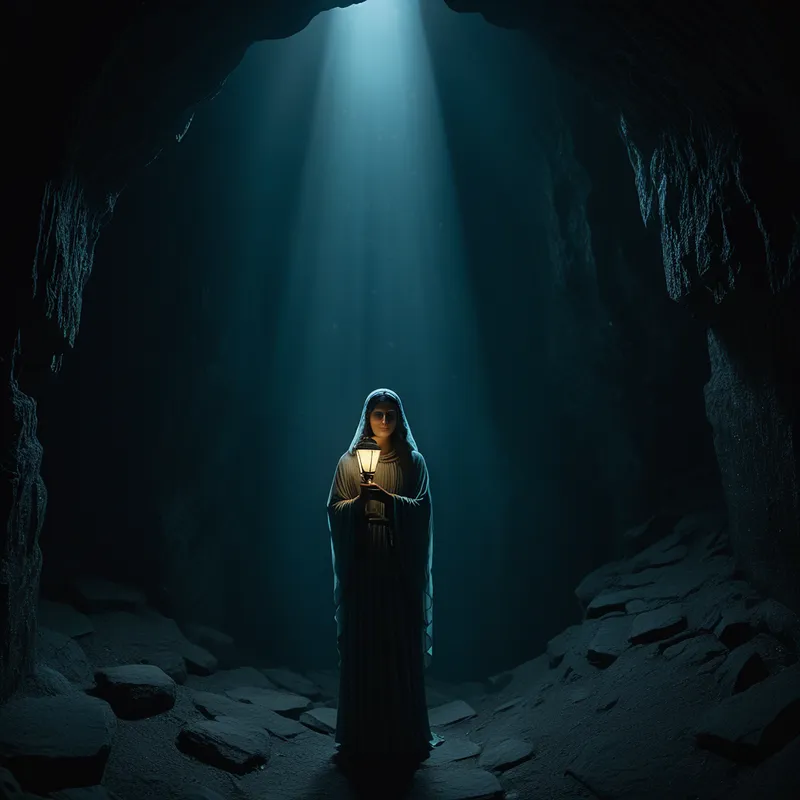
For a time, the sanctuary held. But the human heart is a curious vessel. Loneliness, fed by the whispers of her fearful sisters who claimed her lover was a monstrous serpent, grew within her. One fateful night, her resolve shattered. With a trembling hand, she lit a small oil lamp and raised it over the sleeping form beside her. The light did not fall upon a monster, but upon the most beautiful being her eyes had ever witnessed: Eros, his golden hair, his graceful wings folded in slumber. In her shock, a drop of scalding oil fell upon his shoulder. He awoke. The betrayal in his divine eyes was a colder fire than any lamp. Without a word, he rose, and with him, the sanctuary dissolved like mist. Psyche was left alone on the cold grass, the palace, the love, the very air of her haven gone.
Her true trial then began. The heartbroken Psyche wandered [the earth](/myths/the-earth “Myth from Hindu culture.”/), a soul in exile. She came at last to [the temple](/myths/the-temple “Myth from Jewish culture.”/) of the vengeful Aphrodite, who set before her four impossible labors. She had to sort a colossal mound of mixed grains—a task of despair—until a troop of compassionate ants came to her aid. She had to gather [golden fleece](/myths/golden-fleece “Myth from Greek culture.”/) from fierce, sun-crazed rams—a task of peril—until a whispering reed taught her to collect the fleece caught on brambles at twilight. She had to fill a crystal flask with [water](/myths/water “Myth from Chinese culture.”/) from the deadly river Styx—a task of certain death—until the eagle of Zeus itself swooped down to fill [the vessel](/myths/the-vessel “Myth from Alchemical culture.”/).
The final task was a descent into darkness itself. Aphrodite demanded a casket of beauty from [Persephone](/myths/persephone “Myth from Greek culture.”/), goddess of [the underworld](/myths/the-underworld “Myth from Greek culture.”/). Psyche walked the path to the land of the dead, past the silent ferryman and the three-headed hound. She reached [Persephone](/myths/persephone “Myth from Greek culture.”/), who granted the gift. But on her return to the light, a fatal curiosity once more seized her. Thinking to take a little beauty for herself, she opened the casket. Instead of beauty, the sleep of death—the sleep of [Hades](/myths/hades “Myth from Greek culture.”/)—poured out, and she fell lifeless to the ground.
It was here, at the ultimate threshold, that love returned. Eros, his wound healed but his heart forever bound to hers, flew to her side. He brushed the death-sleep from her face and lifted her soul back to life. His love, now witnessed and known, was her final sanctuary. He flew to Olympus and pleaded before Zeus. The king of gods, moved by Psyche’s endurance and the power of such love, granted her immortality. Ambrosia touched her lips. Psyche the mortal became Psyche the goddess, and in the celestial halls, she and Eros were wed. The soul, tested in fire and darkness, had found its eternal home.
Cultural Origins & Context
This rich, novelistic tale comes to us not from the epic cycles of [Homer](/myths/homer “Myth from Greek culture.”/), but from the later, Latin literature of the Roman Empire. It is the central narrative within The Golden Ass (or [Metamorphoses](/myths/metamorphoses “Myth from Greek culture.”/)), a work by the philosopher and rhetorician Apuleius, written in the 2nd century CE. While the characters and divine framework are Greek, the text is a product of the Roman imperial world, a time of syncretism and philosophical exploration.
The story was likely a sophisticated literary creation designed for an educated audience, weaving together older folk motifs of the invisible husband and impossible tasks with Platonic and mystery-cult ideas about the soul (psyche). Its function was not merely entertainment but edification. It served as an allegory, a “soul story,” reflecting contemporary philosophical and religious currents that viewed the human journey as a series of trials leading to spiritual elevation and union with the divine. It was a myth for the individual, reflecting the inward turn of spirituality in the Hellenistic and Roman eras.
Symbolic Architecture
At its core, the myth is a map of the [soul](/symbols/soul “Symbol: The soul represents the essence of a person, encompassing their spirit, identity, and connection to the universe.”/)‘s [journey](/symbols/journey “Symbol: A journey in dreams typically signifies adventure, growth, or a significant life transition.”/) toward [consciousness](/symbols/consciousness “Symbol: Consciousness represents the state of awareness and perception, encompassing thoughts, feelings, and experiences.”/) and [integration](/symbols/integration “Symbol: The process of unifying disparate parts of the self or experience into a cohesive whole, often representing psychological wholeness or resolution of internal conflict.”/). Psyche is not just a [character](/symbols/character “Symbol: Characters in dreams often signify different aspects of the dreamer’s personality or influences in their life.”/); she is the [human](/symbols/human “Symbol: The symbol of a human represents individuality, complexity of emotions, and social relationships.”/) Self in potential. Her initial, worshipped [beauty](/symbols/beauty “Symbol: This symbol embodies aesthetics, harmony, and the appreciation of life’s finer qualities.”/) represents an unconscious state of being—valued for her [appearance](/symbols/appearance “Symbol: Appearance in dreams relates to self-image, perception, and how you present yourself to the world.”/), not her substance. Her sanctuary with Eros is [the first stage](/myths/the-first-stage “Myth from Alchemical culture.”/) of deep, unconscious [connection](/symbols/connection “Symbol: Connection symbolizes relationships, communication, and bonds among individuals.”/) to the animating principle of [life](/symbols/life “Symbol: The symbol of ‘Life’ represents a journey of growth, interconnectedness, and existential meaning, encompassing both the joys and challenges that define human experience.”/) and desire (Eros).
The first sanctuary is always given, not earned. It is the grace of the unconscious union, the paradise before the fall into awareness.
The [lamp](/symbols/lamp “Symbol: A lamp symbolizes guidance, enlightenment, and the illumination of truth, often representing knowledge or clarity in dark times.”/) is the light of consciousness. Her use of it is not a sin, but a necessary, painful step. To “see” the [nature](/symbols/nature “Symbol: Nature symbolizes growth, connectivity, and the primal forces of existence.”/) of our deepest drives and connections is to shatter the [bliss](/symbols/bliss “Symbol: A state of profound happiness and spiritual contentment, often representing fulfillment of desires or alignment with one’s true self.”/) of unconscious participation. The four labors are the archetypal trials of the conscious ego: sorting [chaos](/symbols/chaos “Symbol: In Arts & Music, chaos represents raw creative potential, uncontrolled expression, and the breakdown of order to forge new artistic forms.”/) (the grains), confronting dangerous, instinctual power (the rams), navigating the waters of the unconscious ([the Styx](/myths/the-styx “Myth from Greek culture.”/)), and finally, descending into the [underworld](/symbols/underworld “Symbol: A symbolic journey into the unconscious, representing exploration of hidden aspects of self, transformation, or confronting repressed material.”/) of the [Shadow](/symbols/shadow “Symbol: The ‘shadow’ embodies the unconscious, repressed aspects of the self and often represents fears or hidden emotions.”/) and the Great [Mother](/symbols/mother “Symbol: The symbol of ‘Mother’ represents nurturing, protection, and the foundational aspect of one’s emotional being, often associated with comfort and unconditional love.”/) (Persephone). Each [task](/symbols/task “Symbol: A task represents responsibilities, duties, or challenges one faces.”/) requires help from the non-human world—ants, [reed](/symbols/reed “Symbol: A flexible plant symbolizing resilience, adaptability, and vulnerability. It bends without breaking, representing survival through yielding.”/), [eagle](/symbols/eagle “Symbol: The eagle is a symbol of power, freedom, and transcendence, often representing a person’s aspirations and higher self.”/)—symbolizing the need to align with instinct and the natural psyche, not just willpower.
Her “[death](/symbols/death “Symbol: Symbolizes transformation, endings, and new beginnings; often associated with fear of the unknown.”/)” from opening the beauty [casket](/symbols/casket “Symbol: A casket symbolizes the containment of something precious, often relating to emotions, memories, or aspects of self that need to be preserved or buried.”/) signifies the ultimate peril: [the ego](/myths/the-ego “Myth from Jungian culture.”/)‘s attempt to claim the numinous power of the unconscious for itself leads to psychic stagnation ([death](/symbols/death “Symbol: Symbolizes transformation, endings, and new beginnings; often associated with fear of the unknown.”/)). Salvation comes only from the return of the transcendent function—Eros, the reconciling [symbol](/symbols/symbol “Symbol: A symbol can represent an idea, concept, or belief, serving as a powerful tool for communication and understanding.”/) of love that bridges the conscious and unconscious.
The Dreamer’s Resonance
When this myth stirs in modern dreams, it signals a profound process of psychic differentiation and the longing for authentic relationship. To dream of a beautiful, hidden place that one is forbidden to examine closely often parallels Psyche’s palace. The dreamer may be in a phase of life—a relationship, a career, a spiritual practice—that feels gifted and magical but rests on unexamined foundations. The anxiety, the “sisters’” voices, manifest as dream figures of criticism or as a pervasive sense of unease within the sanctuary itself.
Dreams of impossible tasks—sorting endless objects, trying to capture something from dangerous animals, or finding oneself in a labyrinthine [underworld](/myths/underworld “Myth from Greek culture.”/)—directly mirror Psyche’s labors. Somatic sensations here are key: overwhelming fatigue, the ache of futile effort, or the chilling dread of the descent. These dreams indicate the psyche is engaged in the hard, often thankless work of ordering inner chaos, confronting powerful complexes (the rams), and courageously facing repressed material (the descent).
The culmination in such a dream series might be an image of failure or death, followed by an unexpected rescue—a winged figure, a sudden helping hand, or a transformative embrace. This marks the critical shift from ego-led striving to a reception of grace, where the psyche acknowledges it cannot complete its transformation alone.
Alchemical Translation
[The myth of Psyche](/myths/the-myth-of-psyche “Myth from Global/Universal culture.”/) is a perfect allegory for the alchemical process of individuation. It begins in the [nigredo](/myths/nigredo “Myth from Alchemical culture.”/), the blackening: Psyche’s exile from her palace, her mourning, her confrontation with Aphrodite’s wrath. This is the dissolution of the old, naive personality.
The four labors represent the albedo, the whitening, the arduous purification. Sorting grains is [separatio](/myths/separatio “Myth from Alchemical culture.”/)—distinguishing components of the psyche. Gathering fleece is a cautious engagement with solar, masculine energy (the rams) through lunar, reflective wisdom (twilight and brambles). Fetching Stygian water is the perilous extraction of transformative energy from the deepest unconscious. The descent to Persephone is the coniunctio with the dark, chthonic feminine, essential for wholeness.
The soul’s immortality is won not by avoiding death, but by carrying the knowledge of the underworld back into the light.
Psyche’s fatal curiosity with Persephone’s casket is a crucial failed multiplicatio—the ego’s attempt to inflate itself with the treasure. Her lifeless state is the necessary return to the nigredo, a total surrender. Eros’s revival of her is the true coniunctio, [the sacred marriage](/myths/the-sacred-marriage “Myth from Various culture.”/) of conscious and unconscious, soul and spirit, which produces the [rubedo](/myths/rubedo “Myth from Alchemical culture.”/), the reddening—the achievement of [the immortal](/myths/the-immortal “Myth from Taoist culture.”/), divine Self. The final wedding on Olympus is the stabilization of this state, the creation of an enduring inner sanctuary. For the modern individual, the myth teaches that wholeness is achieved not by remaining in blissful ignorance, nor by sheer heroic effort alone, but through a devoted, often painful engagement with the depths, culminating in a redeemed relationship with the very source of one’s being. The sanctuary is not a place we find, but a state we become.
Associated Symbols
Explore related symbols from the CaleaDream lexicon: