Psyche's Lamp Myth Meaning & Symbolism
A mortal woman, Psyche, breaks a divine taboo by illuminating her mysterious lover, Eros, with a lamp, initiating a perilous quest for reunion and apotheosis.
The Tale of Psyche’s Lamp
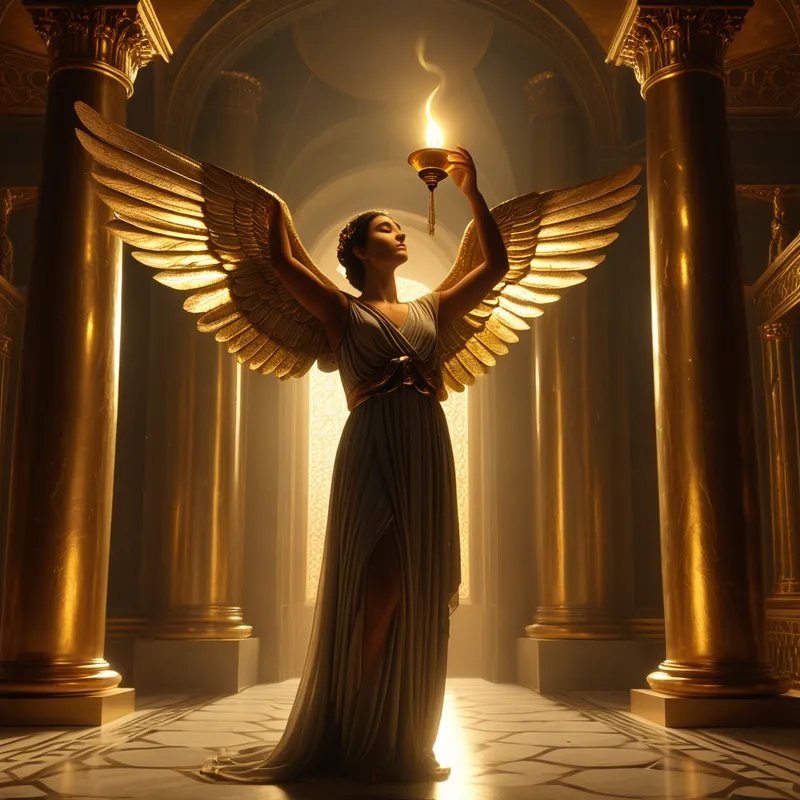
Listen, and hear a story of a love that was not born of sight, but was almost destroyed by it. It begins not with a god, but with a mortal woman whose beauty was so profound it stole the breath from the world. Her name was Psyche. Her radiance was such that men forgot the altars of Aphrodite, and in her green-eyed jealousy, the goddess commanded her son, Eros, to make Psyche fall in love with a monster.
But fate has a will of its own. When Eros beheld Psyche, the arrow meant for her heart pricked his own. He could not carry out his mother’s vengeance. Instead, he orchestrated a mysterious destiny. An oracle declared Psyche must be left on a mountain peak to wed a terrible, serpentine bridegroom. Her family wept as they abandoned her to the winds.
Yet it was not a monster who came for her, but the gentle West Wind, Zephyrus, who carried her softly down to a hidden valley, to a palace wrought by divine hands. It was a place of invisible splendor. Invisible servants attended her, and an invisible voice, sweet and compelling, spoke to her in the darkness of night. This was her husband. He came only under the cloak of darkness, forbidding her ever to seek his face. “If you look upon me,” the voice whispered with a love that trembled, “you will lose me forever.”
For a time, Psyche lived in bliss, her heart full though her eyes were empty. But solitude and the whispers of mortal doubt are potent seeds. When she was granted a visit from her sisters, their envy took the form of concern. “How can you love a husband you have never seen?” they hissed. “What if he is the vile serpent the oracle foretold, fattening you for some unspeakable feast?”
Their words festered in her mind, a poison of curiosity and fear. That night, as her mysterious lover slept beside her, a terrible resolve hardened in Psyche’s heart. She rose. Her hand, trembling with a treasonous mix of dread and desperate need, found the wicked blade she had hidden. But beside it, she placed a small, sputtering oil lamp. The blade was for a monster; the lamp was for the truth.
She lit the wick. The flame caught, and a pool of fragile, golden light spread across the bed. And there, in its glow, was no monster. There lay the most beautiful being mortal or immortal eyes had ever seen: the god Eros himself, his golden curls upon the pillow, his great, feathered wings folded in sleep, a bow and quiver resting by the bedside. A love so vast it was terror washed over her. In her awe, her hand shook. A single, burning drop of oil spilled from the lamp and fell upon the god’s perfect shoulder.
He awoke with a cry of pain and betrayal. His eyes, meeting hers in the lamplight, held not anger, but an anguish that shattered the world. “You have broken faith, Psyche,” he said, his voice the sound of a sacred vow undone. “Love cannot live where there is no trust.” And as he spoke, the palace, the gardens, the very air of the valley began to dissolve into mist. He spread his wings, and though she clung to his ankle, begging, he rose into the dawn sky, leaving her alone on the cold, barren earth with nothing but the dying lamp and a heart in ruins. Her quest—a harrowing journey to win back her love through impossible labors set by Aphrodite—had just begun, ignited by that one, fateful flame.

Cultural Origins & Context
This poignant episode is the pivotal heart of the tale of Eros and Psyche, which survives not in the fragments of early Greek epic, but in the Latin novel The Golden Ass (or Metamorphoses) written by Apuleius in the 2nd century CE. While the characters are Greek, the narrative is filtered through a Roman literary and possibly Isiac mystical lens. It was a story within a story, told by an old woman to comfort a kidnapped girl, embedding a profound allegory within a ribald, magical adventure.
Its societal function was multifaceted. On one level, it was simply a captivating romance. On another, it served as a myth of the soul (psyche means “soul” or “breath” in Greek). In the culturally syncretic Hellenistic and Roman world, where mystery cults promised personal salvation and union with the divine, the story of Psyche resonated as an allegory for the soul’s arduous journey toward the sacred, its trials, its failures of faith, and its ultimate apotheosis. It was a narrative that validated the individual’s inner struggle for wholeness and divine connection, a theme that would deeply influence later Neoplatonic and Christian thought.
Symbolic Architecture
The lamp is the central, transformative symbol. It is not merely a tool for seeing, but an instrument of consciousness itself. In the darkness of the unknown marriage bed—a metaphor for the unconscious, instinctual union—the lamp represents the dawning light of the questioning ego. Psyche’s act is the soul’s first, fraught attempt to bring conscious awareness to a relationship that has been blissful but blind, founded on projection and mystery.
The light of consciousness is both a blessing and a curse; it reveals beauty but can wound the sacred with its hot, inquisitive oil.
Eros, the god of love, represents the autonomous, instinctual force of deep connection—the anima/animus or the Self in its compelling, mysterious form. He operates in the dark, in the realm of feeling and intuition. To demand to see him with the harsh, defining light of the rational mind (the lamp) is to try to possess and define what must remain, in part, numinous and free. The spilled oil is the inevitable consequence: the pain inflicted when the soul tries to pin down the transcendent, to turn a living mystery into a known object. The resulting loss is not a punishment, but a necessary separation—the beginning of the individuation process where the ego must now consciously seek what it once possessed unconsciously.
The Dreamer’s Resonance
When this mythic pattern stirs in the modern dreamer, it signals a critical threshold in a relationship—to a partner, a creative calling, or a deep inner truth. Dreaming of a hidden lover, a forbidden room, or, most potently, of holding a light that reveals something breathtaking yet perilous, speaks to the somatic tension between trust and knowledge, surrender and control.
The psychological process is one of integration. The dreamer is at the point where unconscious attachment (the blissful darkness) is becoming unsustainable. A part of the psyche—often the skeptical, fearful, or rationally demanding part (the “sisters”)—insists on verification. The act of “lifting the lamp” in a dream is the psyche’s own enactment of moving from passive reception to active, if risky, engagement with a profound inner reality. The ensuing feeling of loss or desolation in the dream mirrors the necessary death of a naive state, creating the psychic space where conscious effort and the labor of the quest must begin. It is the painful birth of accountability in love and selfhood.
Alchemical Translation
The myth of Psyche’s Lamp is a perfect map of psychic alchemy. The initial state is the massa confusa, the unconscious union in the dark palace—blissful but unindividuated. The lamp is the nigredo, the blackening. It is the first act of discrimination, which immediately leads to darkness, despair, and the feeling of utter ruin as the golden projection dissolves. The spilled oil is the crucial puncturing of the vessel.
The soul must lose its god to find its own divinity; the lover must be exiled to become a seeker.
Psyche’s subsequent labors—sorting seeds, gathering golden fleece, fetching water from the Styx, descending to the Underworld—are the stages of albedo and citrinitas. They represent the arduous, conscious work of ordering the chaotic psyche (seeds), confronting shadowy energies (the fleece from violent rams), integrating the waters of life and death, and facing the deepest underworld of the personal unconscious. Only by accomplishing these tasks does she earn the final apotheosis, the rubedo: her transformation from mortal to immortal, her conscious reunion with Eros, and the birth of their child, Voluptas. For the modern individual, this alchemy translates to the journey from naive entanglement, through the crisis of conscious questioning and the pain of separation, into the disciplined, soul-forging work that ultimately leads to a mature, conscious, and immortal love—for another, and for the Self.
Associated Symbols
Explore related symbols from the CaleaDream lexicon: