Psyche's Chamber Myth Meaning & Symbolism
A mortal woman, forbidden to see her divine husband, lights a lamp and beholds Love, losing him and beginning a harrowing quest for reunion.
The Tale of Psyche’s Chamber
Hear now a tale spun on the loom of fate, a story of a beauty that shook the heavens and a curiosity that unraveled paradise. It begins not with a god, but with a mortal woman named Psyche, whose radiance was so profound that men neglected the altars of Aphrodite. Enraged, the goddess commanded her son, Eros, to pierce Psyche with a golden arrow, making her fall in love with a vile creature. But fate’s arrow bent. Eros, gazing upon her, pricked himself with his own dart, and a love deeper than any command was born.
Psyche, by a cruel oracle, was left on a mountain peak, a sacrifice to a unknown bridegroom. The West Wind, Zephyrus, caught her trembling form and bore her gently down into a hidden valley, to a palace wrought by divine hands. Walls of polished jasper, floors of liquid silver, and a voice—a sweet, disembodied voice—welcomed her. This was her husband. He came to her only in the utter blackness of night, a presence of warmth and whispered devotion. “You must never seek to see my form,” the voice pleaded, a tremor of divine fear within it. “Trust in the love that holds you. To see me is to lose me.”
For a time, Psyche dwelt in blissful shadow, her senses filled with the scent of night-blooming flowers, the taste of ambrosia, the sound of a lover’s voice that promised eternity. Yet, as the human heart will do, a seed was planted. Was her husband a monster, as her weeping sisters whispered during their visits? Was this glorious prison a gilded cage for a beast? The seed of doubt grew into a vine of desperate curiosity, coiling around her heart until it choked all comfort.
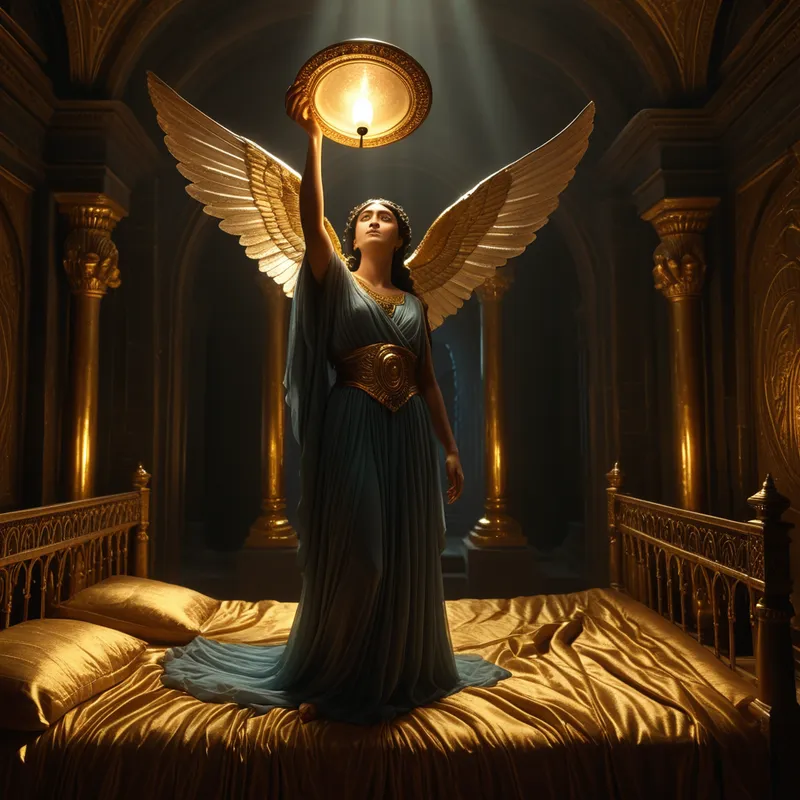
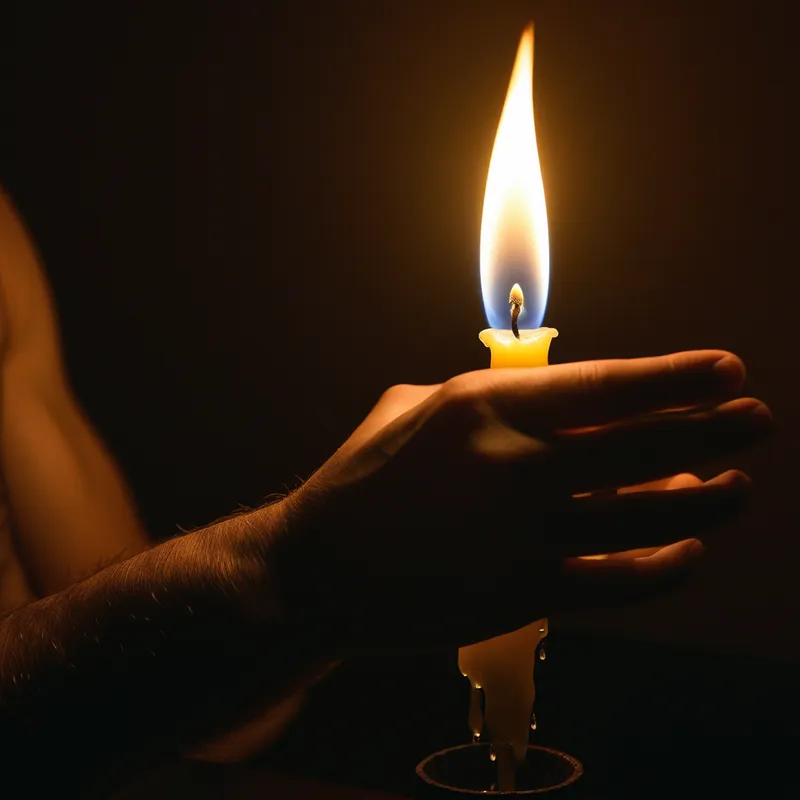
One night, the silence of the palace became a roar in her ears. Resolve, cold and sharp, settled in her breast. She rose. She took a lamp and a dagger—one to reveal, one to slay whatever horror she might find. The oil in the lamp seemed to weep as she lit it. The flame sputtered, then steadied, a tiny, defiant sun in the immense dark. She crept to the bed where her mysterious love lay sleeping.
The golden light spilled over the sheets, then climbed the curve of a shoulder, the line of a jaw. And there, revealed, was no monster, but the most beautiful of all the gods. Curls like spun gold, skin that seemed to glow with an inner moonlight, and from his shoulders, two magnificent wings, soft as swan’s down and powerful as an eagle’s, folded in repose. This was Eros, God of Love himself. In her shock, her hand trembled. A single drop of scalding oil leaped from the lamp and fell upon the god’s perfect shoulder.
He awoke with a cry that was not of pain, but of profound betrayal. His eyes, now open, held not love, but a bottomless sorrow. “You have broken faith, Psyche,” he said, his voice the sound of a sacred vow shattered. “Where there is no trust, love cannot dwell.” And as she reached for him, weeping, he rose from the bed, his wings unfolding to fill the chamber with a storm of despair. In an instant, he was gone. The palace, the gardens, the very ground beneath her feet dissolved into mist and morning air. Psyche stood alone on the barren riverbank, the empty lamp in her hand, paradise lost for a single, searing glance.
Cultural Origins & Context
This poignant episode is the central crisis of the longer tale of Eros and Psyche, which survives not in the fragments of Homer or Hesiod, but in the Latin novel Metamorphoses (also called The Golden Ass) by Apuleius, written in the 2nd century CE. While the characters are Greek, the narrative is filtered through a Roman literary and possibly mystery cult sensibility. Apuleius himself was an initiate into several mysteries, and his telling of Psyche’s trials is rich with the symbolism of initiation, ordeal, and revelation.
The story functioned on multiple levels. On the surface, it was a captivating romance, a “fairy tale” of antiquity. On a deeper level, it served as an allegory for the soul’s (Psyche) arduous journey toward union with the divine (Eros). In the context of mystery religions, Psyche’s trials—of which the violation of the chamber is the catalyst—mirrored the initiate’s path: a necessary descent into suffering, the performance of impossible tasks, and final apotheosis. The myth gave narrative form to the universal human experience of losing paradise through one’s own actions and the long, painful road required to earn it back, transformed.
Symbolic Architecture
The Chamber is the myth’s sacred, paradoxical heart. It is the temenos, the holy precinct of the nascent relationship, a space where opposites—mortal and immortal, known and unknown, light and dark—are held in a fragile, creative tension. The prohibition against light is not a arbitrary test, but a condition of this specific love’s existence.
The soul must learn to love in the dark before it can bear to see the light. To demand premature illumination is to confuse the lamp of curiosity for the sun of wisdom.
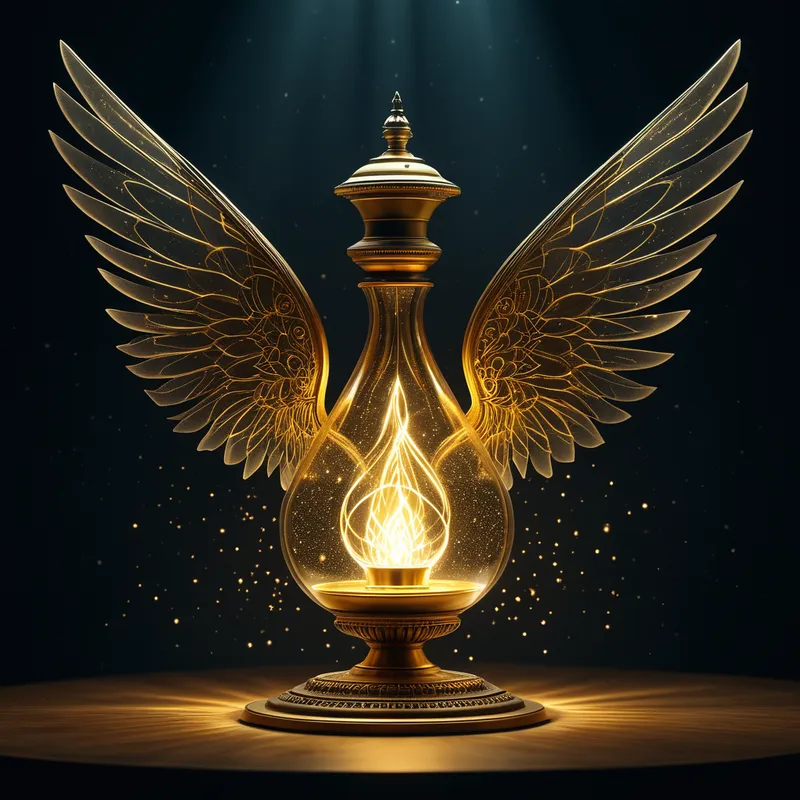
Psyche’s act is not one of evil, but of a human consciousness struggling toward knowing. The lamp represents the incisive, analytical light of the ego—necessary for navigating the world, yet fatal to the mystical, unconscious union she enjoyed. The drop of hot oil is the searing price of consciousness: the moment of realization that wounds the very thing it seeks to understand. Eros, wounded, flees. This is the critical moment of separation, the birth of the ego-Self axis, where the soul realizes its beloved Other is both transcendent and terrifyingly vulnerable to its own actions. The vanished palace signifies the end of unconscious innocence. The quest that follows—Psyche’s desperate search and the impossible labors set by Aphrodite—is the soul’s forced march toward individuation, where love must be earned through conscious effort and suffering, not simply received as a nocturnal gift.
The Dreamer’s Resonance
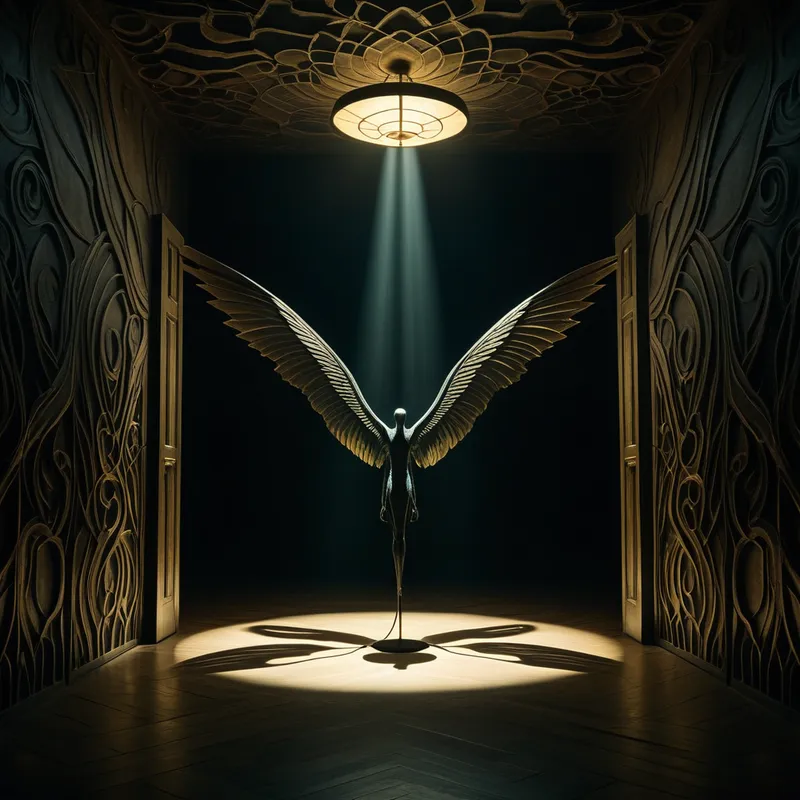
When this myth stirs in the modern dreamer, it often manifests as dreams of forbidden rooms, locked doors we finally open, or secret compartments discovered in familiar homes. The somatic sensation is one of thrilling dread, a pounding heart mixed with irresistible compulsion. Psychologically, this signals a critical threshold in the dreamer’s inner life.
The dreamer is Psyche in that moment. The “chamber” represents a protected, nascent aspect of the Self or a budding relationship (with a partner, a creative project, or a new self-concept) that is still in the unconscious, formative stage. The prohibition is the psyche’s own wise injunction to allow this fragile thing to root in darkness before exposing it to the full glare of scrutiny, doubt, or external opinion. To dream of lighting the lamp is to confront one’s own corrosive curiosity, anxiety, or lack of trust that threatens to sabotage growth. The subsequent feeling of loss, emptiness, or a beautiful space crumbling away mirrors the very real psychological experience of a promising inner state dissolving because we could not tolerate its necessary mystery. The dream is a profound lesson in the timing of consciousness and the virtue of containment.
Alchemical Translation
The myth of the Chamber models the first, crucial operation in the alchemy of the soul: the Nigredo, or blackening. The blissful, dark union is the initial, unconscious coniunctio (union). Psyche’s act is the separatio, the necessary but painful separation that begins the work.
The oil that wounds is also the fuel that lights the long road back. The betrayal that separates is the very event that individuates.
In our own lives, this is the moment a hidden truth comes to light—a personal flaw seen in a partner, the shadow side of a cherished ideal, the cost of a life choice—and the old, unconscious “palace” of our life collapses. It feels like ruin. Yet, this is the alchemical fire. The hot oil is the calcinatio, the burning away of naive projection. We are forced out of passive reception (being loved by an unseen god) into active seeking (becoming a heroine on a quest).
The modern individuation journey requires this “violation.” We must, at some point, turn the lamp of honest scrutiny upon our inner gods and demons, upon the unconscious contracts that govern our relationships and self-image. It will wound. It will cause a flight of what we thought was our secure love or identity. But it is only through this loss that we are propelled onto our own path of labors—facing the jealous mothers (Aphrodite/our complexes), sorting the seeds of our chaos, gathering the golden wool of our resilience, and descending to the underworld of our own psyche to retrieve what was lost. We do not return to the dark chamber. We ascend, with hard-won consciousness, to a marriage on Olympus, a union that can now withstand the light.
Associated Symbols
Explore related symbols from the CaleaDream lexicon: