Psyche's Bed Myth Meaning & Symbolism
A mortal woman, Psyche, is forbidden to see her divine husband, Eros. Her curiosity shatters their union, sending her on a quest to reclaim love.
The Tale of Psyche’s Bed
Hear now the tale of a love born from envy and sealed in darkness. In a time when gods walked the edges of mortal dreams, there lived a princess named Psyche, whose beauty was so radiant it stole the breath from the world. Men ceased their worship of Aphrodite, turning their prayers instead to this mortal girl. A goddess’s pride, once wounded, is a venomous thing. In her gleaming seashell throne, Aphrodite summoned her son, Eros, and commanded him to pierce Psyche with a golden arrow, making her fall in love with the most vile, wretched creature he could find.
But destiny has a will that even gods misunderstand. When Eros beheld Psyche, the point of his own arrow grazed his heart. He was undone, a god felled by his own power. He could not carry out his mother’s command. Yet, the oracle of Apollo, swayed by divine influence, declared Psyche was destined for no mortal husband, but for a monster who dwelt on a lonely mountain peak. Her family, in despair, conducted a funeral wedding and left her upon the crag.
There, the West Wind, Zephyrus, gentler than any bridal escort, lifted her and carried her down into a hidden, emerald valley. He set her before a palace that was not built by human hands. Its columns were of living crystal, its floors of polished river stone, and its air hummed with unseen music. It was a palace of silence, a gift with no giver in sight. A voice, sweet and disembodied, welcomed her as mistress and wife. That night, in the profound and velvet dark, her husband came to her. She felt his presence, heard his voice—a sound like honey and distant thunder—and knew him only through touch in the sightless chamber. He was tenderness incarnate, but with one sacred, non-negotiable law: she must never seek to see his face. She must trust the love in the darkness. “If you look upon me,” the voice warned, a tremor of true fear within it, “you will lose me forever.”
For a time, Psyche lived in a paradise of the senses, a love nourished by night and mystery. But the human heart is a vessel that fills with more than joy; it collects the silt of loneliness and the sharp stones of doubt. Visited by her jealous sisters, their whispers poisoned the well of her contentment. “Your husband is the serpent-monster of the oracle,” they hissed. “He feasts on your beauty by night and will devour you whole when your youth fades. You must take a lamp and a blade, see the truth, and strike!”
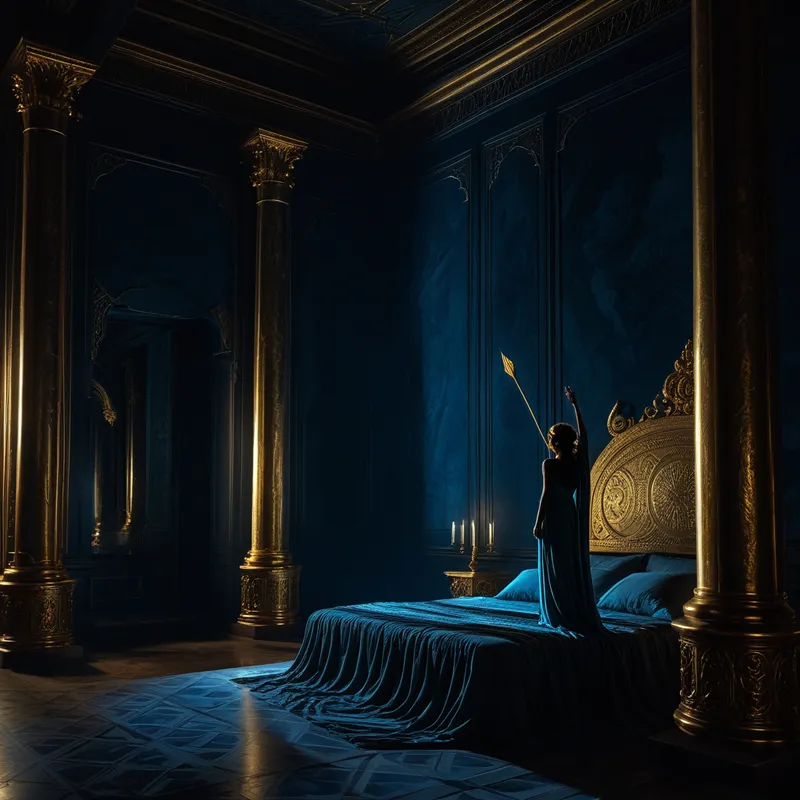
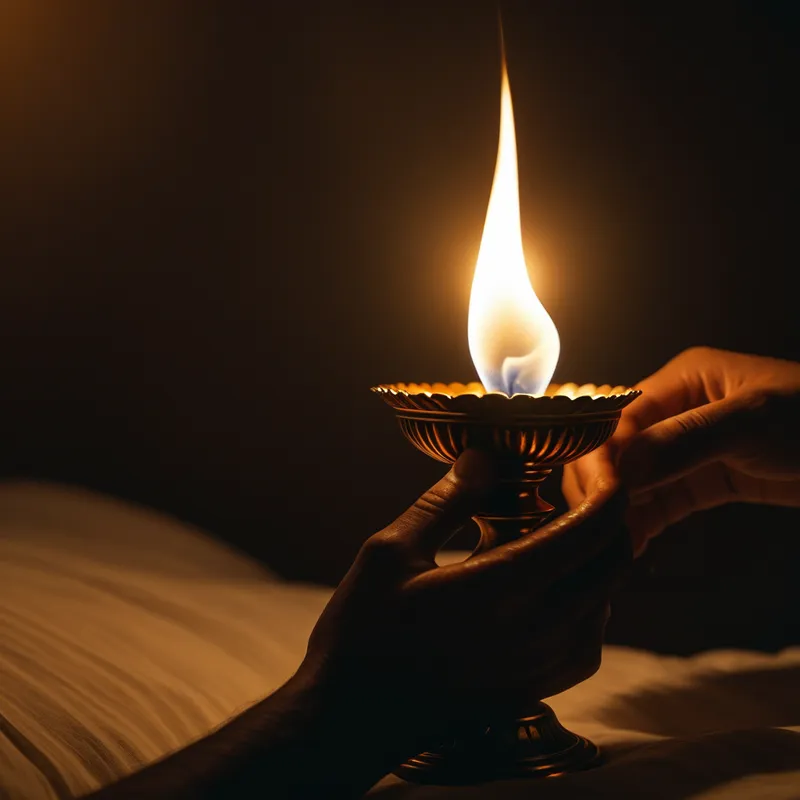
The seed of suspicion, once planted, grows thorns. That night, her heart a drum of dread and desperate need, Psyche took a razor and a small, flickering oil lamp. She waited until the deep rhythm of her husband’s breath signaled sleep. She crept to the side of their bed—the sacred bed of trust and union. Her hand shook as she lifted the lamp. The golden light spilled over the couch, and there, in its radiance, lay not a monster, but the most beautiful being her eyes had ever witnessed: the god Eros himself, his golden hair spilled upon the pillow, his powerful wings folded at his shoulders, his bow and arrows resting beside the bed.
A gasp of awe and devastating love escaped her lips. Her hand trembled. A single drop of scalding oil fell from the lamp and seared the god’s perfect shoulder. He awoke with a cry of betrayal and pain. His eyes, meeting hers, held not love, but a bottomless sorrow. “You have destroyed us, Psyche,” he said, his voice breaking. “Love cannot live where there is no trust.” And as he spoke, the palace, the gardens, the very air of paradise began to dissolve like mist in morning sun. He spread his wings and fled into the star-flecked sky, leaving Psyche alone in the cold grass, clutching a dying lamp, her paradise lost by the light she had demanded to see.
Cultural Origins & Context
This poignant episode is the central crisis of the longer tale of Eros and Psyche, which survives not in the fragments of Homer or Hesiod, but within a Latin novel, The Golden Ass (or Metamorphoses), written by the Roman author Apuleius in the 2nd century CE. While the framing is Roman, the myth’s heart, characters, and themes are deeply Greek, belonging to the rich tradition of folktale and allegory that explored the relationship between the human and the divine.
Apuleius was a Platonic philosopher, and his telling is infused with Neoplatonic ideas about the soul’s journey. The story was likely a sophisticated literary reworking of older oral traditions—a “fairy tale” elevated to philosophical allegory. In the context of the Greco-Roman world, it served multiple functions: as an entertaining romance, a moral fable about the dangers of curiosity (polypragmosyne), and a profound symbolic narrative about the trials of the psyche seeking union with the divine (eros). It was a story told not just to explain, but to initiate reflection on the nature of love, trust, and the painful path to maturity.
Symbolic Architecture
The bed of Psyche and Eros is far more than a piece of furniture; it is the temenos, the sacred precinct, of their relationship. It represents the container of intimacy, a space where two beings meet in vulnerability, shielded from the judging eyes of the world—and even from the analytical gaze of the conscious self.
The bed is the altar where the mystery of the Other is preserved. To illuminate it with the lamp of scrutiny is to profane the sacred darkness where connection truly lives.
Psyche’s act is the archetypal movement from participation mystique—a blind, unconscious merging—toward consciousness. She is the human soul yearning not just to feel love, but to know its source. Her “crime” is the soul’s inevitable hunger for consciousness, which initially shatters the bliss of unconscious union. The oil lamp represents the light of the inquiring mind, a double-edged tool that reveals truth but can also wound with its harsh, isolating clarity. The drop of burning oil is the inevitable pain and consequence that accompanies this awakening; consciousness burns, and its first revelation is often of loss.
Eros represents the animating force of life, desire, and connection that seeks the soul. He operates in the realm of the unseen, the intuitive, the felt. To demand he be seen—to literalize and objectify him—is to force a divine principle into mortal terms, causing it to flee. Their separation initiates the soul’s arduous journey of proving its worth through tasks set by Aphrodite, symbolizing the trials required to make a conscious relationship with love possible.

The Dreamer’s Resonance
When this mythic pattern stirs in the modern dreamer, it often manifests as dreams of forbidden rooms, hidden partners, or a profound anxiety about looking at something—or someone—directly. You may dream of a beloved whose face is always turned away, or of a radiant light you are forbidden to approach. The somatic experience is one of thrilling intimacy coupled with a deep, gnawing tension in the solar plexus—the seat of identity and personal power.
Psychologically, this dream signals a critical juncture in a relationship, either to another person or to an inner potential (like creativity or a spiritual calling). The psyche is grappling with the tension between trust and doubt, between surrendering to an experience and needing to control or understand it. The “bed” in the dream is the container of this unfolding process. To dream of illuminating it may reflect a necessary, if painful, move toward consciousness in a situation that has been based on projection or idealization. The ensuing feeling of loss in the dream mirrors the necessary death of an immature form of relating, making space for something more conscious—and more real—to be born, though only after a period of lonely searching.

Alchemical Translation
The alchemy modeled here is the transformation of naïve, unconscious love into coniunctio, the sacred marriage of the conscious ego (Psyche) and the guiding Self (Eros). The initial, dark union is the nigredo—a blissful but undifferentiated merging. Psyche’s transgression with the lamp is the albedo, a searing illumination that reveals the divine nature of the connection but simultaneously separates the elements.
The soul must lose the god to find him; it must shatter the paradise of dependency to earn the citizenship of partnership.
The subsequent quest—Psyche’s impossible tasks—is the lengthy citrinitas, the painful work of purification and integration. She must sort seeds (discernment), gather golden wool (confront shadowy aspects without force), fetch water from the Styx (descend to the depths), and finally journey to the Underworld (confront mortality and the Mother). Each task builds her capacity, her Aptitude. She is no longer the passive bride in a dark room but an active heroine navigating a conscious cosmos.
The final stage, rubedo, is achieved only when Psyche, nearly destroyed by her own curiosity again (opening the box of Persephone’s beauty), is rescued by Eros. He pleads with Zeus, and she is granted immortality. Their union is now eternal, conscious, and celebrated in the light of Olympus. The alchemical gold is a love that has passed through the fire of doubt, the water of despair, and the air of separation, and has been made indestructible. For the modern individual, this myth maps the non-negotiable journey: we must risk the sacred darkness of trust, survive the searing light of truth, and undertake the labors of self-development to become a partner worthy of the divine love that first sought us out in the night.
Associated Symbols
Explore related symbols from the CaleaDream lexicon: