
Psyche and Eros Myth Meaning & Symbolism
A mortal woman's love for a god leads her through impossible trials, forging her soul and uniting love with consciousness.
The Tale of Psyche and Eros
In a time when the breath of the gods still warmed the mortal world, there lived a princess whose beauty was a silent curse. Her name was [Psyche](/myths/psyche “Myth from Greek culture.”/). So radiant was she that men ceased to worship Aphrodite, turning their prayers instead to this mortal girl. In her sea-foam palace, the goddess heard this blasphemy and her heart turned to cold salt. She summoned her son, Eros, and commanded him to pierce [Psyche](/myths/psyche “Myth from Greek culture.”/) with a golden arrow, making her fall in love with the most vile creature he could find.
But destiny is a thread even gods cannot always cut. When Eros beheld Psyche, the arrow meant for her heart turned in his own hand and pricked his divine finger. He was undone by a love more potent than any magic he commanded. He could not obey his mother.
Psyche, meanwhile, found herself an object of awe, not love. No suitor dared approach a woman who seemed a goddess. Her despairing father sought an oracle, which delivered a terrible decree: Psyche must be dressed in funeral garb and left on a lonely mountain crag to wed a monstrous, winged serpent. The procession was a funeral march. Abandoned in terror, Psyche felt not the jaws of a beast, but the gentle caress of the West Wind, [Zephyrus](/myths/zephyrus “Myth from Greek culture.”/). He lifted her from the rock and carried her down into a hidden, sun-drenched valley, to a palace wrought of light and whispers.
This was a palace without servants, where voices attended to her every need and a feast appeared at her thought. When night fell, utter darkness enveloped the halls. In that profound blackness, a presence came to her—a voice of honey and shadow, a touch as soft as moth wings. This was her husband. He gave her everything but one [thing](/myths/thing “Myth from Norse culture.”/): the light to see his face. “You must never seek to look upon me,” his voice murmured in the dark. “Trust in the love we share in this blessed night.”
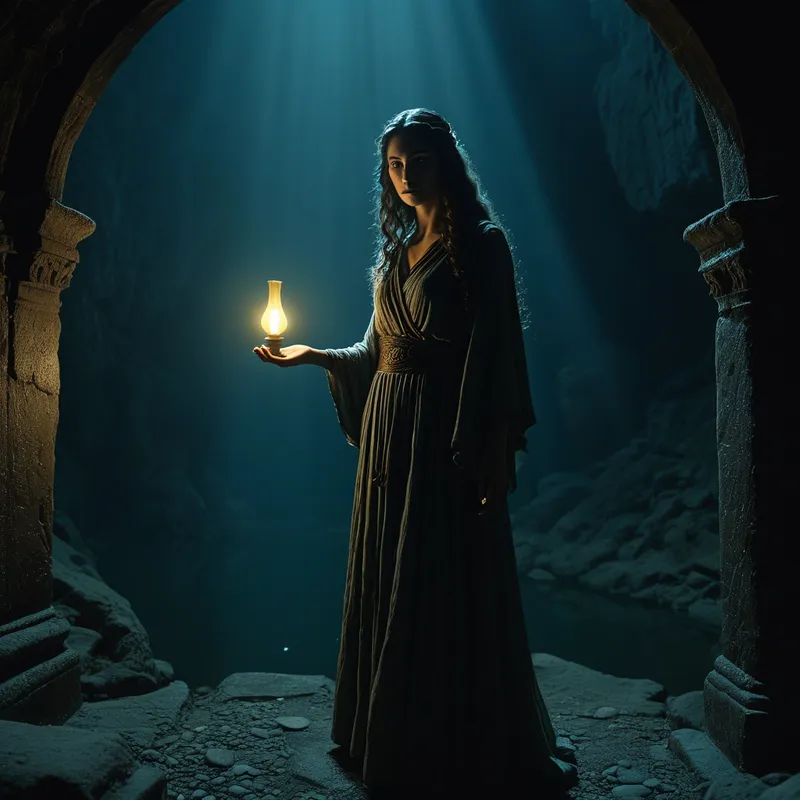
For a time, Psyche dwelt in this paradise of touch and sound. But loneliness, that sly serpent, coiled in her heart. When her sisters visited, seeded by their own envy, they poisoned her peace. “Your husband is the monster the oracle foretold,” they hissed. “He hides in darkness because his face would stop your heart with fear.” Tormented by doubt, Psyche that night took a dagger and a small oil lamp. As her divine husband slept, she raised the light.
The glow fell not on a horror, but on the most beautiful being she had ever seen: golden curls, wings of a butterfly folded in sleep, the face of Love itself. In her trembling awe, a drop of scalding oil fell upon his shoulder. He awoke. His eyes, full of a pain deeper than the burn, met hers. “You have broken trust, Psyche,” he said, his voice breaking. “Love cannot live where there is no faith.” And with those words, he and the palace vanished, leaving her alone in a barren field.
Thus began her wanderings. To win back her lost love, she had to face the very source of her torment: Aphrodite. The goddess, seeing her chance for vengeance, set four impossible tasks. Psyche had to sort a mountain of mixed grains before nightfall (a swarm of ants took pity and helped her); gather golden wool from vicious, sun-crazed sheep (a reed whispered to her to collect the wool caught on brambles at dusk); fill a crystal flask with [water](/myths/water “Myth from Chinese culture.”/) from the source of the rivers Styx and Cocytus (an eagle of Zeus performed the deed); and finally, descend into [the underworld](/myths/the-underworld “Myth from Greek culture.”/) itself to procure a box containing a day of [Persephone](/myths/persephone “Myth from Greek culture.”/)‘s beauty.
Guided by a talking tower and armed with two coins for [the ferryman](/myths/the-ferryman “Myth from Various culture.”/) and two cakes for the three-headed hound Cerberus, Psyche walked the path of the dead. She succeeded, but on her return, a mortal curiosity overcame her once more. Thinking a touch of divine beauty might help her win back Eros, she opened the box. Inside was not beauty, but the sleep of death itself, and she fell lifeless to the ground.
It was here that Eros, his wound healed by longing, found her. He brushed the death-sleep from her lips and lifted her into the light. His love had made him bold. He flew to Zeus and pleaded their case. The father of gods was moved. He granted Psyche immortality, serving her ambrosia himself. Aphrodite was appeased by the honor. And in the great hall of Olympus, Eros and Psyche were wed in a true marriage, their union giving birth to a daughter named Voluptas—Pleasure.
Cultural Origins & Context
[The myth of Psyche](/myths/the-myth-of-psyche “Myth from Global/Universal culture.”/) and Eros is preserved for us in the Latin novel [Metamorphoses](/myths/metamorphoses “Myth from Greek culture.”/) (also known as The Golden Ass) by the Roman author Apuleius, written in the 2nd century CE. While set within a Greek mythological framework, the tale is a literary creation of the Roman Imperial period, a sophisticated allegory woven into a larger narrative about spiritual awakening. It is not a “state” myth used for civic ritual, but rather a philosophical and initiatory story, likely told in educated, mystery-cult circles interested in the fate of the soul. Its function was less about explaining natural phenomena and more about mapping the soul’s arduous journey toward divine union and self-realization, reflecting the era’s growing interest in personal spirituality and salvation cults.
Symbolic Architecture
At its core, this is the myth of the [Soul](/symbols/soul “Symbol: The soul represents the essence of a person, encompassing their spirit, identity, and connection to the universe.”/) (Psyche) seeking conscious union with the transformative power of Love and Desire (Eros). Psyche begins as mere “[appearance](/symbols/appearance “Symbol: Appearance in dreams relates to self-image, perception, and how you present yourself to the world.”/),” a [beauty](/symbols/beauty “Symbol: This symbol embodies aesthetics, harmony, and the appreciation of life’s finer qualities.”/) worshipped from afar but not truly known, even to herself. Her [journey](/symbols/journey “Symbol: A journey in dreams typically signifies adventure, growth, or a significant life transition.”/) is one of earning her [identity](/symbols/identity “Symbol: Identity represents the sense of self, encompassing personal beliefs, cultural background, and social roles.”/).
The soul does not become conscious by remaining in paradise, but by being cast out of it. The first task is always one of separation.
Her initial “[marriage](/symbols/marriage “Symbol: Marriage symbolizes commitment, partnership, and the merging of two identities, often reflecting one’s feelings about relationships and social obligations.”/)” in darkness represents the unconscious, instinctual bond with the animating force of [life](/symbols/life “Symbol: The symbol of ‘Life’ represents a journey of growth, interconnectedness, and existential meaning, encompassing both the joys and challenges that define human experience.”/) (Eros). It is blissful but incomplete, for it lacks the light of [consciousness](/symbols/consciousness “Symbol: Consciousness represents the state of awareness and perception, encompassing thoughts, feelings, and experiences.”/). The [lamp](/symbols/lamp “Symbol: A lamp symbolizes guidance, enlightenment, and the illumination of truth, often representing knowledge or clarity in dark times.”/) she lifts is the light of the inquiring mind—a necessary, if painful, step that shatters naive [projection](/symbols/projection “Symbol: The unconscious act of attributing one’s own internal qualities, emotions, or shadow aspects onto external entities, people, or situations.”/) and forces the soul into the harsh daylight of [responsibility](/symbols/responsibility “Symbol: Responsibility in dreams often signifies the weight of duties and the expectations placed upon the dreamer.”/) and [quest](/symbols/quest “Symbol: A quest symbolizes a journey or search for purpose, fulfillment, or knowledge, often representing life’s challenges and adventures.”/).
The four impossible tasks are alchemical operations of the soul: sorting (discrimination), gathering from [danger](/symbols/danger “Symbol: The symbol of ‘Danger’ often indicates a sense of threat or instability, calling for caution and awareness.”/) (harnessing volatile instincts), drawing sacred [water](/symbols/water “Symbol: Water symbolizes the subconscious mind, emotions, and the flow of life, representing both cleansing and creation.”/) (integrating the [depths](/symbols/depths “Symbol: Represents the subconscious, hidden emotions, or foundational aspects of the self, often linked to primal fears or profound truths.”/)), and the nekyia, the descent to the [underworld](/symbols/underworld “Symbol: A symbolic journey into the unconscious, representing exploration of hidden aspects of self, transformation, or confronting repressed material.”/). This final [task](/symbols/task “Symbol: A task represents responsibilities, duties, or challenges one faces.”/) is the ultimate confrontation with the unconscious, where the soul must navigate the [realm](/symbols/realm “Symbol: The symbol of ‘Realm’ often signifies the boundaries of one’s consciousness, experiences, or emotional states, suggesting aspects of reality that are either explored or ignored.”/) of the dead (past traumas, repressed contents) without becoming identified with it. Her final failure—opening the box—is crucial. It signifies that the soul’s old, curious, grasping [nature](/symbols/nature “Symbol: Nature symbolizes growth, connectivity, and the primal forces of existence.”/) must “die” for its transformation to be complete. She is not saved by her own final [effort](/symbols/effort “Symbol: Effort signifies the physical, mental, and emotional energy invested toward achieving goals and personal growth.”/), but by the love she catalyzed returning for her.
The Dreamer’s Resonance
When this myth stirs in modern dreams, it often signals a profound process of psychic differentiation. Dreaming of a beautiful but empty palace, or a beloved whose face is hidden, points to an idealized relationship or life situation that is nourishing but lacks conscious recognition. It is a comfortable unconsciousness.
Dreams of being given impossible tasks by a stern, jealous, or magnificent figure (often feminine) reflect [the ego](/myths/the-ego “Myth from Jungian culture.”/)‘s confrontation with the super-ego or the inner critic—the part of us that demands we “prove our worth” through ordeal. Sorting endless piles, facing dangerous animals, or finding oneself at a dark, forbidding river are classic motifs of the psyche organizing chaos and preparing to confront its own shadow.
The most potent dream symbol is the forbidden glance that leads to loss. This is the somatic shock of insight—the moment a hidden truth about a relationship, a self-deception, or a life pattern becomes conscious. The ensuing feeling of abandonment and barren landscape in the dream mirrors the depression and disorientation that follows a major psychological disillusionment, the necessary mourning for a lost paradise.

Alchemical Translation
The myth of Psyche and Eros is a perfect map of the Jungian process of individuation. Psyche begins in a state of unconscious identity with her image (the beautiful princess). Aphrodite, as the jealous Great Mother archetype, forces her out of this static perfection, initiating the journey.
The goal is not to escape the trials, but to be forged by them. The mortal must become worthy of the god, and the god must learn compassion for the mortal.
The palace of darkness is the coniunctio ([sacred marriage](/myths/sacred-marriage “Myth from Alchemy culture.”/)) in the unconscious—a potent, creative, but unstable union. Bringing [the lamp](/myths/the-lamp “Myth from Alchemical culture.”/) of consciousness to it causes the [separatio](/myths/separatio “Myth from Alchemical culture.”/), a painful but essential differentiation. The four tasks are the operatio: the hard, meticulous work of building a conscious personality (ego) capable of containing the divine.
The descent for Persephone’s beauty is the integration of the shadow and the anima/animus. Persephone is the queen of the [underworld](/myths/underworld “Myth from Greek culture.”/)—the beauty here is not superficial, but the profound allure of the fully acknowledged deep self, which includes death and transformation.
Psyche’s “death” and resuscitation by Eros symbolize the final stage: the unio mentalis, the spiritual marriage. The ego (Psyche) does not achieve divinity through its own will alone; it is made immortal by the grace of [the Self](/myths/the-self “Myth from Jungian culture.”/) (Eros), the central, guiding archetype of wholeness. [The child](/myths/the-child “Myth from Alchemy culture.”/) born of their union, Pleasure (Voluptas), is the ultimate prize: not fleeting happiness, but the profound joy that emerges when Soul and Love, consciousness and deep instinct, are united in a lasting, divine partnership.
Associated Symbols
Explore related symbols from the CaleaDream lexicon: