
Psyche Myth Meaning & Symbolism
A mortal woman's love for an invisible god leads her through impossible trials, forging her soul into an immortal through devotion and courage.
The Tale of Psyche
Listen, and hear a tale not of a hero with a sword, but of a soul with a heart. In a time when gods walked just beyond the edge of sight, there lived a mortal princess named Psyche. Her beauty was not of this earth; it was so radiant that men ceased praying to Aphrodite and turned their worship to her. This was a transgression that echoed in the halls of Olympus, stirring a divine and jealous wrath.
Aphrodite, her pride wounded, summoned her son, Eros. “Go,” she commanded, her voice like poisoned honey. “Make her fall in love with the most vile, the most wretched creature you can find.” But destiny is a thread even gods sometimes fail to cut. As Eros descended, arrow nocked, and beheld Psyche in her sorrowful solitude, he pricked his own finger on his golden point. The god of love was felled by love itself.
Thus began the great mystery. An oracle, surely guided by unseen hands, declared Psyche must be left on a lonely mountain peak to wed a monstrous, serpentine bridegroom. Her family wept as they abandoned her to the cruel wind. But Zephyrus caught her trembling form and carried her not to death, but to a hidden valley cradling a palace of impossible splendor. It was a place woven from whispers and twilight, where invisible hands served her every need. And when darkness fell, her husband came to her. He was a presence of warmth and tenderness, a voice of night and honey, but he laid down one law, spoken with grave love: “You must never seek to see my face. Trust in the darkness, and you will know me.”
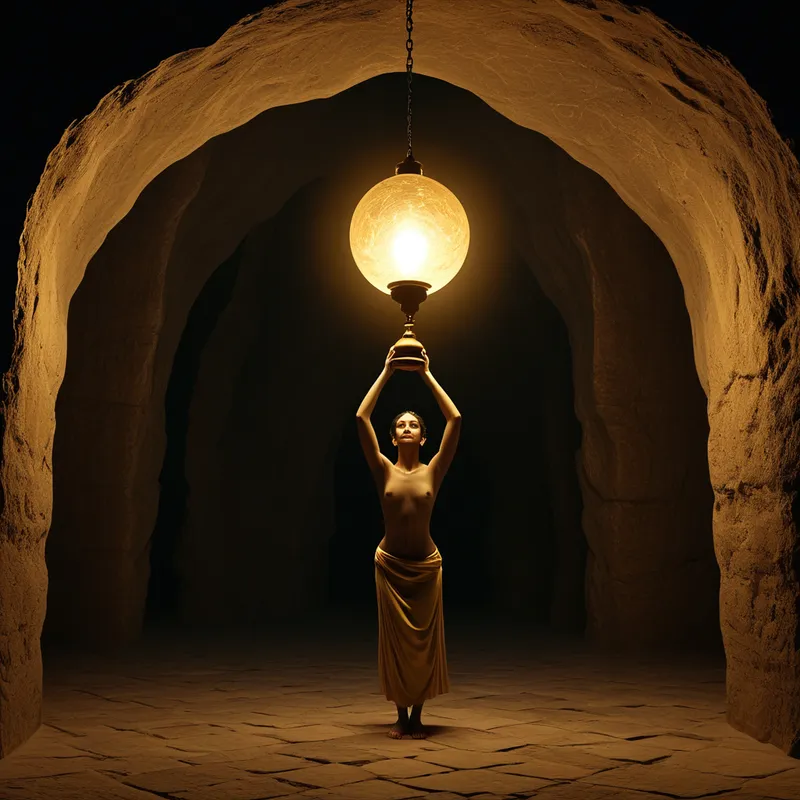
For a time, Psyche dwelt in this blissful paradox, a paradise built on a single prohibition. But the human heart is a vessel for both love and doubt. Visited by her sisters, who seeded envy and fear, she was convinced her unseen lover was the monster the oracle foretold. One fateful night, armed with a dagger and a flickering oil lamp, she crept to their bed. The golden light fell not on a horror, but on the most beautiful being imaginable: Eros himself, his wings shimmering, his face the very image of divine desire. In her shock, a drop of scalding oil fell upon his shoulder.
He awoke. The betrayal in his eyes was colder than the mountain peak. “Love cannot live where there is no trust,” he said, his voice breaking the world. And he was gone. The palace vanished like a dream at dawn, leaving Psyche alone in a barren field, clutching only the empty lamp.
Her journey then truly began—a descent not into hell, but into the crucible of her own making. She wandered, a soul in exile, until she stood before the very source of her woes: Aphrodite’s temple. The goddess, triumphant in her cruelty, set forth four impossible labors. Sort a mountain of mixed grains before nightfall; fetch golden wool from deadly, sun-crazed sheep; fill a crystal flask from the speaking, forbidding stream of the river Styx; and finally, descend into the underworld itself to procure a box of Persephone’s beauty.
Psyche did not complete these tasks by force, but by yielding to a deeper wisdom. Ants came to sort the seeds. A reed whispered the secret to gathering the wool from brambles. An eagle of Zeus retrieved the sacred water. Guided by a mysterious tower’s voice, she navigated the land of the dead, holding coins for Charon and cakes for Cerberus, returning with the sealed box. Yet, at the final threshold, human frailty surfaced again. Opening the box, hoping for a drop of divine beauty to win back her love, she was overcome not by beauty, but by a deathlike sleep.
It was here that love, wounded but not slain, returned. Eros, his wing healed, flew to her. He wiped the sleep from her eyes and then turned to face his mother. His argument was not of defiance, but of fate fulfilled. A mortal soul had endured what no god could demand. Moved, or perhaps bound by a deeper law, Zeus himself granted Psyche ambrosia, the drink of immortality. From the ashes of betrayal and the trials of despair, Psyche was transformed. She and Eros were united in the full light of day, and their child was named Voluptas.
Cultural Origins & Context
This exquisite narrative comes to us from the Latin novel Metamorphoses (also known as The Golden Ass) by Apuleius, written in the 2nd century CE. While the characters are Greek, the framing is Roman, reflecting the syncretic spiritual landscape of the late classical world. It is a rare, complete myth from this period that was crafted as a literary tale rather than a fragment of epic or cult practice.
Told within the larger, picaresque story of a man transformed into a donkey, the tale of Psyche is presented as an “old wife’s tale”—a seemingly simple story that contains profound, hidden truth. This placement is itself symbolic: a story of the soul’s ascent is nestled within a tale of bodily degradation, suggesting that wisdom and redemption are often found in humble, unexpected containers. In a culture where mystery religions like the Eleusinian Mysteries promised initiates knowledge of life, death, and rebirth, the Psyche myth functioned as a popular, accessible allegory of the soul’s arduous journey toward divine union and immortality, resonating with philosophical ideas about the soul’s trials in the material world.
Symbolic Architecture
The myth is a masterwork of psychological symbolism. Psyche is not just a character; she is the human soul incarnate. Her extraordinary beauty represents the soul’s innate, divine spark, which inevitably provokes the envy of the narrower, personal ego (symbolized by Aphrodite, the goddess of personal passion and vanity).
The first marriage is to the mystery itself; the beloved is known only by touch and whisper in the dark. To demand the face too soon is to slay the numinous with the light of the rational mind.
Her invisible husband, Eros, represents the animating force of life, desire, and deep, instinctual connection—the animus in its pure, archetypal form. Their nocturnal union is the soul’s initial, unconscious communion with this powerful inner force. The lamp and the dagger of her betrayal are the tools of conscious scrutiny and defensive fear, which, when applied prematurely to the mysteries of the deep psyche, wound the connection and plunge the individual into a state of alienation and longing—the “dark night of the soul.”
The four impossible labors are not random punishments, but the precise alchemical operations required for healing. They map onto the four classical elements and fundamental psychological tasks: Discernment (sorting seeds/Earth), Harnessing Volatile Instincts (gathering golden wool/Fire), Containing the Waters of the Unconscious (fetching Stygian water/Water), and Confronting Mortality (the underworld descent/Air, or spirit). Each task is accomplished not by heroic might, but by humility, listening, and receiving aid from the natural world and the deeper Self—represented by the helping creatures and the guiding tower.

The Dreamer’s Resonance
When this myth stirs in the modern dreamer, it often signals a profound initiation into the realm of soul-making. To dream of a radiant but inaccessible lover, or of a beautiful place with one forbidden room, speaks to the psyche’s encounter with a transformative inner value—perhaps creative potential, spiritual calling, or deep love—that feels both promised and perilously conditional.
Dreams of sorting endless, mixed materials reflect a somatic process of psychological integration, a literal “getting one’s house in order” at a foundational level. The body may feel heavy, tasked. Dreams of being given impossible errands by a cold, beautiful, or authoritarian figure often coincide with life periods where external pressures or internal critics demand we prove our worth through grueling trials. The feeling upon waking is one of anxious burden. Conversely, dreams of receiving unexpected help from animals or nature spirits in such tasks indicate the supportive, instinctual intelligence of the unconscious beginning to engage in the process.
The final, crucial dream motif is the catastrophic curiosity: opening the forbidden box and being plunged into a deathlike sleep or paralysis. In somatic terms, this can feel like a sudden depletion, a nervous system collapse after pushing too hard for conscious understanding or control. It is the psyche’s way of enforcing a necessary surrender, the very state that allows the wounded but redeemed Eros—the capacity for deep, trusting connection—to return and enact the final healing.

Alchemical Translation
The journey of Psyche is the quintessential map of individuation. It begins with the inflation of the ego (worship for her beauty), which is necessarily punctured by the demands of the Self (Aphrodite’s wrath). The soul is then called away from collective, familial identity to a mysterious, individual fate.
The central, alchemical operation is the coniunctio—the sacred marriage. But Apuleius shows us this occurs in two stages. The first is the unio mentalis, the union in the darkness: the soul learns to relate to the transformative power (Eros) through feeling, trust, and intimacy, not sight and analysis. The shattering of this trust is not a failure, but a necessary separatio. The soul must be cast out of paradise to develop consciousness, will, and endurance.
The soul is not perfected by avoiding error, but by metabolizing the consequences of its deepest flaws. The scar from the drop of oil becomes the seal of earned consciousness.
The four labors are the mortificatio and putrefactio—the dying of the old, naive self. By submitting to these impossible tasks, Psyche’s mortal pride is broken down, making space for the intervention of transpersonal forces (the ants, the reed, the eagle). This is the stage of humble service, where the ego aligns itself with the purposes of the larger Self.
The final descent and the sleep from the box represent the ultimate surrender, the nigredo or blackening, where all seems lost. It is only from this state of complete psychic death that the true, immortal coniunctio can be achieved. The drink of ambrosia is the rubedo, the reddening: the infusion of the mortal personality with timeless, archetypal substance. The born child, Voluptas (Pleasure), signifies the new, enduring psychic reality that results from this completed process—not a fleeting happiness, but the deep, abiding joy that is the fruit of a soul made whole through its own arduous, loving labor.
Associated Symbols
Explore related symbols from the CaleaDream lexicon:
- Underwear
- Soul
- Bug
- Bare
- Feels
- Bride
- Fine
- Slight
- Strip
- Felt
- Drop
- Princess
- Butterfly
- Gentle
- Celine
- Minor
- Emotion
- Lungs
- Sheer
- Request
- Loved
- Paper Lantern
- Stripped Pajamas
- Fairy Wings
- Translucent Robe
- Transparent Skin
- Scratching Surface
- Batting Butterfly
- Fleeting Whisper
- Teal Parrot
- Fuchsia Butterfly
- Diamond Tear
- Tanzanite Gem
- Cubic Zirconia Stone
- Sapphire Tear
- Oxygen Cloud
- Rhodium Essence
- Indium Whisper
- Aromatic Oxygen
- Butterfly Orchid
- Pansy Dream
- Freesia Fragrance
- Caterpillar Crawl
- Cocoon Transformation
- Butterfly Wings
- Caterpillar
- Cocoon
- Insect Bite
- Insect Wings
- Giant Caterpillar
- Transforming Insect
- Speak to a Moth
- Moth
- Gnat
- Bedbug
- Fleeting Skylark
- Wraith’s Whisper
- Gargling Slyph
- Wispy Watercolor
- Emotional Landscape
- Phantom Brushstroke
- Charcoal Sketch
- Butterfly Book Cover
- Glass Slipper
- Beneath the Surface
- Cushioned Window Seat
- Peeler
- Joyous Butterfly
- Transformative Butterfly
- Windblown Grass
- Gwishin Ghost
- Bride’s Veil
- Subtle Scent
- Relaxed Breath
- Anima
- Anima Shadow
- Transformation Cocoon
- Emotional Drain
- Acoustic Membrane
- Evaporation
- Respiration
- Oxygen
- Receptor
- Alveoli
- Release
- Allergy
- Itching
- Inward
- Chiffon
- Tears
- Flutter
- Silhouette