
Prometheus / Hephaestus Myth Meaning & Symbolism
The myth of the Titan who stole fire for humanity, and the smith god forced to chain him, revealing the agony and ecstasy of creation.
The Tale of Prometheus / Hephaestus
Listen, and hear the tale of the giver and the binder, the fire-thief and the chain-maker. In the age when the new gods, the Olympians, had freshly seized the scepter of the cosmos from the old Titans, [the world](/myths/the-world “Myth from Tarot culture.”/) was a cold and dim place. Humanity, molded from clay, shivered in the shadows, a witless and ephemeral brood.
But one Titan’s heart was not made of stone. [Prometheus](/myths/prometheus “Myth from Greek culture.”/), whose name means Forethought, looked upon these fragile creatures with a pity that burned hotter than any celestial flame. He saw their potential, a spark waiting for kindling. From the sun-chariot of [Helios](/myths/helios “Myth from Greek culture.”/), or from the very forge-hearth of Olympus—the stories vary—he stole a fragment of divine fire. He hid it in a hollow fennel stalk, its pith smoldering with the secret of the gods, and descended to the mortal plain. With this gift, he taught them: the arts of [the hearth](/myths/the-hearth “Myth from Norse culture.”/) to ward off the night’s chill, the craft of metal to shape tools and not just cower from beasts, and the subtle skill of sacrifice, how to offer the bones and fat to the gods while keeping the nourishing meat for themselves.
The scent of roasting meat and the smoke of countless new fires reached the nostrils of Zeus on high Olympus. His wrath was a [thunderclap](/myths/thunderclap “Myth from Various culture.”/) that shook the foundations of the world. The order of being had been violated; the bright line between immortal and mortal, blurred. For this act of cosmic treason, a punishment was required—not just of death, for Prometheus was immortal, but of eternal, conscious agony.
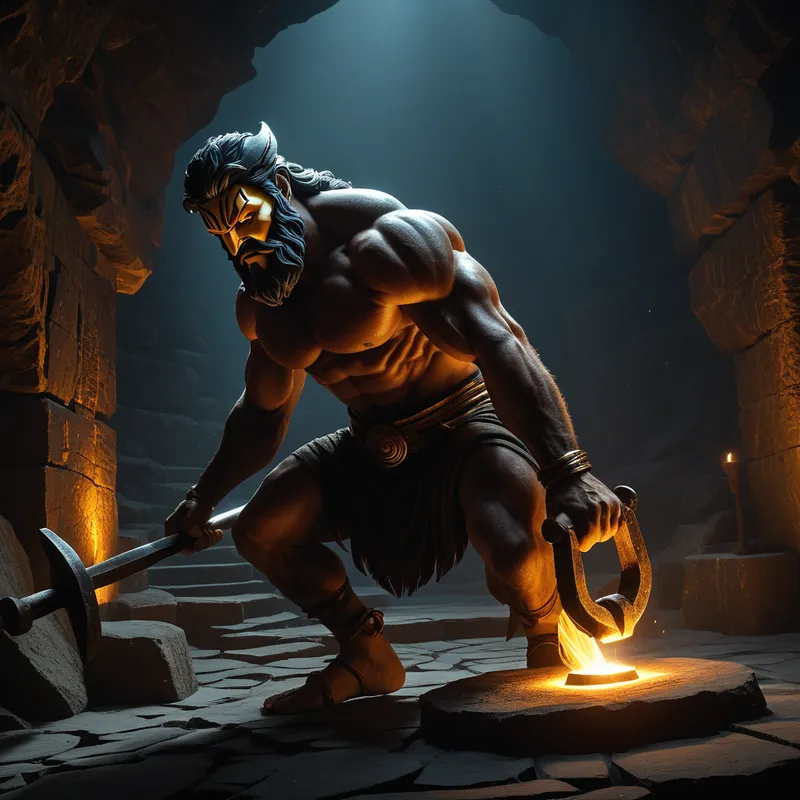
The sentence fell to the divine artisan, [Hephaestus](/myths/hephaestus “Myth from Global/Universal culture.”/). The god who walked with a limp, cast out from Olympus at birth for his imperfection, yet whose hands could fashion wonders beyond imagining. He was friend to Prometheus, fellow shaper, fellow outsider. Yet the command of Zeus was absolute. With a heavy heart, [Hephaestus](/myths/hephaestus “Myth from Global/Universal culture.”/) gathered his tools and his assistants, Kratos and Bia. They journeyed to the uttermost end of the world, to the barren, wind-scoured peaks of the Caucasus.
“Forgive me, son of Iapetus,” Hephaestus whispered, his voice thick with grief, as he worked. His hammer fell not on a beautiful creation, but on unbreakable, pitiless adamant. He forged shackles of unyielding metal and drove a stake through Prometheus’s middle, pinning the Titan to the naked rock. As he bound his friend, link by terrible link, Prometheus did not curse him, but stared with a fire undimmed into the distance. The task done, Hephaestus wept, but Kratos and Bia sneered at his weakness.
And so began the eternal cycle. Each day, an eagle—the emblem of Zeus himself—would descend from the iron sky. With talons like bronze sickles, it would tear open the Titan’s side and feast upon his immortal liver. Each night, the organ would regrow, lush and vulnerable, ready for the dawn’s fresh torment. There Prometheus remained, bound by the artistry of a friend, paying the price for the flame of consciousness he gave to a world still learning how to bear its light and its shadow.
Cultural Origins & Context
This profound myth comes to us primarily from the pen of the poet Hesiod, in his Theogony and Works and Days (8th-7th century BCE), and later, most powerfully, from the tragedy Prometheus Bound attributed to Aeschylus (5th century BCE). It was not mere entertainment; it was a foundational narrative for the Greek understanding of the human condition. Told at symposia, performed in sacred theatrical festivals like the City Dionysia, it served as a theodicy—an explanation for the paradox of human suffering amidst divine gift.
The myth justified the practice of animal sacrifice (the trick with the bones and meat), explained the origin of technology (techne), and framed humanity’s relationship with the gods as one born from both benefaction and transgression. It positioned human progress as a hard-won prize, paid for by a divine proxy, setting a template for the tragic hero who defies fate for a greater good. The involvement of Hephaestus, the patron of craftsmen, linked this cosmic drama directly to the lived experience of the artisan, whose creativity is often a painful, isolating, and physically demanding labor.
Symbolic Architecture
At its core, this is the myth of the stolen spark of [consciousness](/symbols/consciousness “Symbol: Consciousness represents the state of awareness and perception, encompassing thoughts, feelings, and experiences.”/). Prometheus represents [the principle](/symbols/the-principle “Symbol: A fundamental truth, law, or doctrine that serves as a foundation for a system of belief, behavior, or reasoning, often representing moral or ethical standards.”/) of foresight and rebellious intelligence that pulls the latent potential of the [human](/symbols/human “Symbol: The symbol of a human represents individuality, complexity of emotions, and social relationships.”/) [psyche](/myths/psyche “Myth from Greek culture.”/) out of unconscious, instinctual [clay](/symbols/clay “Symbol: Clay symbolizes malleability, creativity, and the potential for transformation, representing the foundational aspect of life and the ability to shape one’s destiny.”/) and into the painful light of self-[awareness](/symbols/awareness “Symbol: Conscious perception of self, surroundings, or internal states. Often signifies awakening, insight, or heightened sensitivity.”/).
The fire is not just tool-making; it is the light of the mind, the capacity for reflection, culture, and technology—the very gifts that make us human and also burden us with knowledge of our mortality.
Hephaestus embodies a profound and often overlooked [archetype](/symbols/archetype “Symbol: A universal, primordial pattern or prototype in the collective unconscious that shapes human experience, behavior, and creative expression.”/): the wounded [creator](/symbols/creator “Symbol: A figure representing ultimate origin, divine power, or profound authorship. Often embodies the source of existence, innovation, or personal destiny.”/). His lameness signifies the inherent imperfection and cost of incarnation and craft. He is the part of the creative [spirit](/symbols/spirit “Symbol: Spirit symbolizes the essence of life, vitality, and the spiritual journey of the individual.”/) that must, often against its will, give form to the dictates of a higher [authority](/symbols/authority “Symbol: A symbol representing power structures, rules, and control, often reflecting one’s relationship with societal or personal governance.”/) (the super-ego, tradition, or necessity). His binding of Prometheus is the ultimate creative act turned against itself—the intellect fashioning its own [prison](/symbols/prison “Symbol: Prison in dreams typically represents feelings of restriction, confinement, or a lack of freedom in one’s life or mind.”/). The unbreakable chains are the laws of [nature](/symbols/nature “Symbol: Nature symbolizes growth, connectivity, and the primal forces of existence.”/), causality, and the [body](/symbols/body “Symbol: The body in dreams often symbolizes the dreamer’s self-identity, personal health, and the relationship they have with their physical existence.”/) itself, which bind the limitless [spirit](/symbols/spirit “Symbol: Spirit symbolizes the essence of life, vitality, and the spiritual journey of the individual.”/) to a finite, suffering form.
The eternal [torment](/symbols/torment “Symbol: A state of intense physical or mental suffering, often representing unresolved inner conflict, guilt, or psychological distress.”/)—the [liver](/symbols/liver “Symbol: Represents emotional processing, purification, and vitality. Often symbolizes anger, toxicity, or life force in dreams.”/) devoured and regenerated—is a perfect [symbol](/symbols/symbol “Symbol: A symbol can represent an idea, concept, or belief, serving as a powerful tool for communication and understanding.”/) of the cyclical nature of psychological suffering. The [liver](/symbols/liver “Symbol: Represents emotional processing, purification, and vitality. Often symbolizes anger, toxicity, or life force in dreams.”/) was considered the seat of [passion](/symbols/passion “Symbol: Intense emotional or physical desire, often linked to love, creativity, or purpose. Represents life force and deep engagement.”/) and [life](/symbols/life “Symbol: The symbol of ‘Life’ represents a journey of growth, interconnectedness, and existential meaning, encompassing both the joys and challenges that define human experience.”/)-force. To have it perpetually consumed is to experience an endless return of one’s most vital, passionate self being attacked by a “[bird](/symbols/bird “Symbol: Birds symbolize freedom, perspective, and the connection between the earthly and spiritual realms, often representing the soul’s aspirations or personal growth.”/) of prey” from the lofty [heights](/symbols/heights “Symbol: Represents ambition, fear, or spiritual elevation. Often symbolizes life challenges or a desire for perspective.”/) of one’s own spirit or conscience.
The Dreamer’s Resonance
When this myth stirs in the modern dreamer, it speaks to a critical juncture in the psyche. To dream of being chained to a rock or a modern structure suggests a profound feeling of being bound by one’s own creations—a career, a relationship, an identity—that has become a prison. The dreamer may be a Prometheus, feeling punished for a bold act of independence or insight that set them apart.
Conversely, to dream of being the forger of chains, like Hephaestus, points to a deep inner conflict where one part of [the self](/myths/the-self “Myth from Jungian culture.”/) is enforcing a painful limitation or duty upon another, more rebellious or visionary part. The somatic resonance is often in the chest or solar plexus—a feeling of being ripped open, or a heavy, metallic constriction. These dreams surface during life phases where the cost of consciousness—of ambition, creativity, or non-conformity—is being exacted, asking the dreamer to confront what eagle feeds on their vitality each day, and what miraculous, painful regeneration occurs each night.
Alchemical Translation
The alchemical journey modeled here is the transmutation of suffering into conscious craft. The myth presents the full arc of individuation for the creative spirit. First, the theft: the heroic, necessary rebellion where one claims one’s own inner fire (authentic voice, unique vision) from the collective “gods” (parental expectations, societal norms). This is the Promethean spark.
Then, the binding: the inevitable consequence—the depression, the creative block, the isolation, the “wounding” that comes when the world, or one’s own inner Hephaestus, resists this new consciousness. This is not a failure, but the [nigredo](/myths/nigredo “Myth from Alchemical culture.”/), the blackening, where the raw material is dissolved.
The alchemical secret lies in Hephaestus’s forge. The pain of the binding and the eagle’s feast is the fire of the opus. The regenerating liver is the prima materia that is endlessly worked upon.
The ultimate goal is not to escape the rock, but to integrate the roles. The mature individual becomes both Prometheus and Hephaestus. They learn to consciously endure the cyclical suffering inherent in growth (the rock), while simultaneously becoming the master artisan of their own limitations (the forger). The chains, once symbols of torture, become recognized as self-made, and thus potentially self-understood and self-modified. The fire stolen for humanity becomes the inner fire that fuels the enduring, creative work of building a soul that can hold both its divine aspirations and its mortal, wounded, binding reality. In this synthesis, the rebel and the craftsman forge not shackles, but meaning.
Associated Symbols
Explore related symbols from the CaleaDream lexicon: