Prodigal Son Myth Meaning & Symbolism
A son squanders his inheritance in a distant land, hits rock bottom, and returns home to an unexpected, unconditional welcome from his waiting father.
The Tale of Prodigal Son
Listen. There was a man who had two sons. The air in their house was thick with the unspoken, the weight of land and legacy pressing on every stone. The younger son, his blood humming with a restless fire, could bear it no longer. He went to his father, the words sharp on his tongue: “Father, give me the share of the property that will belong to me.” It was a request that cut like a knife, a demand for his inheritance as if the giver were already dead. And the father, with a silence more profound than any storm, divided his life between them.
Not many days later, the younger son gathered all he had. You could smell the dust kicked up by the caravan, hear the clink of coin as he turned his birthright into currency. He traveled to a distant country, a land of blurred edges and forgetfulness. There, he scattered his substance in wild living—a riot of wine, laughter that echoed in empty halls, and the grasping hands of fair-weather friends. The coins flew from his fingers like startled birds.
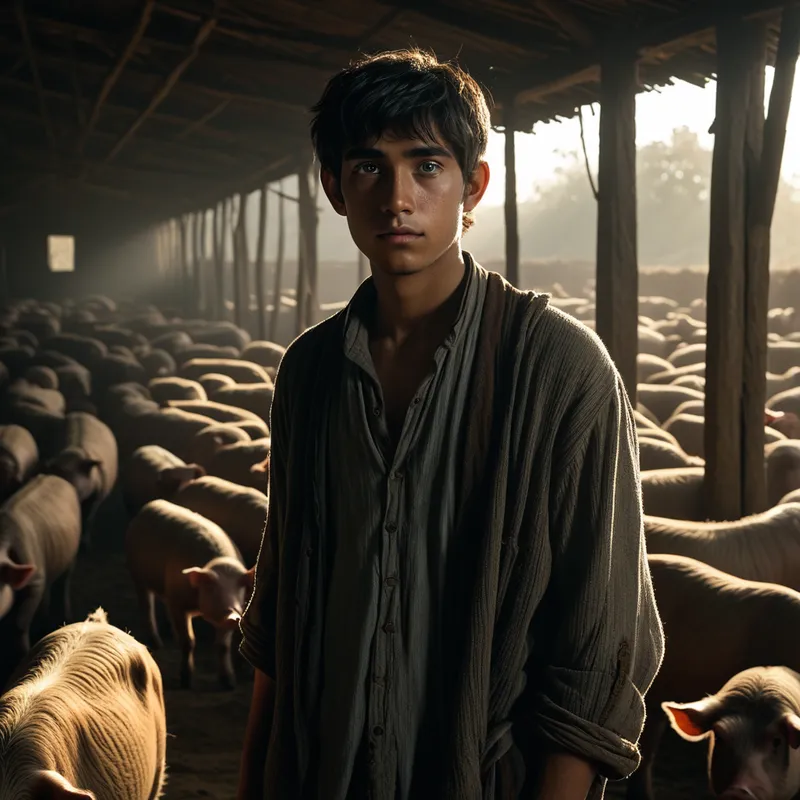
Then famine struck. A great hunger gripped that land, a hollowing out. He began to be in need. The friends vanished with the last of the wine. Desperate, he attached himself to a citizen of that country, who sent him into the fields to feed swine. Feel the grit under his nails, smell the sour stench of the pens. He was so famished he longed to fill his belly with the pods the pigs ate, but no one gave him anything.
In that moment, kneeling in the muck, he came to himself. The phrase is precise: he returned to the chamber of his own soul. The memory of his father’s house arose—not as a place of rule, but of abundance. “How many of my father’s hired hands have bread enough and to spare, but I am dying here with hunger!” Shame was his bread, but within it, a seed of resolve. “I will get up and go to my father, and I will say to him, ‘Father, I have sinned against heaven and before you; I am no longer worthy to be called your son; treat me like one of your hired hands.’”
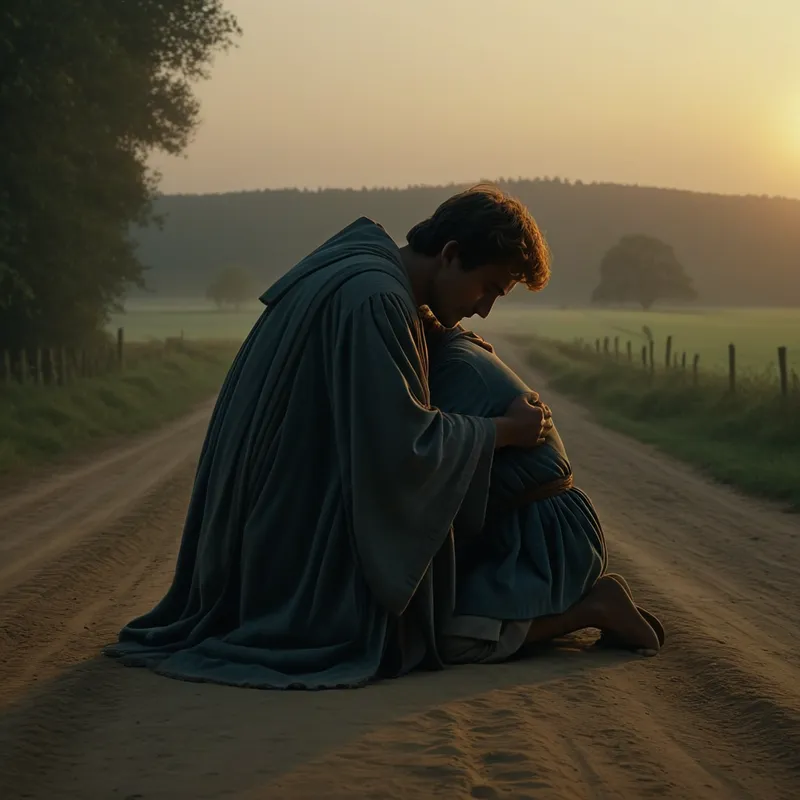
So he rose. The journey back was longer than the journey out, each step a weight. But while he was still far off, his father saw him. The old man had been watching, his eyes wearing a path on [the horizon](/myths/the-horizon “Myth from Various culture.”/). Compassion—a visceral, gut-deep movement—seized him. He ran. Robes flying, dignity forgotten, he ran to his son, threw his arms around him, and kissed him.
The son began his rehearsed speech: “Father, I have sinned…” But the father was already calling to his servants: “Quickly, bring out a robe—the best one—and put it on him; put a ring on his finger and sandals on his feet. And get the fatted calf and kill it, and let us eat and celebrate; for this son of mine was dead and is alive again; he was lost and is found!” Music and feasting shook the house.
But outside, in the cooling twilight, stood the elder son. He heard the celebration, the rhythm of a joy he did not share. He refused to go in. His father came out and pleaded with him. His voice was tight with a lifetime of rightness: “Listen! For all these years I have been working like a slave for you, and I have never disobeyed your command; yet you have never given me even a young goat so that I might celebrate with my friends. But when this son of yours came back, who has devoured your property with prostitutes, you killed the fatted calf for him!”
The father’s reply was soft, encompassing them both: “Son, you are always with me, and all that is mine is yours. But we had to celebrate and rejoice, because this brother of yours was dead and has come to life; he was lost and has been found.” The story ends there, with the feast inside and the unresolved conversation under the stars.
Cultural Origins & Context
This narrative is a parable attributed to [Jesus of Nazareth](/myths/jesus-of-nazareth “Myth from Christian culture.”/), as recorded in the Gospel of Luke. It was spoken not in temple courts but along dusty roads and in crowded homes, part of a series of teachings addressing Pharisees and scribes who grumbled about his association with “tax collectors and sinners.” Its primary audience was a mix of the religiously rigorous and the socially outcast.
Its function was revolutionary in its context. Within a culture deeply structured by honor, shame, and covenant fidelity, the parable subverted expectations. Inheritance was sacred; to demand it early was a profound insult. The son’s descent into feeding swine, animals considered unclean in Judaism, marked the absolute depth of degradation. The father’s response—running (an undignified act for an elder), restoring symbols of sonship (robe, ring, sandals) before any penance was completed—presented a radical theology of grace. It was an oral story, designed to be remembered, retold, and to provoke a crisis of understanding about the nature of divine grace, repentance, and familial jealousy.
Symbolic Architecture
The myth is a perfect triptych of the [human](/symbols/human “Symbol: The symbol of a human represents individuality, complexity of emotions, and social relationships.”/) [psyche](/myths/psyche “Myth from Greek culture.”/). The Younger Son embodies the [Shadow](/symbols/shadow “Symbol: The ‘shadow’ embodies the unconscious, repressed aspects of the self and often represents fears or hidden emotions.”/) in active rebellion—the [impulse](/symbols/impulse “Symbol: A sudden, powerful urge or drive that arises without conscious deliberation, often linked to primal instincts or emotional surges.”/) to flee containment, to experience [life](/symbols/life “Symbol: The symbol of ‘Life’ represents a journey of growth, interconnectedness, and existential meaning, encompassing both the joys and challenges that define human experience.”/) through extremity, to sever oneself from [source](/symbols/source “Symbol: The origin point of something, often representing beginnings, nourishment, or the fundamental cause behind phenomena.”/) in the name of freedom. His [journey](/symbols/journey “Symbol: A journey in dreams typically signifies adventure, growth, or a significant life transition.”/) is the necessary, if destructive, [path](/symbols/path “Symbol: The ‘path’ symbolizes a journey, choices, and the direction one’s life is taking, often representing individual growth and exploration.”/) of [differentiation](/symbols/differentiation “Symbol: The process of distinguishing or separating parts of the self, emotions, or identity from a whole, often marking a developmental or psychological milestone.”/). The “distant [country](/symbols/country “Symbol: Dreaming of a country often symbolizes a quest for belonging, identity, or exploration of one’s inner landscape through the metaphor of physical space.”/)” is not just a geographic [location](/symbols/location “Symbol: The symbol of ‘Location’ signifies a sense of place, context, and the environment in which experiences unfold.”/) but a state of psychic [dissociation](/symbols/dissociation “Symbol: A psychological separation from one’s thoughts, feelings, or identity, often experienced as a journey away from the self during trauma or stress.”/), where one lives on [capital](/symbols/capital “Symbol: A capital city represents the center of power, governance, and national identity, often symbolizing authority, structure, and collective aspirations.”/) (inheritance) rather than generative [relationship](/symbols/relationship “Symbol: A representation of connections we have with others in our lives, often reflecting our emotional state.”/).
The Elder Son represents the [Persona](/symbols/persona “Symbol: The social mask or outward identity one presents to the world, often concealing the true self.”/) of dutiful obedience, but one corroded by [resentment](/symbols/resentment “Symbol: A deep-seated emotional bitterness from perceived unfairness or injury, often festering silently and poisoning relationships.”/) and a transactional worldview. His fidelity is not born of love but of a contract; he keeps accounts. He is lost while staying home, a poignant [symbol](/symbols/symbol “Symbol: A symbol can represent an idea, concept, or belief, serving as a powerful tool for communication and understanding.”/) of spiritual stagnation. His conflict is not with [the world](/myths/the-world “Myth from Tarot culture.”/), but with the grace that seems to reward failure.
The Father is the archetype of the Self, the central, organizing principle of the psyche that waits, sees from afar, and runs to meet the returning fragment. His actions are not of justice but of recognition.
The [robe](/symbols/robe “Symbol: A robe often represents comfort, authority, or a transition in one’s life, symbolizing the roles we play or the comfort of solitude.”/), ring, and sandals are not rewards for a journey well-made, but instantaneous restorations of [identity](/symbols/identity “Symbol: Identity represents the sense of self, encompassing personal beliefs, cultural background, and social roles.”/). They symbolize the core Self’s unwavering recognition of the essence beneath the [error](/symbols/error “Symbol: A dream symbol representing internal conflict, perceived failure, or a mismatch between expectations and reality.”/). The fatted calf represents the psychic [energy](/symbols/energy “Symbol: Energy symbolizes vitality, motivation, and the drive that fuels actions and ambitions.”/) (libido) that must be sacrificed from the [herd](/symbols/herd “Symbol: Represents collective behavior, social conformity, and group dynamics. Symbolizes both safety in numbers and loss of individuality.”/) of routine to celebrate a reintegration. The feast is the symbol of wholeness regained, a nourishing communion of parts long at war.

The Dreamer’s Resonance
When this myth stirs in modern dreams, it rarely appears as a biblical pastiche. More likely, the dreamer finds themselves in the “distant country”: a repetitive, degrading job that feels beneath them; a series of hollow relationships where they spend their emotional capital; a landscape of meaningless consumption. The somatic feeling is one of profound depletion, a hunger that cannot be sated by what’s at hand.
Dreams of returning home, but finding the door locked or the house unrecognizable, touch the Elder Son’s complex. This is the bitterness of the one who “played by the rules” yet feels unseen and unrewarded. The psychological process is one of confronting the ledger of life—the hidden contracts of “I did this, so I deserve that”—and the suffocating righteousness that blocks joy.
To dream of being embraced despite filth, or of offering a broken apology that is cut short by welcome, signals a profound moment in shadow-work. The psyche is rehearsing the surrender of [the ego](/myths/the-ego “Myth from Jungian culture.”/)’s self-justification and opening to a forgiveness that precedes and enables true change. The feast in the dream, if it comes, often has a quality of deep, somatic nourishment previously missing.

Alchemical Translation
The alchemy here is not of turning lead to gold, but of turning disgrace into grace, fragmentation into wholeness. The [prima materia](/myths/prima-materia “Myth from Alchemical culture.”/) is the raw, rebellious impulse of the younger son—the necessary, if toxic, pride that forces separation. The “far country” and the pigsty are the [nigredo](/myths/nigredo “Myth from Alchemical culture.”/), the blackening, the utter dissolution of the ego’s pretensions. “He came to himself” is the moment of albedo, the whitening, the clarifying insight that arises from the ashes of failure.
The return journey is the conscious, arduous work of individuation—carrying the truth of one’s failure back to the source.
The father’s run is the [rubedo](/myths/rubedo “Myth from Alchemical culture.”/), the reddening, the passionate, uncalculated movement of [the Self](/myths/the-self “Myth from Jungian culture.”/) toward the integrating part. This is critical: the transformation is not completed by the son’s trek, but is consummated by the father’s grace. The alchemical vessel is the relationship itself, the space between them where the old identities (“prodigal,” “dutiful slave”) are dissolved.
For the modern individual, the process models a psychic homecoming that bypasses endless penance. One must first “squander the inheritance”—exhaust the ego’s projects and identities, experience the alienation of living from a severed source. One must then formulate the honest, unadorned speech of the returning self. But the final, transformative step is to allow the welcome. This is often the hardest part: to accept restoration not as a wage earned, but as a gift given to one’s essence. The unresolved elder brother within must also be addressed—the part that resents this easy grace, that clings to its own righteousness. The full individuation requires inviting that bitter, faithful sibling to the feast, reconciling the responsible [persona](/myths/persona “Myth from Greek culture.”/) with the redeemed shadow. The myth, in its unresolved ending, leaves us with that invitation hanging in the air, the final step in our own alchemical return.
Associated Symbols
Explore related symbols from the CaleaDream lexicon: