Procrustes Myth Meaning & Symbolism
A bandit forces travelers to fit his iron bed, stretching or amputating them. A myth of violent conformity and the hero who ends the tyranny of the single measure.
The Tale of Procrustes
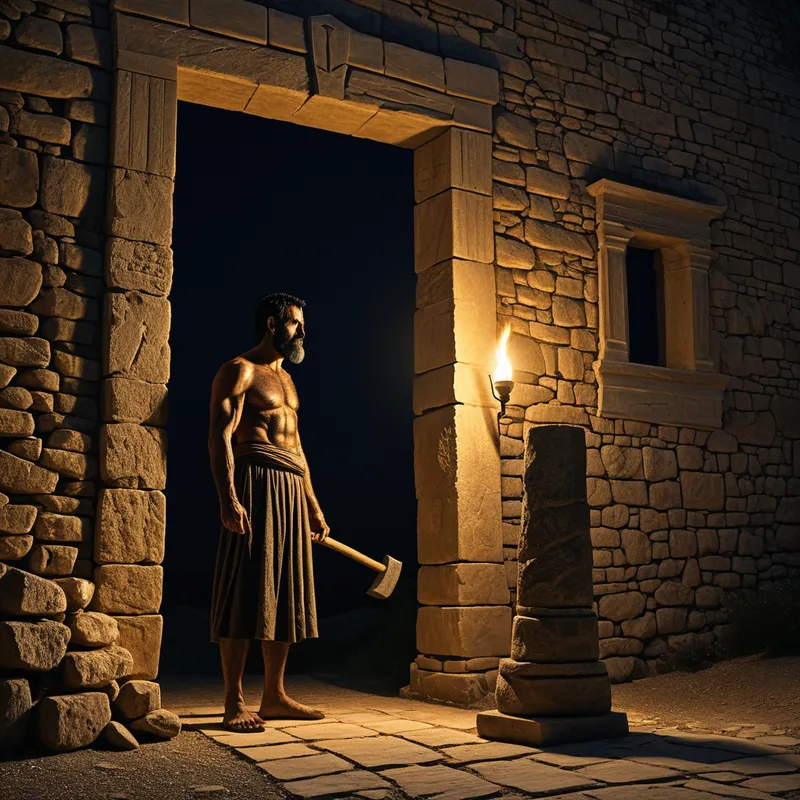
Hear now of the last horror on the road to sacred Athens. Where the path wound through the wilds of Attica, a house of stone stood sentinel. Its keeper was no humble innkeeper, but a son of [Poseidon](/myths/poseidon “Myth from Greek culture.”/), a giant in spirit and limb named Procrustes, “the Stretcher.” His hospitality was a trap, his welcome a sentence.
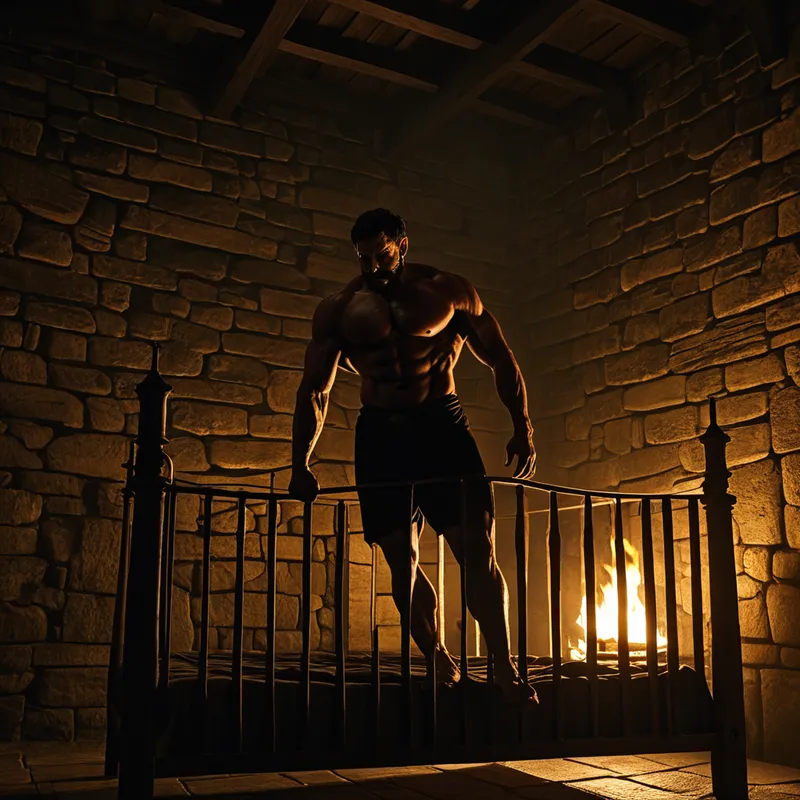
He offered weary travelers rest upon his famed iron bed, a masterpiece of cruel design. “See!” he would boom, a false smile upon his lips. “A bed of perfect dimension, crafted by the gods themselves! You shall find sleep such as you have never known.” But when the guest lay down, the true measure began. If the traveler was too short, Procrustes, with terrifying strength, would stretch his limbs upon a rack, sinews tearing, bones groaning, until the body kissed the cold iron at head and foot. If the traveler was too long, out came the great, pitiless saw. The excess was hewn away, a bloody offering to his idea of perfection. The bed was the only truth; the man was but errant material to be corrected.
The road grew silent, haunted by the ghosts of those made to fit. The very earth seemed to recoil from that place. Until a hero came, not in a chariot of fire, but walking the dusty road. His name was [Theseus](/myths/theseus “Myth from Greek culture.”/), on his way to claim his birthright in Athens, cleansing the land of its monsters as he went. He came to the stone house, and Procrustes offered his lethal hospitality once more.
Theseus, with the cunning of the hero, accepted. He saw the iron bed, the stains upon the floor, the tools of butchery in the shadows. When Procrustes demanded he lie down, Theseus instead seized the giant. “You have measured many,” he declared, his voice cutting through the gloom. “Now let this bed be your measure.” A great struggle shook the stones. With divine strength, Theseus forced the shrieking Procrustes onto his own device. The bandit was too long. And so, upon the cold, unyielding iron of his own making, the tyrant of the single measure met the very [justice](/myths/justice “Myth from Tarot culture.”/) he had dealt. The stretching rack and the sharp saw served their final guest. The road was cleansed.
Cultural Origins & Context
The myth of Procrustes is preserved for us primarily in the library of Diodorus Siculus and the later compilations of mythographers. It belongs to the cycle of stories surrounding the labors of Theseus, the foundational hero-king of Athens. These tales were not mere entertainment; they were a cultural map, charting the transition from archaic, monstrous law to the civilized order of the polis.
Told in symposia and public gatherings, the story functioned as a powerful social metaphor. Ancient Greece was a world of diverse city-states, each with its own customs, laws, and measures. The Procrustean bed represented the danger of any one standard—be it legal, social, or cultural—being violently imposed upon all others. It was a warning against the tyranny of absolutism, a celebration of the Athenian ideal of measured justice (which they embodied in their goddess, Athena), and a mythic justification for Theseus’s role as the unifier of Attica. He didn’t conquer by imposing one bed, but by destroying the bed that denied all others.
Symbolic Architecture
At its core, the myth is a stark parable of the violence of [conformity](/symbols/conformity “Symbol: The act of adjusting one’s behavior, beliefs, or appearance to match those of a group or societal norms, often involving pressure to fit in.”/). The iron bed is the absolute standard, the rigid dogma, the unexamined rule. It is the “way things have always been done,” the societal expectation that admits no variance. Procrustes himself is the enforcer of this dogma, the inner tyrant or the external [authority](/symbols/authority “Symbol: A symbol representing power structures, rules, and control, often reflecting one’s relationship with societal or personal governance.”/) that demands we amputate our excess or stretch ourselves thin to fit a predetermined mold.
The Procrustean bed is the archetype of the unlived life, where the soul is sacrificed to the blueprint.
Psychologically, Procrustes represents the [shadow](/symbols/shadow “Symbol: The ‘shadow’ embodies the unconscious, repressed aspects of the self and often represents fears or hidden emotions.”/) [aspect](/symbols/aspect “Symbol: A distinct feature, quality, or perspective of something, often representing a partial view of a larger whole.”/) of the ruler [archetype](/symbols/archetype “Symbol: A universal, primordial pattern or prototype in the collective unconscious that shapes human experience, behavior, and creative expression.”/)—not the wise [king](/symbols/king “Symbol: A symbol of ultimate authority, leadership, and societal order, often representing the dreamer’s inner power or external control figures.”/), but the brutal tyrant who demands order at the cost of [life](/symbols/life “Symbol: The symbol of ‘Life’ represents a journey of growth, interconnectedness, and existential meaning, encompassing both the joys and challenges that define human experience.”/) itself. His tools, the rack and the saw, symbolize the two poles of psychic violence we inflict upon ourselves: the painful, exhausting strain of trying to be what we are not (stretching), and the cruel self-mutilation of cutting away our unique gifts, passions, or traits because they do not conform ([amputation](/symbols/amputation “Symbol: A dream symbol representing loss, sacrifice, or the severing of an aspect of self. It often signifies a forced separation or the need to let go.”/)). The road to Athens is the [journey](/symbols/journey “Symbol: A journey in dreams typically signifies adventure, growth, or a significant life transition.”/) toward Selfhood, and Procrustes’s inn is the final, most insidious [obstacle](/symbols/obstacle “Symbol: Obstacles in dreams often represent challenges or hindrances in waking life that intercept personal progress and growth. They can symbolize fears, doubts, or external pressures.”/): not a [monster](/symbols/monster “Symbol: Monsters in dreams often symbolize fears, anxieties, or challenges that feel overwhelming.”/) to fight, but a [host](/symbols/host “Symbol: The symbol of a ‘host’ often represents nurturing, hospitality, or the willingness to offer support and guidance to others.”/) offering a comfortable, normalized destruction.
The Dreamer’s Resonance
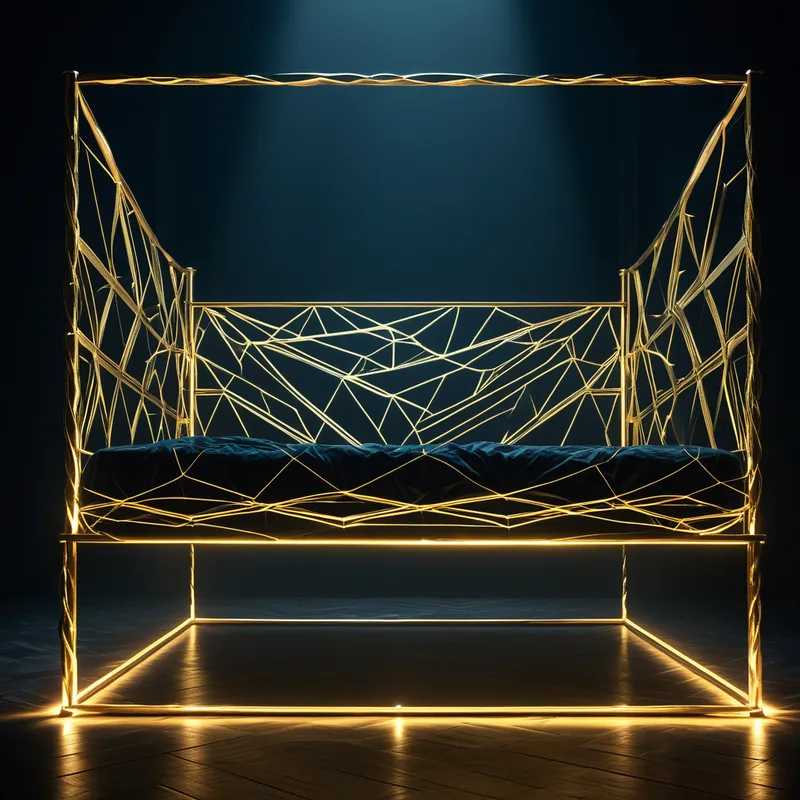
When this myth stirs in the modern dreamscape, it rarely appears as a classical scene. Instead, one may dream of being in a school, office, or family home where the furniture—a chair, a desk, a bed—is mechanically adjusting itself, painfully reshaping the dreamer’s body to fit. Or perhaps the dreamer is handed a uniform or a script that feels alien, and a terrifying authority figure insists they wear it or speak it perfectly.
Somatically, this can manifest as a feeling of constriction in the chest, a literal shortness of breath (the bed too short), or a feeling of being pulled apart, of aching joints and tendons (the rack). Psychologically, it signals a critical point of confrontation with a “Procrustean” complex. The dreamer is undergoing the painful awareness of where they are violating their own nature to fit an external standard—be it a job, a relationship, a social role, or an internalized parental expectation. The dream is the [psyche](/myths/psyche “Myth from Greek culture.”/)’s rebellion against this self-betrayal, a primal scream from the parts of [the self](/myths/the-self “Myth from Jungian culture.”/) being stretched or sawed away.
Alchemical Translation
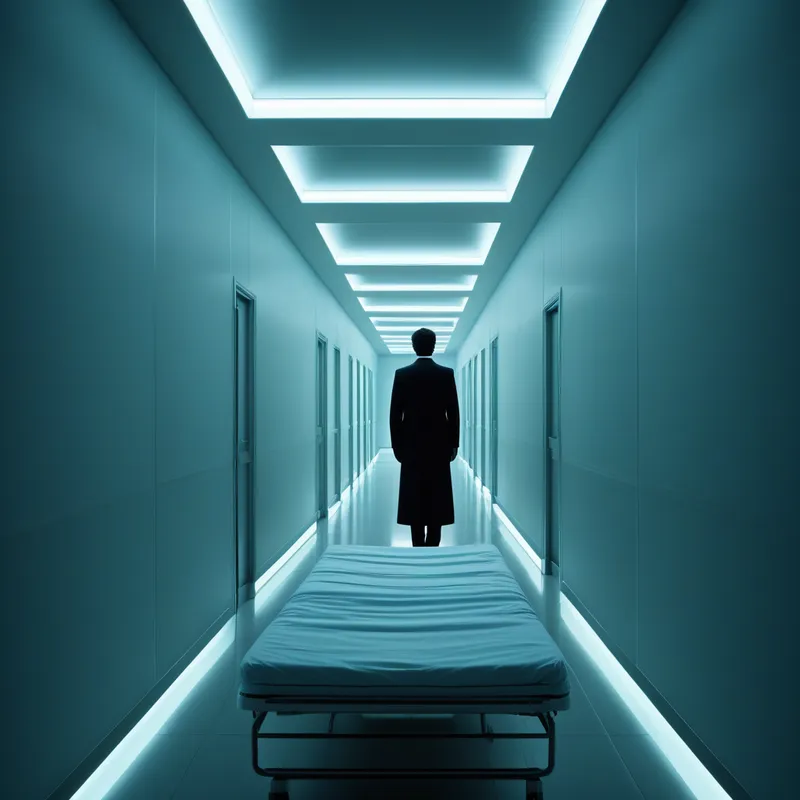
The alchemical process modeled here is the [nigredo](/myths/nigredo “Myth from Alchemical culture.”/)—the blackening, the confrontation with the most base and brutal material of the psyche. Procrustes and his bed are the lead, the heavy, rigid weight of unconscious conformity. Theseus’s journey represents the conscious ego’s commitment to the path of individuation. The hero does not simply avoid the inn; he enters it and turns the tyrant’s own law against him.
This is the alchemical key: the instrument of oppression becomes the instrument of liberation. The modern individual’s task is not to flee their “Procrustean bed”—the rigid inner critic, the societal pressure—but to force it into consciousness. One must make the unconscious standard visible, lay it out like the iron bed, and then ask: “Who made this? Does it serve life, or only its own rigid geometry?”
The triumph is not the destruction of all measure, but the destruction of the single, tyrannical measure. It is the birth of self-measurement.
The transmutation occurs when we, like Theseus, use the energy of the complex to dismantle the complex itself. We apply the saw of discernment to cut away the identification with the tyrant (“I must be this way”). We use the rack’s tension not to stretch ourselves to fit, but to expand our awareness to see the bed for what it is—a tool, not a truth. In doing so, we liberate not only ourselves but also the inner Procrustes, the brutal enforcer who is merely a traumatized part of the psyche desperate for a false order. We integrate him, ending his reign of terror and reclaiming the raw, sovereign power he held. The road to Athens—the city of wisdom—is then open, traveled by a self that is measured only by its own authentic dimensions.
Associated Symbols
Explore related symbols from the CaleaDream lexicon: