
Prithvi Myth Meaning & Symbolism
The myth of the Earth Goddess Prithvi, separated from her celestial consort, embodying the sacred tension between spirit and matter, sky and soil.
The Tale of Prithvi
Listen. In the time before time, when the cosmos was a churning ocean of potential, there was a unity so profound it had no name. It was the embrace of the boundless sky, Dyaus, and the fertile, waiting earth, Prithvi. They were not two, but one—a single, endless horizon where thought was form and desire was creation. Their union was the first hymn, a vibration that gave rise to all life. From their bliss, the Adityas, the Vasus, and all moving creatures were born, cradled in the seamless womb of their existence.
But the children grew numerous, and their divine play became a clamorous storm. They filled the space between their parents, a riot of light and sound that pressed in from all sides. The unity became a cage. Prithvi, the mother, felt the weight of infinite worlds upon her being. Dyaus, the father, felt his expanse pierced and crowded. A silent, cosmic anguish grew between them—a longing for the pristine silence of their original embrace, now impossible amidst the glorious chaos of their progeny.
The tension became a scream in the fabric of being. It called forth a resolution in the form of a being of pure, fierce order: Indra, the champion of the gods, born of that very tension. He saw the suffering of his parents, the suffocation of the sky upon the earth. His heart, a drum of divine resolve, knew what must be done. It was not an act of malice, but of terrible, necessary mercy.
With a roar that split eternity, Indra took up his vajra, forged from the bones of the sage Dadhici. He did not attack an enemy, but the very form of the problem. He seized the great celestial bull that was the symbol of this unified cosmos. With a strength born of compassion for both captor and captive, he rent the beast asunder.
The sound was the first sound of separation. One half of the bull he lifted high, propping it up to become the arching dome of the sky—Dyaus, now distant, adorned with sun, moon, and stars. The other half he spread out beneath, firm and vast—Prithvi, now grounded, bearing mountains, forests, and rivers. The act was violent, yet it was a birth. The children now had a field for their play, a stage for the drama of life. Prithvi, though parted from her beloved sky, felt the crushing weight lift. She could breathe. She could bear. She became the stable ground, the patient receiver of rain and sunlight, the holder of all roots. The embrace was broken, but in its place arose a relationship—a sacred, longing gaze across the expanse of air, a dialogue of rain and harvest, of thunder and fertile soil. The separation was the price of creation, and Prithvi, the Mother, paid it willingly, becoming the foundation of all that is.

Cultural Origins & Context
The myth of Prithvi is one of the most ancient strata of Vedic thought, found primarily in the Rigveda. She is not merely a personification but a fundamental cosmological principle. The hymn known as the “Prithvi Sukta” celebrates her directly. This story was not confined to temple lore but was the living cosmology of an agrarian, pastoral society whose survival was intimately tied to the cycles of the earth and sky.
It was told by the rishis, who perceived the divine in natural forces. Its societal function was profound: it explained the very structure of the experienced world. It provided a sacred justification for the human condition—our existence in a realm of duality (earth and sky, male and female, spirit and matter) that originated from a primordial unity. The myth established the earth as a conscious, divine being to be revered, not merely exploited, fostering an ethic of gratitude and reciprocity with nature. It positioned humanity as the child of this sacred separation, responsible for honoring both parents through ritual (yajna) and righteous living (dharma).
Symbolic Architecture
At its core, the myth of Prithvi is a master narrative of differentiation, the necessary trauma that creates the conditions for conscious life.
The cosmos is born not from a singular explosion, but from a sacred separation. Wholeness must be divided to become creative.
Psychologically, Prithvi represents the principle of the Anima in its most grounded, earthly form—the capacity for relatedness, containment, and nurturing. Dyaus represents the Animus as spirit, logos, and transcendence. Their original unity is the unconscious, undifferentiated state of the psyche, a potential paradise that is also a prison of non-individuation.
Indra, the catalyst, symbolizes the eruptive force of consciousness itself—the ego that must perform the difficult, seemingly violent act of separation. The rending of the celestial bull is the act of discrimination, of making distinctions (good/evil, self/other, thought/feeling). This is not a negative act, but the foundational act of psyche-building. Prithvi, as the stabilized earth, becomes the symbol of the somatic, embodied self—the vessel that holds our experiences, our traumas, our growth. She is the psychological “ground” of our being.

The Dreamer’s Resonance
When this myth stirs in the modern unconscious, it often manifests in dreams of profound grounding or terrifying separation. To dream of fertile, stable earth, of planting seeds or building a firm home, signals a somatic process of integration. The psyche is successfully embodying a new consciousness, creating an internal “Prithvi”—a stable foundation after a period of upheaval or spiritual inflation (being lost in the “sky” of ideas without grounding).
Conversely, dreams of earthquakes, splitting land, or being crushed by immense weight point to the active phase of the separation. The dreamer may be undergoing an Indra-like moment in their waking life: making a painful but necessary choice that divides a previously unified situation (leaving a job, ending a relationship, challenging a deep-seated belief). The crushing pressure is the felt sense of an unconscious, fused state that must be broken for growth to occur. The dream is the psyche’s dramatic enactment of this foundational, often traumatic, restructuring.
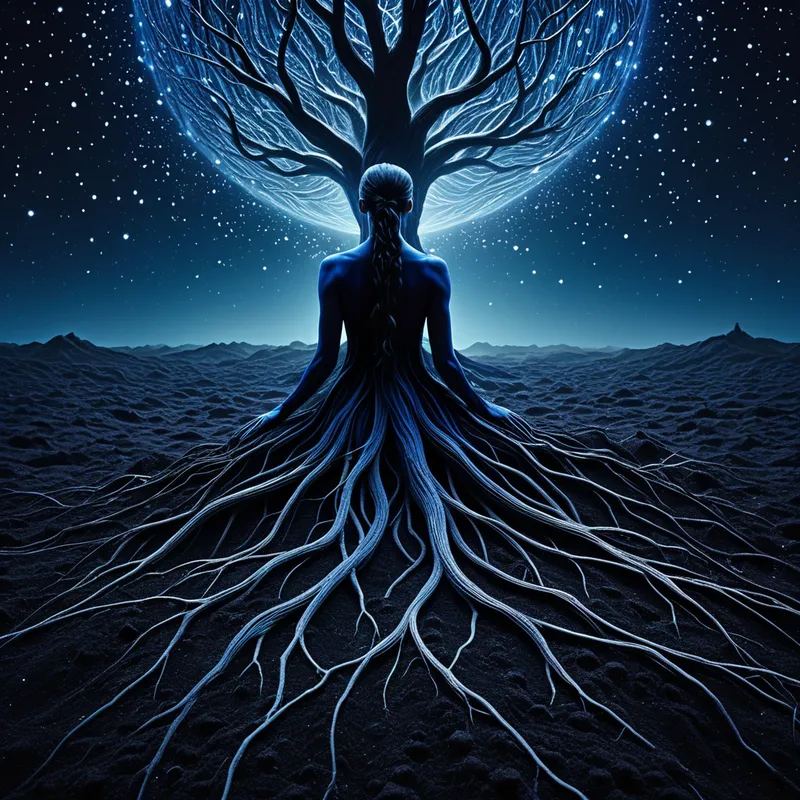
Alchemical Translation
The alchemical journey modeled by Prithvi’s myth is the opus contra naturam—the work against nature—which here means the work against unconscious, fused nature. The goal is not to return to the primordial unity, which would be regression, but to consciously re-unite the separated principles on a higher level.
Individuation is not becoming one; it is becoming the conscious vessel that holds the tension of the two.
The first stage is separatio, vividly depicted by Indra’s act. In our lives, this is the difficult differentiation: leaving the family system to find our own values, distinguishing our feelings from those of a partner, separating our self-worth from our achievements. It feels violent because it breaks a familiar wholeness.
Prithvi’s transformation represents the stabilization that follows. After the rupture, we must become the grounded earth. This is the often-overlooked work of building somatic awareness, creating healthy routines, and tending to the “soil” of our physical and emotional health. It is the cultivation of the caregiver archetype within—the capacity to hold, nurture, and patiently support our own growth.
The final, alchemical stage is the coniunctio—the sacred marriage. This is not a return to the old unity, but a conscious relationship between the now-grounded self (Prithvi) and the transcendent spirit or purpose (Dyaus). The rain falls, the sun shines, and the earth brings forth fruit. Psychologically, this is when our embodied existence becomes a fertile field for inspired action, when our grounded reality is in dialogue with our highest aspirations. We no longer are crushed by the sky nor lost in it; we are the stable ground from which we can look up and comprehend the stars, having made peace with the necessary separation that made us whole.
Associated Symbols
Explore related symbols from the CaleaDream lexicon: