Primordial Dust Myth Meaning & Symbolism
A universal creation myth of form emerging from undifferentiated potential, symbolizing the primal ground of being from which all consciousness arises.
The Tale of Primordial Dust
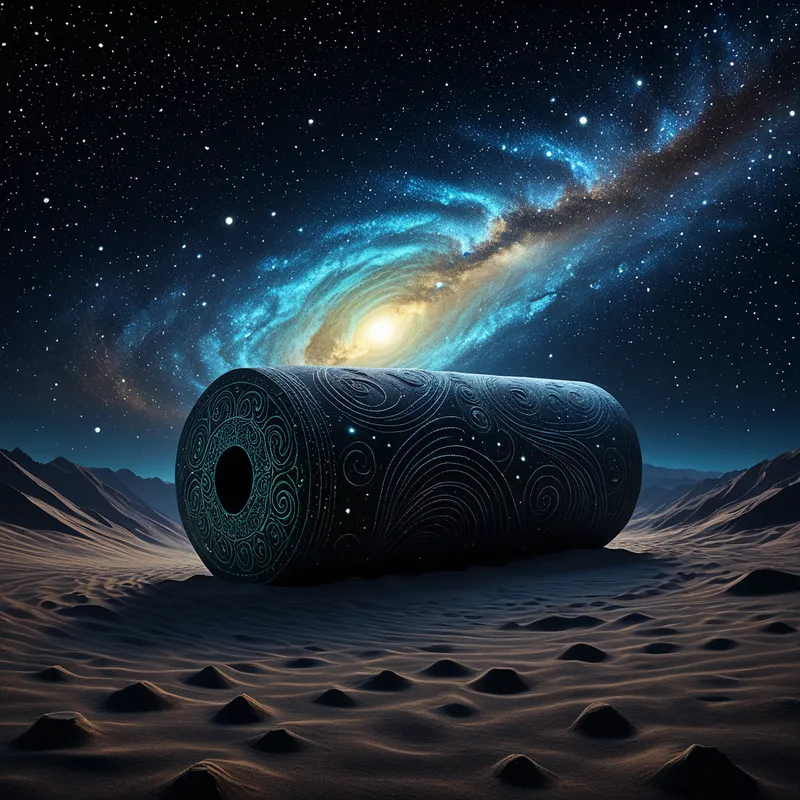
In the time before time, there was no sun to cast a shadow, no earth to hold a footprint, no wind to carry a sound. There was only the Void, a silence so profound it was a presence, a darkness so complete it was a substance. And within that substance, suspended like breath held for eternity, was the Primordial Dust.
It did not drift, for there was no direction. It did not gather, for there was no place to gather. It was a sleeping multitude, each mote a dream of a world yet undreamt—a dream of fire, a dream of stone, a dream of rushing [water](/myths/water “Myth from Chinese culture.”/), a dream of rooted life. They were all possibilities tangled together in perfect, silent equilibrium.
Then, from within the Dust itself, arose a yearning. It was not a voice, but a pull; not a thought, but a tension. Some tales name this yearning The Dreamer. Others say it was the Dust dreaming itself awake. The tension grew, a silent vibration humming through the infinite stillnes. A single mote, dreaming of light, trembled.
Its trembling was a contagion. A mote dreaming of heat shuddered in resonance. One dreaming of cold echoed back. The silent symphony of potential began to find a discord, a beautiful, terrifying disharmony. The Dust, which knew only the peace of the undivided, began to stir. It was a slow churn at first, a gentle swirl in the boundless dark.
But the movement bred desire. The motes dreaming of ascent began to pull away from those dreaming of descent. The dreamers of hardness brushed against the dreamers of softness and recoiled. The equilibrium shattered. [The Void](/myths/the-void “Myth from Buddhist culture.”/) was filled with a rushing, a whispering, a chaotic dance of infinite specks seeking their kindred dreams.
In the tumult, the first patterns emerged. Motes of fiery dream clumped together, their collective yearning igniting into the first, faint, struggling stars. Motes of heavy, patient dream sank into a slow whirlpool, forming the first mud of a world not yet born. The Dust was separating, the One becoming the Many. It was a birth-cry of the cosmos, a violent, glorious scattering.
And from that scattering, from the collisions and unions of different dreams, new things were forged. [Stardust](/myths/stardust “Myth from Scientific culture.”/) and earth-dust mingled to dream of metal. Wind-dust and water-dust danced to dream of storm. It was not an act of a maker from outside, but the Dust making itself through its own inherent, conflicted longing. The formless was taking form, not by command, but by conversation—a vast, wordless dialogue of attraction and repulsion that wove the first threads of reality from the raw loom of its own being.
Cultural Origins & Context
The myth of Primordial Dust is not the property of a single culture, but a profound archetypal pattern emerging independently across continents and epochs. We find its echoes in the <abbr title="The chaotic, watery void from which the world emerged in Mesopotamian myth">Apsu</abbr> and <abbr title="The primeval sea in Mesopotamian myth">[Tiamat](/myths/tiamat "Myth from Mesopotamian culture."/)</abbr> of Mesopotamia, a mingling of sweet and salt waters that precedes the gods. It resonates in the <abbr title="The cosmic egg or mound of primeval chaos in Egyptian mythology">Nu</abbr> or the <abbr title="The primordial waters in Egyptian myth">Nun</abbr>, the dark, infinite waters containing all latent life. In the Aboriginal Australian concept of <abbr title="The 'Dreamtime', the sacred era of creation">Alcheringa</abbr>, the landscape is sung into being by ancestral beings from a formless state.
In philosophical traditions, it appears as the <abbr title="The unmanifest, potential state in Samkhya philosophy">Prakriti</abbr> of Hindu thought, the primal nature from which all qualities evolve, or the <abbr title="The primordial chaos in Greek cosmology">Chaos</abbr> of Hesiod, the gaping void that is the first of all things. This myth was likely told not as a single, canonical story, but as a foundational understanding passed down by shamans, philosophers, and elders around fires and in temples. Its function was ontological: to answer the fundamental human question, “What was here before here?” It provided a cosmic genealogy, rooting the community and the individual in a narrative that begins with pure, undifferentiated potential, making the diverse world a story of relationship and differentiation from a common source.
Symbolic Architecture
Psychologically, the Primordial [Dust](/symbols/dust “Symbol: Dust often symbolizes neglect, forgotten memories, or the passage of time and life’s impermanence.”/) represents the <abbr title="The totality of the psyche, both conscious and unconscious">Self</abbr> in its most unformed, potential state—the unconscious not as a repository of repressed [trauma](/symbols/trauma “Symbol: A deeply distressing or disturbing experience that overwhelms the psyche, often manifesting in dreams as unresolved emotional wounds or psychological injury.”/), but as the fecund ground of all possible being. It is the [pleroma](/symbols/pleroma "Symbol: In Gnostic cosmology, the Pleroma is the divine fullness or totality of spiritual powers, representing the realm of perfection beyond the material world."/), the [fullness](/symbols/fullness “Symbol: A state of complete satisfaction, abundance, or completion, often representing emotional, spiritual, or physical fulfillment.”/) of what could be, before [the ego](/myths/the-ego “Myth from Jungian culture.”/)-[consciousness](/symbols/consciousness “Symbol: Consciousness represents the state of awareness and perception, encompassing thoughts, feelings, and experiences.”/) arises to make distinctions.
The Dust is the psyche before the first thought, containing every contradiction without conflict.
The <abbr title="The undifferentiated, potential-filled state before creation">Void</abbr> is not [emptiness](/symbols/emptiness “Symbol: Emptiness signifies a profound sense of void or lack in one’s life, often related to existential fears, loss, or spiritual quest.”/), but the [condition](/symbols/condition “Symbol: Condition reflects the state of being, often focusing on physical, emotional, or situational aspects of life.”/) of possibility itself. The subsequent “stirring” symbolizes the first [movement](/symbols/movement “Symbol: Movement symbolizes change, progress, and the dynamics of personal growth, reflecting an individual’s desire or need to transform their circumstances.”/) of consciousness, the initial [tension](/symbols/tension “Symbol: A state of mental or emotional strain, often manifesting physically as tightness, pressure, or unease, signaling unresolved conflict or anticipation.”/) that breaks eternal [peace](/symbols/peace “Symbol: Peace represents a state of tranquility and harmony, both internally and externally, often reflecting a desire for resolution and serenity in one’s life.”/) and begins the arduous, creative, and often painful process of becoming. Each “mote” is an archetypal potential—the [warrior](/symbols/warrior “Symbol: A spiritual archetype representing inner strength, discipline, and the struggle for higher purpose or self-mastery.”/), the [child](/symbols/child “Symbol: The child symbolizes innocence, vulnerability, and potential growth, often representing the dreamer’s inner child or unresolved issues from childhood.”/), the [destroyer](/symbols/destroyer “Symbol: A figure or force representing radical change through dismantling existing structures, often evoking fear and awe.”/), the [lover](/symbols/lover “Symbol: A lover in dreams often represents intimacy, connection, and the emotional aspects of relationships.”/)—all existing in harmonious latency until the call to incarnation.
The [chaos](/symbols/chaos “Symbol: In Arts & Music, chaos represents raw creative potential, uncontrolled expression, and the breakdown of order to forge new artistic forms.”/) of [separation](/symbols/separation “Symbol: A spiritual or mythic division between realms, states of being, or consciousness, often marking a transition or loss of connection.”/) is not a fall from grace, but the necessary [crisis](/symbols/crisis “Symbol: A crisis symbolizes turmoil, urgent challenges, and the need for immediate resolution or change.”/) of creation. Individuation, the process of psychological [integration](/symbols/integration “Symbol: The process of unifying disparate parts of the self or experience into a cohesive whole, often representing psychological wholeness or resolution of internal conflict.”/), begins not with unity, but with the recognition of inner multiplicity and conflict. The myth assures us that our inner [chaos](/symbols/chaos “Symbol: In Arts & Music, chaos represents raw creative potential, uncontrolled expression, and the breakdown of order to forge new artistic forms.”/) is not a flaw, but the signature of the creative process itself, the Dust beginning its world-making work within us.
The Dreamer’s Resonance
When this myth stirs in modern dreams, it often manifests as experiences of profound, formless potential or terrifying, fertile chaos. One might dream of standing in an endless gray plain where shapes half-form and dissolve. Or of a room filled with swirling, luminous particles that resist control. One might be a single speck in a cosmic sandstorm, or hold a handful of dust that transforms into jewels, then insects, then ash.
Somatically, this can correlate with feelings of groundlessness, dissociation, or the anxiety that precedes a major life transition. Psychologically, it signals a regression to the bedrock of the [psyche](/myths/psyche “Myth from Greek culture.”/). The conscious ego-structure is temporarily dissolved, allowing the dreamer to contact the <abbr title="The totality of the psyche, both conscious and unconscious">Self</abbr> in its raw, unconstructed state. It is a dream of deconstruction before reconstruction. The discomfort is the friction of potential becoming actual—the same primordial tension that birthed the stars. The dreamer is not breaking down; they are returning to the Dust, to the source material from which a new, more authentic personality structure may coalesce.
Alchemical Translation
The alchemical journey mirrors the myth of the Dust perfectly. The process begins with the <abbr title="The blackening, a stage of dissolution and putrefaction">[Nigredo](/myths/nigredo "Myth from Alchemical culture."/)</abbr>, a descent into the primal, chaotic matter—the massa confusa. This is the stirring of the Dust within the individual soul, a necessary disintegration of outworn identities and conscious attitudes.
The alchemist does not create gold from nothing, but liberates it from the base matter in which it sleeps. So too, the Self is not built, but revealed from the Dust of the psyche.
The subsequent stages of <abbr title="The whitening, a stage of purification">Albedo</abbr>, <abbr title="The yellowing, a stage of integration">Citrinitas</abbr>, and <abbr title="The reddening, the final stage of unification and perfection">[Rubedo](/myths/rubedo "Myth from Alchemical culture."/)</abbr> model the coalescence of the scattered motes into a coherent, luminous whole—the <abbr title="The philosopher's stone, symbol of perfected wholeness">[Lapis Philosophorum](/myths/lapis-philosophorum "Myth from Alchemical culture."/)</abbr>. For the modern individual, this translates to the process of <abbr title="The process of integrating the conscious and unconscious to become a psychological individual">Individuation</abbr>.
We are asked to become the <abbr title="A primordial spirit or force of consciousness that initiates creation">Dreamer</abbr> of our own Dust. To allow the inner tensions—between ambition and rest, intellect and emotion, shadow and [persona](/myths/persona “Myth from Greek culture.”/)—to interact, collide, and ultimately forge new, more complex unities. The goal is not to return to the silent Void, but to consciously participate in [the world](/myths/the-world “Myth from Tarot culture.”/)-making activity of our own souls, to shape a life from the primal material of our deepest, most contradictory potentials. We are not born whole; we are born as Dust, and our life’s work is the sacred, chaotic, and glorious act of gathering ourselves into a world.
Associated Symbols
Explore related symbols from the CaleaDream lexicon: